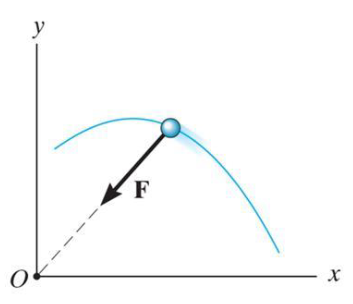
Curvilinear Motion/Force
Newton’s Laws of Motion
Link to original
- In dynamics, we commonly use Newton’s 2nd law:
- Rectangular coordinates:
- Normal and tangential coordinates:
- Polar coordinates:
Work
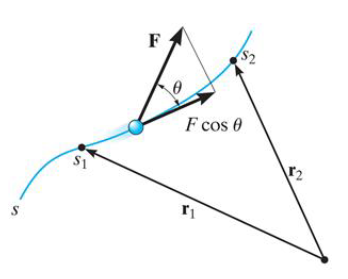
Work of a Force
- Work is the product of force and the displacement components in the direction of the force
- Where is the angle between the force and displacement vector
- is the increment of work done
Integrate and use dot product to get:
If is a function of position, this becomes:
If both and are constant, the equation can be simplified to:
Link to originalWork is positive if the force and the movement are in the same direction If the force and displacement are perpendicular, the work is zero
Work of a Spring Force
- When stretched, a linear elastic spring develops force
is exerted on a particle in the opposite direction to the force exerted on the spring, meaning the work done on the particle will be negativeLink to original
- Equation above only for linear springs
- Work of a spring is not just spring force times distance at some point
- Always double check the sign of the spring work!
Work of a Weight
Link to original
- The work done by gravity acting on a particle is given by:
If is upward, the work is negative since weight force acts downwards
Energy
Kinetic Energy
- When we considered kinetic energy of a particle, there was no rotation
- However, for a rigid body, we need to account for rotational velocity
Remember that means a vector is applied at the centre of massWe can simplify this equation depending on the scenario:
Link to original
Pure Translation body subject to only curvilinear or rectilinear translation (no rotational kinetic energy)
Pure Rotation body rotates about fixed axis passing through
Note:
- If rotation occurs around (i.e. ),
Principle of Work and Energy
Link to original
- Recall: Sum of the initial kinetic energy and work done by all external forces and couple moments equals the body’s final kinetic energy
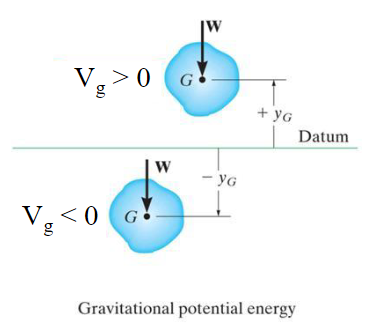
Gravitational Potential Energy
Link to original
Potential energy is function of bodies’ height above/below a datum
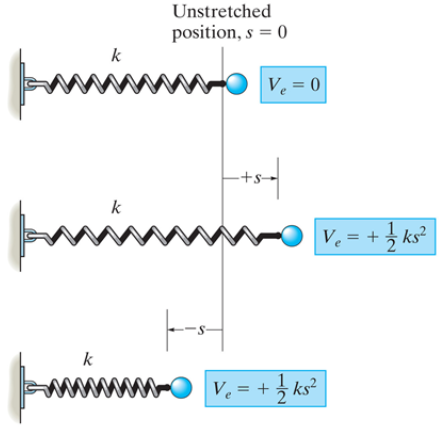
Elastic Potential Energy
Link to original
- Potential energy of a spring:
Conservation of Energy
- When a particle is acted upon by only conservative forces, the sum of kinetic energy and potential energy remains constant
Note:
Link to original
Momentum
Principle of Impulse and Momentum
- Force → creates impulse → creates change in momentum
- Use these equations to solve problems with force, velocity, and time
Linear impulse-linear momentum equation:
Angular impulse-angular momentum equation:
Link to original
Angular Momentum
Link to original
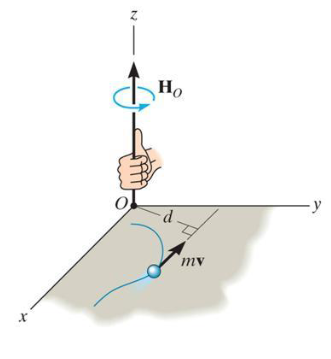
Angular momentum of a particle about is defined as the “moment” of the particles linear motion about
in this diagram would beAngular moment is not the same as the linear momentum!
A dot above a character represents a time derivativeIf something starts at rest, its initial angular momentum = 0
Principle of Angular Impulse and Momentum
By integrating the equation above, we can get:
Link to original
- This is known as the principle of angular impulse and momentum
- → angular impulse
- Angular momentum is sometimes represented with
Conservation of Angular Momentum
Link to original
If sum of angular impulses is zero, angular momentum is conserved
e.g. if a particle is only subject to forces pointing towards
A good example of this in practice, would be the tension force acting upon a ball swinging around a pole from a ropeTypically you will use: