Assessments
- Quizzes (fortnightly) 25%
- Labs 15%
- Exam (closed book) 60%
Kinematics and Kinetics
- Kinematics describes motion of bodies without considering forces
- Kinetics studies relationship between motion and forces
Relating Displacement, Velocity & Time
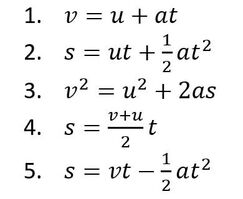
For when acceleration is a function of position:
Useful trigonometric integral identity:
General solution for is:
- -> starting velocity
- -> starting displacement
See Wk1: Sample Problem 1 for application of above formulae
Coordinate Systems
Rectangular Coordinates
- Velocity Magnitude:
- Velocity Direction:
Normal and Tangential Coordinates
Normal and Tangential Components
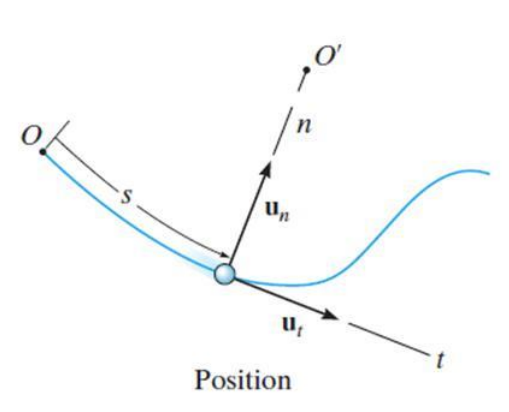
- When a particle moves along a curved path, it is convenient to describe its motion using normal () and tangential () coordinates
- The origin () is located on the particle, thus it alongside the coordinate system moves with the particle
- The centre of curvature () lies on the concave side of the curve
- The -axis has positive direction towards
- The radius of curvature () is perpendicular distance from curve to
The position of the particle at any instant is defined by
Link to original
- is the distance along the curve from a fixed reference point
radius of curvature
angular velocity
- Velocity:
- Acceleration:
Types of Motion
Relative Motion
Relative Position
- The absolute positions of two particles A and B with respect to the fixed -reference frame are given by and
- The position of B relative to A is represented by:
Relative Velocity
- The velocity of B relative to A is represented by:
OR:
Note:Relative Acceleration
Link to original
- The acceleration of B relative to A is represented by:
OR:
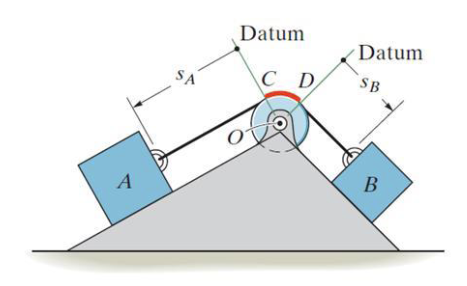
Dependent Motion
- In kinematics problems, motion of one object can depend on another
To find an equation relating velocities, determine the relation in position coordinates and then derive the expression
- You don’t need to consider line segments that don’t change
As they derive to 0!- See examples in slides
Full Method:
- Define position coordinates from fixed datum lines, along the path of each particle
- Relate the position coordinates to the cord length
- If a system contains more than one cord, relate position of a point on one cord to a point on another cord
- Separate equations are written for each cord
- Differentiate the position coordinate equation(s) to relate velocities and accelerations
Helpful video:
Link to original