Motion of a Projectile
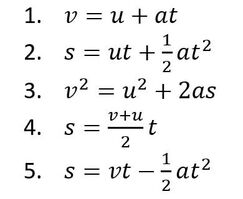
- Projectile motion can be treated as two rectilinear motions
- One in horizontal direction with zero acceleration
- One in vertical direction experiencing constant acceleration
Normal and Tangential Components
- When a particle moves along a curved path, it is convenient to describe its motion using normal () and tangential () coordinates
- The origin () is located on the particle, thus it alongside the coordinate system moves with the particle
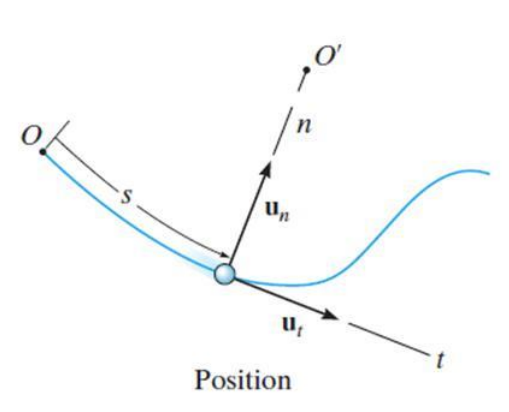
- The centre of curvature () lies on the concave side of the curve
- The -axis has positive direction towards
- The radius of curvature () is perpendicular distance from curve to
The position of the particle at any instant is defined by
- is the distance along the curve from a fixed reference point
Parameters in the n-t Coordinate System
- Velocity is tangent to path of motion:
where- defines magnitude and defines direction
- Acceleration is the time rate of change of velocity:
where represents change in magnitude of velocity and represents rate of change in direction of
Alternatively:
→ tangential acceleration:
i.e. is equal to the rate in change of speed
→ normal (centripetal) acceleration:
is the radius of curvature
Special Cases of Motion
- Particle moves along a straight line
- Particle moves with constant speed along curve
- is constant
- Particle moves along path
Three-Dimensional Motion
- Binomial axis () is used when working in 3D space
- It is perpendicular to the osculating plane
Thus, is defined by cross product
- It is perpendicular to the osculating plane
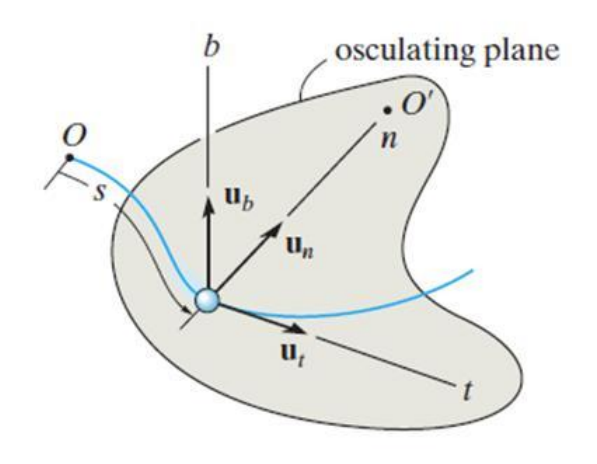
No motion, thus no velocity or acceleration, in the binomial direction