Relative Motion
Relative Position
- The absolute positions of two particles A and B with respect to the fixed -reference frame are given by and
- The position of B relative to A is represented by:
Relative Velocity
- The velocity of B relative to A is represented by:
OR:
Note:
Relative Acceleration
- The acceleration of B relative to A is represented by:
OR:
Laws of Sines and Cosines
- Can be used to solve vector problems “graphically”
Law of Sines:
Law of Cosines:
You can choose to either use trigonometry to solve problems or to break vectors into components for basic arithmetic
Dependent Motion
- In kinematics problems, motion of one object can depend on another
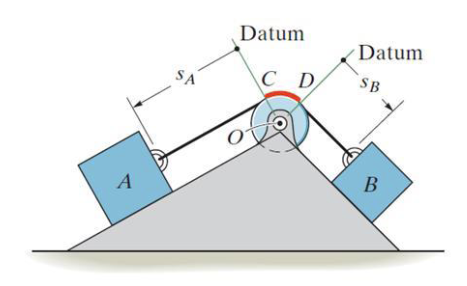
To find an equation relating velocities, determine the relation in position coordinates and then derive the expression
- You don’t need to consider line segments that don’t change
As they derive to 0! - See examples in slides
Full Method:
- Define position coordinates from fixed datum lines, along the path of each particle
- Relate the position coordinates to the cord length
- If a system contains more than one cord, relate position of a point on one cord to a point on another cord
- Separate equations are written for each cord
- Differentiate the position coordinate equation(s) to relate velocities and accelerations
Helpful video: