Work of a Force
- Work is the product of force and the displacement components in the direction of the force
- Where is the angle between the force and displacement vector
- is the increment of work done
- Where is the angle between the force and displacement vector
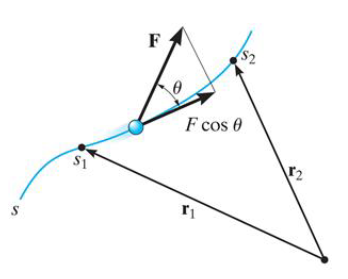
Integrate and use dot product to get:
If is a function of position, this becomes:
If both and are constant, the equation can be simplified to:
Work is positive if the force and the movement are in the same direction If the force and displacement are perpendicular, the work is zero
Work of a Weight
- The work done by gravity acting on a particle is given by:
If is upward, the work is negative since weight force acts downwards
Work of a Spring Force
- When stretched, a linear elastic spring develops force
is exerted on a particle in the opposite direction to the force exerted on the spring, meaning the work done on the particle will be negative
- Equation above only for linear springs
- Work of a spring is not just spring force times distance at some point
- Always double check the sign of the spring work!
Principle of Work and Energy
is the work done by all the forces acting on the particle as it moves from point 1 to point 2
and are the kinetic energies of the particle at the initial and final position respectively
- Kinetic energy is always a positive scalar (velocity is squared!)
Power and Efficiency
- Power is defined as the amount of work performed per unit of time
- Mechanical efficiency of a machine is the ratio of the useful power produced (output power) to the power supplied (input power)
- If energy input and removal occur at the same time, efficiency may also be expressed as:
Machines will always have frictional forces, since frictional forces dissipate energy, additional power is required to overcome these forces