Conservative Force
- A force is conservative if the work done is independent of the path followed by the force acting on a particle as it moves from A to B
- This also means that the work done by the force in a closed path is zero
The work done by a conservative force depends only on the positions of the particle and is independent of its velocity or acceleration
The “conservative” potential energy of a particle/system is typically written using the potential function
- There are two major components to commonly encountered:
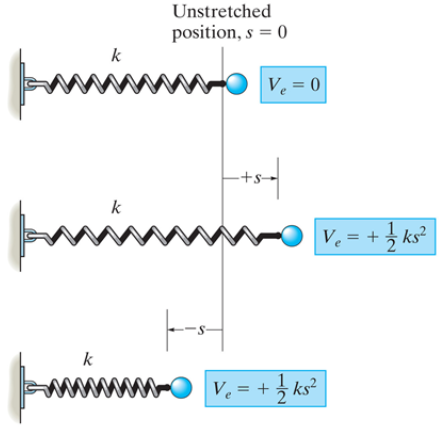
Elastic Potential Energy
- Potential energy of a spring:
Conservation of Energy
- When a particle is acted upon by only conservative forces, the sum of kinetic energy and potential energy remains constant
Note:
Principle of Linear Impulse and Momentum
- Obtained by integrating the equation of motion with respect to time
- This equation represents the principle of linear impulse and momentum
- Relates particle’s final and initial velocity and the forces acting upon it as a function of time
Linear momentum
- Same direction as
- Units:
Linear impulse (denoted by )
- Same direction as
- Measures effect of a force during its time interval of action
- If is constant:
Equation typically written as:
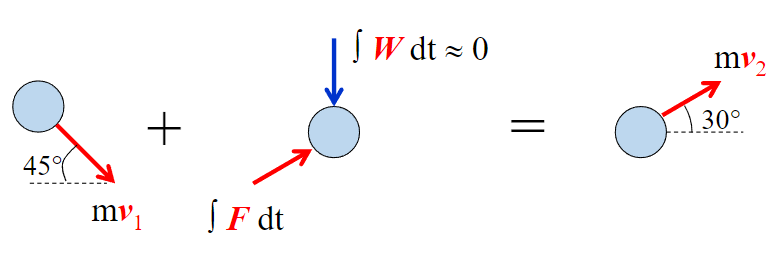
Note: for this diagram, weight force is negligible