Conservation of Linear Momentum
- Only the impulse of external forces can cause a change in momentum
- Internal forces do not matter, as they occur as pairs
- Internal forces do not matter, as they occur as pairs
- When the sum of external impulses is zero:
- Typically applied when particles collide or interact
Angular Momentum
-
Angular momentum of a particle about is defined as the “moment” of the particles linear motion about
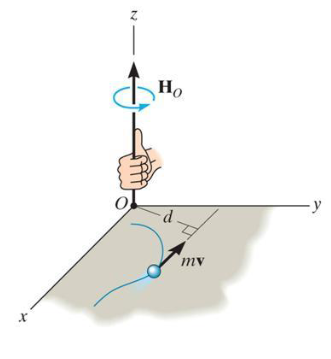
in this diagram would be -
Angular moment is not the same as the linear momentum!
A dot above a character represents a time derivative -
If something starts at rest, its initial angular momentum = 0
Principle of Angular Impulse and Momentum
By integrating the equation above, we can get:
- This is known as the principle of angular impulse and momentum
- → angular impulse
- Angular momentum is sometimes represented with
Conservation of Angular Momentum
-
If sum of angular impulses is zero, angular momentum is conserved
e.g. if a particle is only subject to forces pointing towards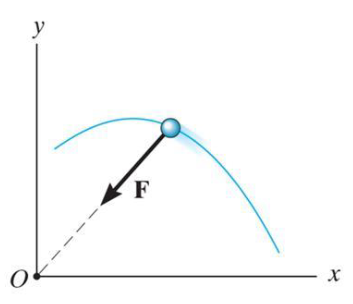
A good example of this in practice, would be the tension force acting upon a ball swinging around a pole from a rope -
Typically you will use: