ENSC2004 - Lecture 20
Impulse and Momentum (Rigid Bodies) - Slides
Linear and Angular Momentum
- The linear momentum of a rigid body is mass times speed:
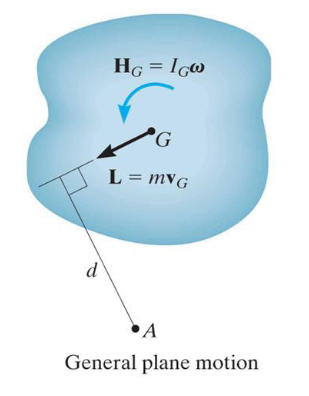
This equation states that the linear momentum vector has a magnitude equal to () and a direction defined by - The angular momentum of a rigid body is inertia times angular velocity:
When body undergoes purely rectilinear or curvilinear translation, thus, angular momentum is zero ()
When a rigid body is rotating about a fixed axis passing through , then:
The equations above still apply
When a rigid body is subjected to general plane motion, both the linear momentum and the angular momentum computed about G are required
The angular momentum about point A is:
Principle of Impulse and Momentum
- Force → creates impulse → creates change in momentum
- Use these equations to solve problems with force, velocity, and time
Linear impulse-linear momentum equation:
Angular impulse-angular momentum equation:
Conservation of Momentum 2
- Recap: Conservation of Linear & Angular Momentum
- ! When linear impulses are negligible or non-impulse, we can use the conservation of linear momentum to solve problems
- You can identify negligible forces if they act over a very short/instantaneous period of time
- See example in slides
End of Unit!