ENSC2004 - Lecture 16
Impulse and Momentum of Fluid Flow - Slides
Steady Fluid Flow
- Principle of impulse and momentum can be applied to the steady flow of fluid into and out of a control volume
- Flow in = flow out → steady flow
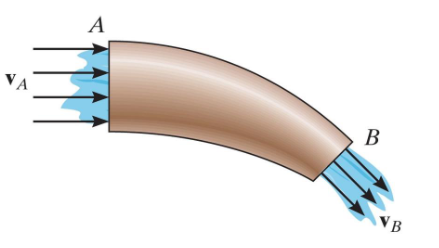
The change in direction of the fluid flow is caused by the impulse produced by the resultant external force exerted on the fluid volume by the boundaries
Steady Fluid Flow Linear Momentum
- Same flow of water at both A and B
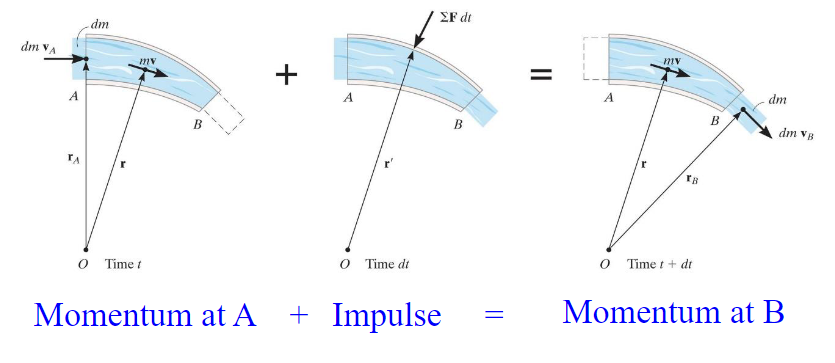
- Change in linear momentum:
- When calculating forces:
Steady Fluid Flow Angular Momentum
- Angular momentum at A + Angular Impulse = Angular Momentum at B
- Change in angular momentum about :
Mass Flow Rate
- The term dm/dt is the mass flow rate and can be expressed as:
fluid density
cross-sectional area
volumetric flow rate ()
You will need to combine this equation with either equation above (usually linear momentum) to solve questions
Propulsion with a Control Volume that Loses Mass
- Analysis of a rocket is complicated as it loses mass over time
i.e. fuel is burnt and expelled - Problem can be analysed using impulse and momentum and considering control volume

rate at which mass is being ejected
velocity of ejected mass relative to ground
Remember is acceleration!
- The last term in this equation is also known as the thrust ()