Rigid Body Motion
- ! When we need to consider the size and shape of an object, we must use a rigid body model
i.e. when rotation of the body becomes an important aspect in the analysis of motion!
Planar Rigid Body Motion
- Planar motion is when all parts of the body move along parts equidistant from a fixed plane
- Equidistant at equal distances
Three types of planar rigid body motion:
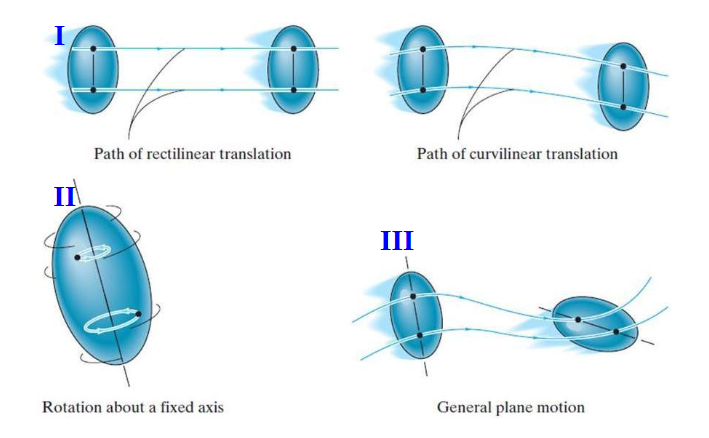
- Translation:
- Occurs if every line segment on the body remains parallel to its original direction during the motion
- Rotation about a fixed axis:
- All particles of the body, except those on the axis of rotation, move along circular paths in planes perpendicular to the axis of rotation
- General plane motion:
- Body undergoes both translation and rotation
Translation
Positions of two points A and B on a translating body are related by:
where and are absolute position vectors and is the relative position vector between B and A
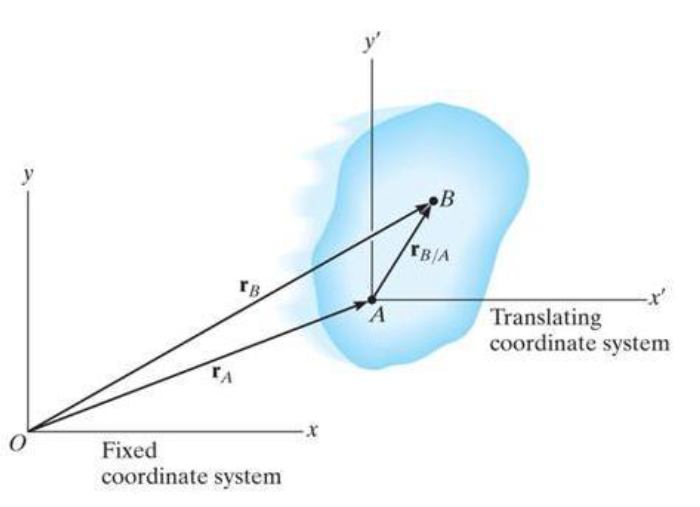
All points on a rigid body subject to translation move with the same velocity and acceleration
Rotation About a Fixed Axis
- @ Any point P in the body travels along a circular path
- Angular position of P is defined by
- measured in radians or revolutions
- 1 revolution = radians
- Angular velocity:
- Angular acceleration:
- Angular position of P is defined by
- ! If is constant ():
- )
Magnitude of velocity of P:
- Direction is tangent to circular path of P
- ? In vector formulation, magnitude and direction of can be determined using cross product:
- It is important to note, that you will need to use this conversion in a lot of impulse and momentum questions to remove an unknown
where is distance between and pivot
- It is important to note, that you will need to use this conversion in a lot of impulse and momentum questions to remove an unknown
Acceleration of P broken into normal and tangential components
Note: you can work with scalar or vector forms, its best to use what you are most comfortable (remember your differential equations for switching between position, velocity and acceleration!)
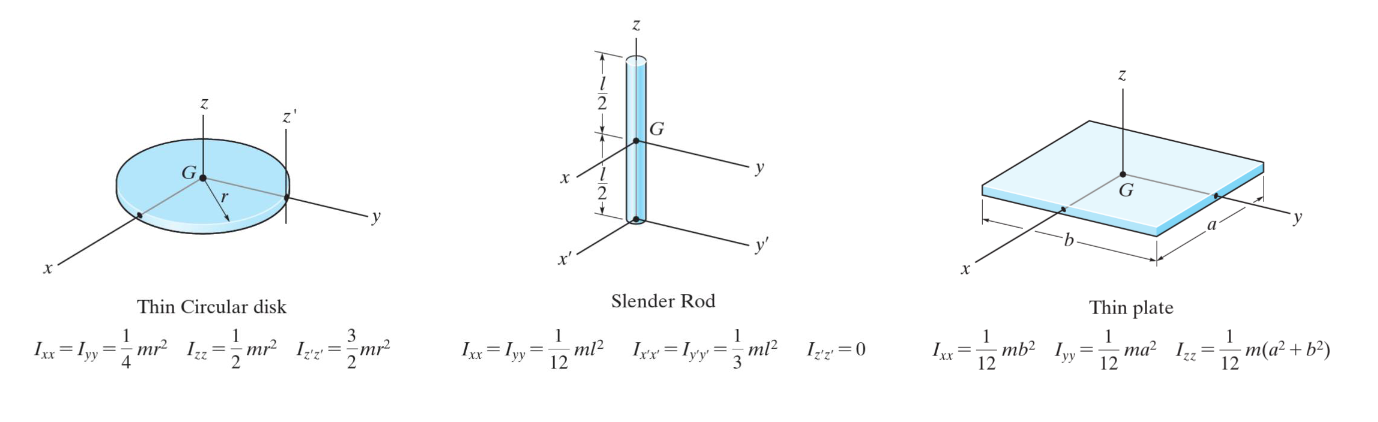
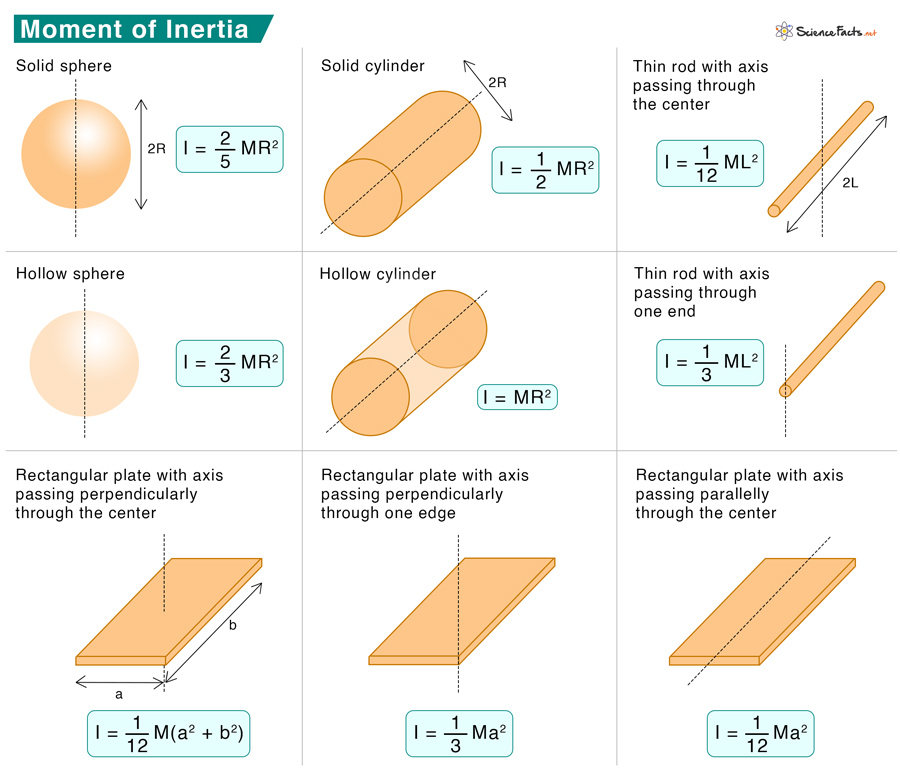
Mass Moment of Inertia
- If you apply torque T to a body about -axis, it begins to rotate with angular acceleration
the mass moment of inertia (MMI) about -axis - MMI () is a property of the body that measures the resistance of the body to angular acceleration
Units: - Alternatively, for a point mass:
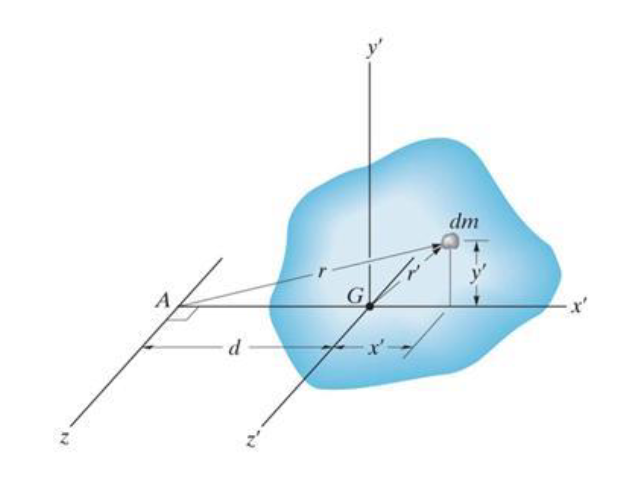
Parallel-Axis Theorem
- If MMI is known for an axis passing through centre of mass:
MMI about body’s centre of mass
perpendicular distance between parallel axes
Radius of Gyration
- MMI can be found using radius of gyration ()
- is a measure of body’s mass distribution about axis at which the moment of inertia is defined:
Composite Bodies
- ~ If a body is constructed of various simple shapes, such as disks, spheres, or rods, the mass moment of inertia of the body about any axis can be determined by algebraically adding together the mass moments of inertia, each found about the same axis, of these different shapes