Equations of Translational Motion
- Translational motion:
The sum of external forces equals the mass times acceleration of the mass centre ()
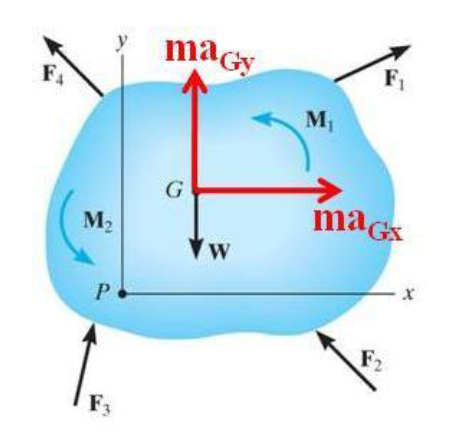
Equations of Rotational Motion
-
Moment around point P can be written as:
moments from external forces
external couple moments
the kinetic moment about P
distance/position vector from
inertial vector
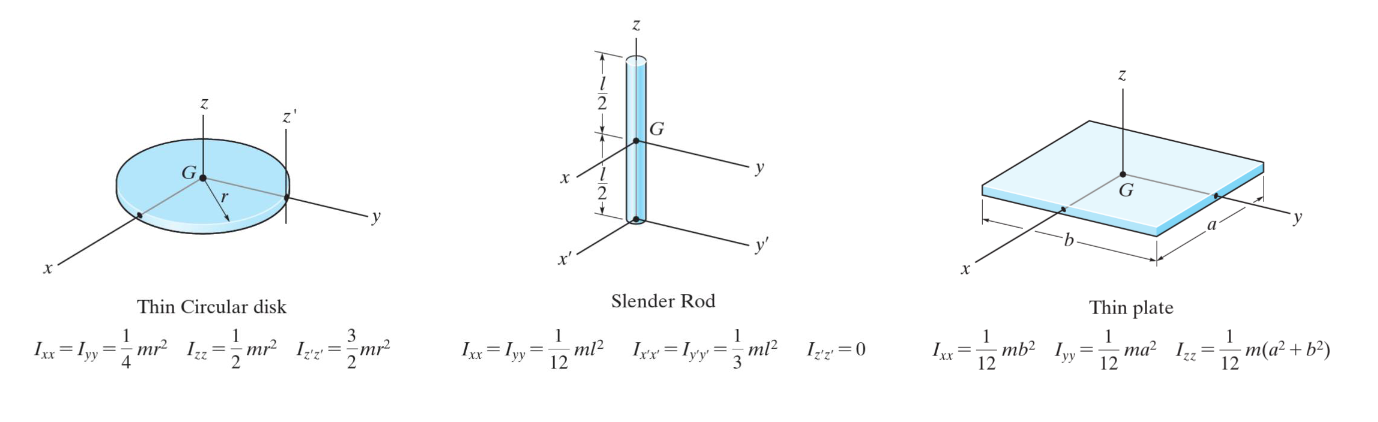
mass moment of inertia about -
If point P is G, then we get scalar equation:
The sum of moments about the centre of mass equals the moment of inertia about G times angular acceleration ()
Translation-Only Motion
- When a body undergoes only translation:
- All particles share same acceleration →
- Angular acceleration
- Thus:
- Moments can be taken about other points if convenient:
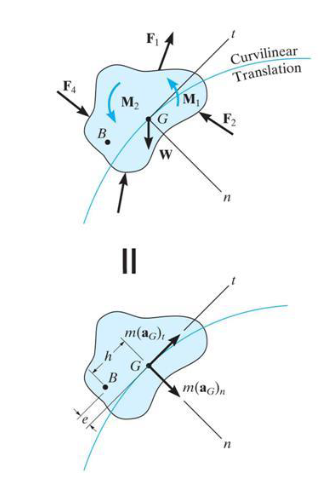
Curvilinear Translation
- Use n-t coordinate system
- Additionally:
Fixed Axis Rotational Motion
- When a rigid body rotates about a fixed axis:
- Every point moves in a circular path
- The centre of mass follows a circle of radius
- Acceleration of has:
- Tangential component:
- Normal component:
- We get equations of motion:
moment of inertia about the fixed axis ()
Derived from parallel axis theorem
angular acceleration
angular velocity (in radians)
mass
Thus:
See: MMI