ENSC2004 - Lecture 4
Equations of Equilibrium - Slides
Recap: Equilibrium
Two-Force Member
- Equilibrium problems can be simplified if we recognise members that are subjected to forces at only two points
- The two forces must have equal magnitude and point in opposite directions along the line joining the two points
- Thus, we can easily know the direction of both forces
This concept can be applied to when there are many forces at two distinct points on a rigid body. The many forces can be simplified into two resultant forces.
Three-Force Member
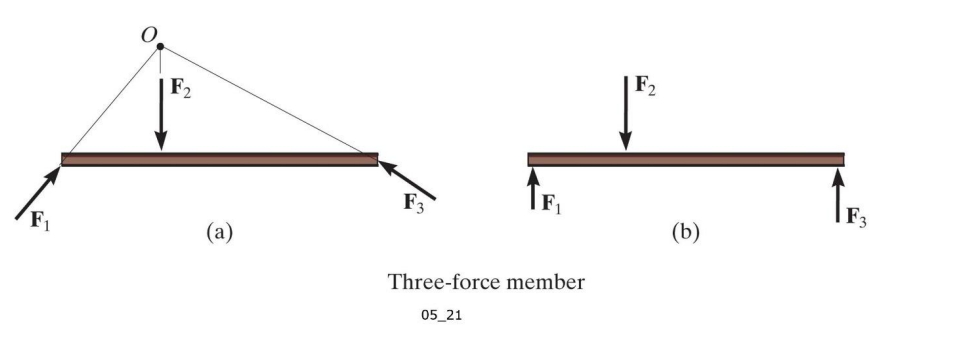
- If a member is subjected to only three forces it is called a three-force member
- Moment equilibrium is only satisfied when the three forces are concurrent or parallel
- Concurrent is when all forces lines of action intersect at a single point even if they act in different directions
Statically Indeterminate Structures
- Structures that have more unknown forces than equilibrium equations are known as statically indeterminate
- Not possible to determine reaction forces using equilibrium alone when unknowns > equations
We need to be able to classify a structure as either statically indeterminate or statically determinate
- However, for this course, we do not need to solve them
Indeterminate Cases:
- Two (or more) non-collinear unknowns forces in a particular direction + one (or more) moment reactions
- More than two unknown forces in a particular direction
- Two collinear unknowns in a particular direction
- Or, where there are 4 or more unknown reactions
Improper Constraints
- Improperly constrained structures have too few constraints than needed to maintain stability
- Opposite of statically indeterminate structures
- The structure cannot maintain its shape/stability under load
Improper Cases:
- No reaction force in a particular direction
- If all reaction forces are concurrent