Deformation Under Axial Loading
-
Force-displacement relation relationships between forces acting on a bar and its changes in lengths
-
Axial means that a force is applied directly along the longitudinal or central axis of an object
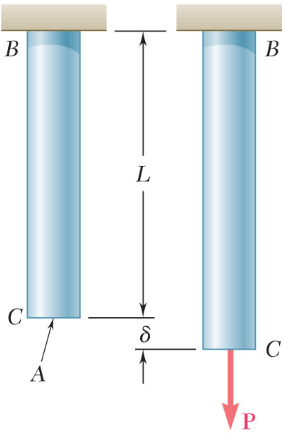
i.e. force acts parallel to length of object -
Displacement is change in length → has units of length
- Do not confuse with strain which is dimensionless
- Your answers for displacement should usually be in scale
Displacement formula:
- pressure
- length
When parameters vary, we use integration:
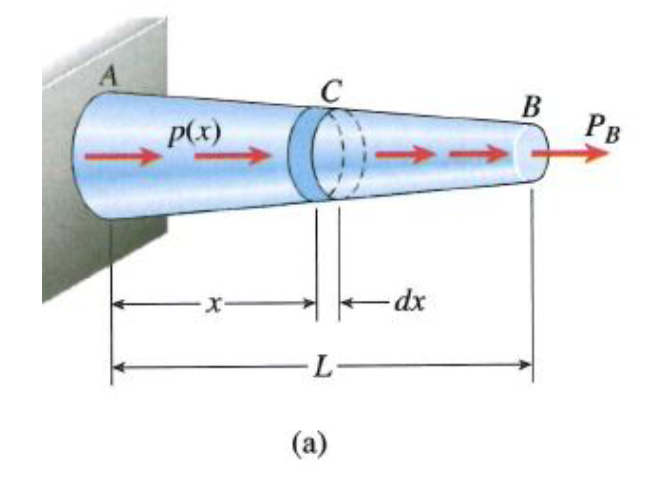
- ? Cantilever structural element that is firmly attached at one end and unsupported at the other
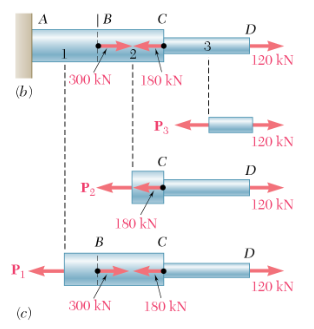
Example: for cantilever beams, start at free end
We get values for the internal forces:
We can then solve our displacement equation for each segment of the beam and sum the results together to get total displacement:
Statically Indeterminate Structures
Recap: ENSC2004 - Statically Indeterminate Structures
- Structures that have more unknown forces than equilibrium equations are known as statically indeterminate
- Not possible to determine reaction forces using equilibrium alone when unknowns > equations
- To analyse such structures → supplement equilibrium eqns with additional eqns pertaining to the displacements of the structure
Compatibility Equations
- Compatibility equation expresses the fact that the change in length of the bar must be compatible with the conditions at the supports
Example of Using a Compatibility Equation
- Imagine a concrete column reinforced with steel rods
- When you press down on it, the steel and concrete must shorten by the exact same amount because they are bonded together
- We represent this using a compatibility equation:
- Without it, you wouldn’t be able to figure out how much of the load each material is carrying
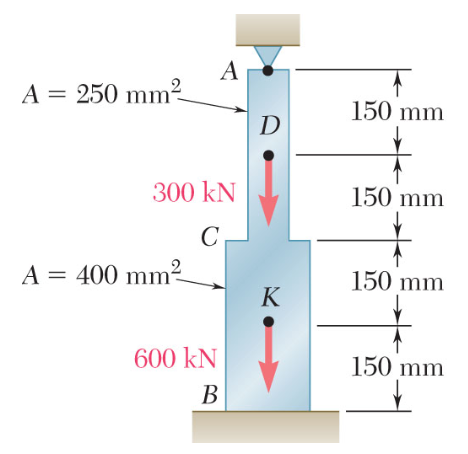
Full example in slides determine reactions at and :
-
More supports than required for equilibrium → statically indeterminate
-
Redundant reactions replaced with unknown loads
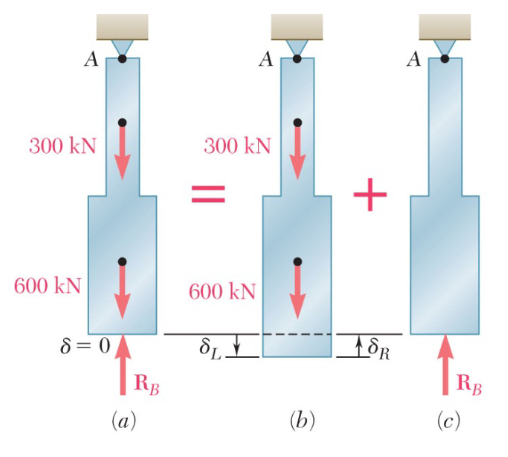
- This is known as superposition method
-
Deformations due to actual loads and redundant reactions are determined separately and then added
This is our complexity equation!- We know that total deformation must be zero as the object is fixed at both ends
-
Our equilibrium equation:
Temperature-Displacement Relation
- Temperature change results in change in length or thermal strain
- coefficient of thermal expansion
- No stress associated with thermal strain unless elongation is restrained by the supports; unrestrained displacement:
- If restrained: treat additional support as redundant, apply superposition
- Thermal strain is prevented as object is constrained
- Mechanical displacement:
- These equations rearranged to:
Stress Concentrations
-
Our equations for stress in axially loaded bars assume that stress distribution is uniform
-
In reality, bars may have holes, groves, notches, etc.
- These disruptions create high concentrations of stress in the bar
- Known as stress concentrations
- The discontinuities themselves are known as stress raisers
- These disruptions create high concentrations of stress in the bar
-
stress concentration factor
Stress Concentration: Circular Hole
For a circular hole in an object (example uses a flat bar under axial loading):
At these specific points on the hole, has this value
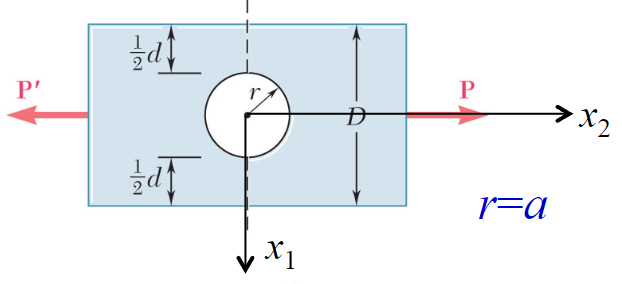
- Stress is forces to curve sharply around the hole above:
- The top and bottom of the hole are under tension
- The left and right sides of the hole are under compression
- ! This logic seems reversed to what is intuitive, but it is due to the way stress flows around the hole
- We also get a as seen by our first equation
Assumptions:
- The bar/plate is infinite or “very large”
- Linear elasticity & small deformation
- Perfectly circular hole (in reality we would have defects)
Stress Concentration: Fillet
- Fillets are very common in engineering
- Found in shafts, shoulders, brackets, etc.
- As ; fillets are useful for reducing stress concentration
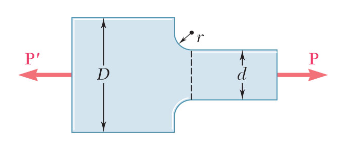
- No single closed-form equation for fillets, unlike circular holes
- This is because fillets have more relevant dimensions ()
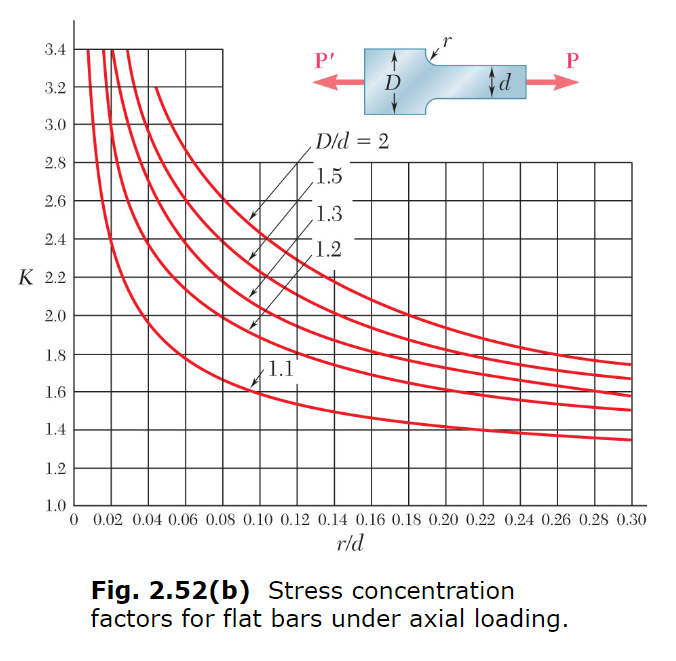
- This is because fillets have more relevant dimensions ()
- You will need to use a graph like the one above to find
- Using values for and , find corresponding on graph