Simple Trusses
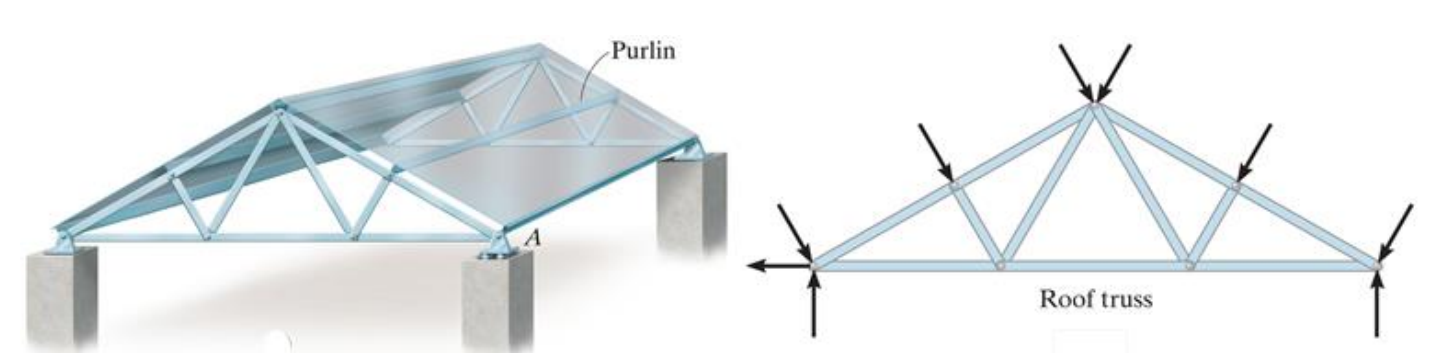
- A truss is a structure composed of slender members joined together at their end points
- If a truss lies in a single plane, it is called a planar truss
-
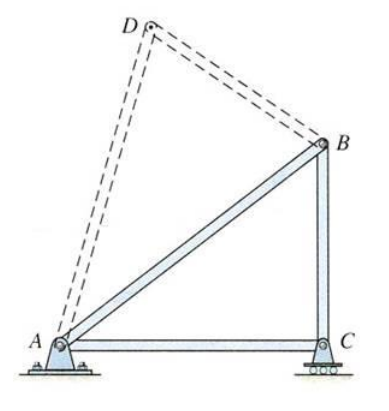
A simple truss is a planar truss which begins with a triangular element and is expanded by adding two members and a joint
-
The relationship between # of members and # of joints:
Analysis and Design Assumptions
- When designing truss, necessary to determine forces in each member
- This is known as force analysis of a truss
- When doing this, we have two assumptions:
- All loads are applied at the joints
- Weight of members is neglected as weight is small
- The members are joined together by smooth pins
- All loads are applied at the joints
- With these assumptions, the members act as two-force members
- They are loaded in either tension or compression
Using our equations of equilibrium, we can solve for the forces acting upon members in a simple truss!
Zero-Force Member
- If a joint has only two non-collinear members and there is no external load or support reaction at that joint, then those two members are zero-force members
- In a THREE member joint: If TWO of those members ARE parallel AND there are no other external loads (or reactions) at the joint THEN the member that is not parallel is a zero force member
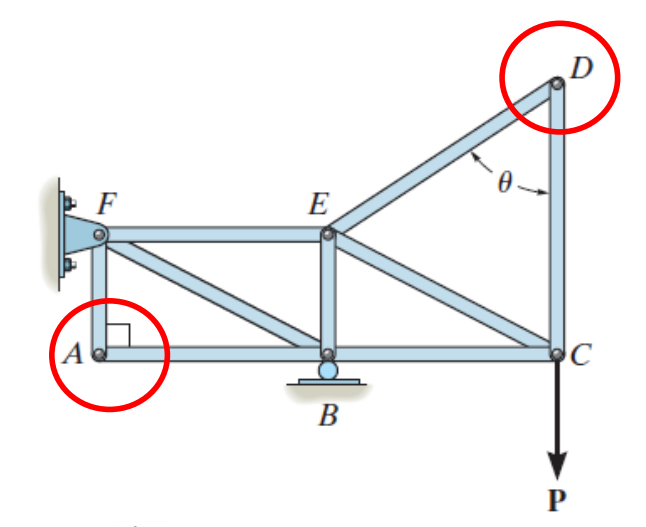
- They can be excluded from your analysis
Zero-force members are used to increase stability and rigidity of the truss, and to provide support for various different loading conditions
External Determinacy
- If a truss has more external supports than is necessary to ensure equilibrium, the truss as a whole is statically indeterminate
- The extra support is referred to as external redundancy
Internal Determinacy
- If a truss has more internal members than is necessary to ensure stability, the truss as a whole is statically indeterminate
- The extra member is referred to as redundant member
Determinacy
- For a truss that is externally statically determinate, we will have 3 unknown reaction forces
- We have unknown internal forces
- is the # of members
- Total unknowns:
- We have unknown internal forces
- At each joint () we have two equations of equilibrium
- Number of equations:
- Therefore, a truss is statically determinate when:
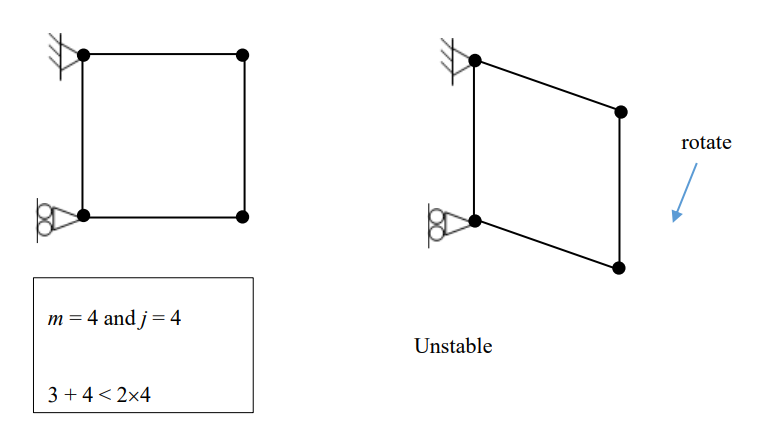
Stability
- If the truss will be unstable
e.g. if we remove the diagonal member in the system below: