Overview
-
We will look at applying methods of joints from last lecture to designing effective truss members
- Goal: minimise cost and weight, simplify manufacture
- Design for yield and buckling
-
For members under tension:
- We care about only yield
-
For members under compression:
- We care about yield and buckling
Determining Appropriate Dimensions
Review: Stress & Strain
- Using the relationship between force, area and stress, we can determine the minimum cross-sectional area each member must have
- where is the yield strength
- This is known as the allowable stress
- where is the yield strength
A member will yield at the same stress value regardless of whether it is in tension or compression
Buckling
- Members subjected to compressive force may bend and deflect laterally and fail due to buckling
- length
- Young’s modulus
- moment of inertia
- is the critical buckling load
- Any load past this point will cause buckling
Moment of Inertia
- Moment of inertia is a measure of how well an area resists buckling
Also known as the second moment of area - The value for can be found in a table
Usually, we will look for a material with an value high enough to sustain a certain load without buckling, as always, we scale up the load by 60% as a safety margin
Method of Sections
- In the method of sections, a truss is divided into two parts
- The internal forces at cut members also will be tensile or compressive
- Same magnitude as forces at the joint
- Using method of sections allows us to apply our moment equilibrium equation meaning we can solve 3 unknowns!
- Method of joints only uses two equilibrium equations
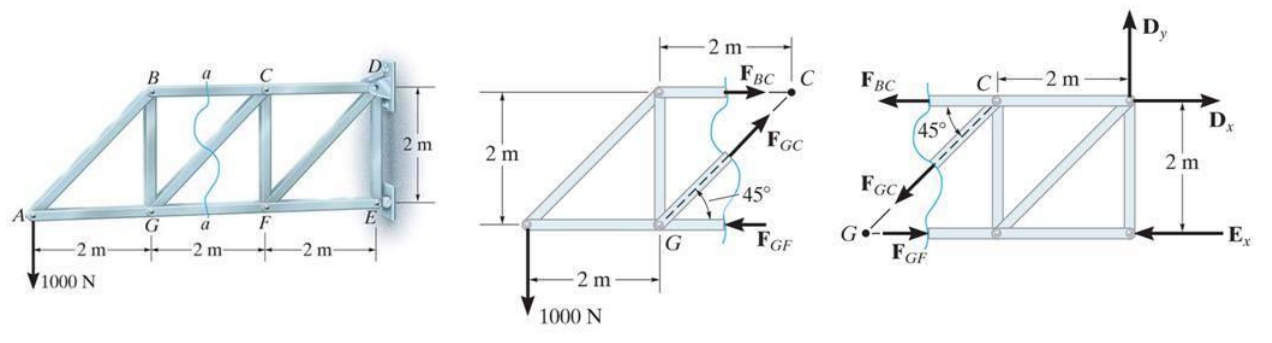
Key Principles:
- Cut through the member with the force you want to find
- Minimise the number of members you cut through
- Limit to 3 or less
- Only need to consider internal forces of split members
This method is useful as a lot of structures in real life are made of long trusses (e.g. cranes, transmission towers). Method of joints would require us to analyse many joints before we determine forces in the middle.
Worked examples in slides