Overview
- Unlike truss members, beams don’t just stretch/squash under axial loads
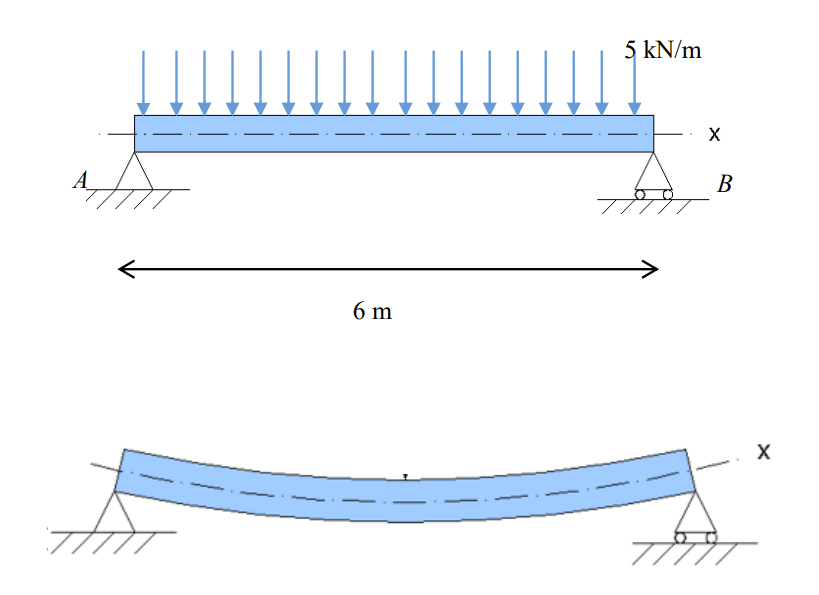
- They bend under the action of transverse loads
- Transverse loads are loads that are right angles to the long axis of the member
Internal Forces in a Beam
Lets say you have solved for all external forces acting upon a beam
- To solve for the internal forces:
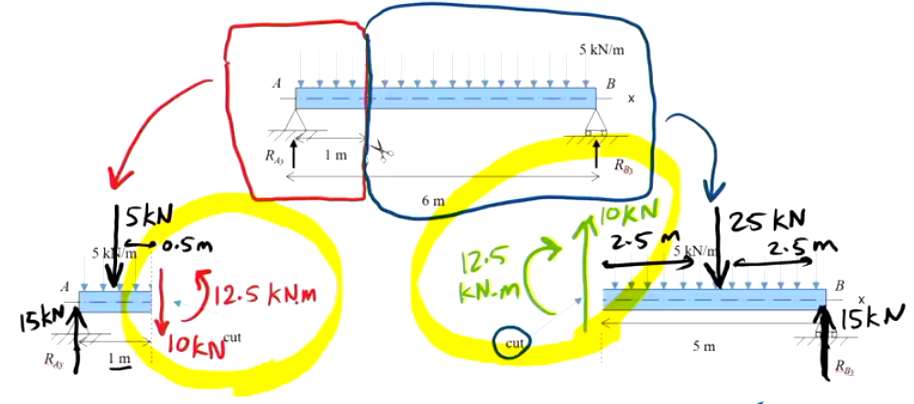
- Take a cut at some point along the beam
- Ensure the internal forces are in equilibrium with the external actions (including reactions) on ONE side of the cut
In summing forces, you may find that there is a missing vertical (or horizontal force), to achieve vertical equilibrium, there must be a vertical “internal” force on the cut section
- This vertical force is referred to as the internal Shear forces
- This is denoted by
- can be easily solved to resolve equilibrium
- There must also be an “internal” moment on the cut
- This is to resolve moment equilibrium
- Also known as a bending moment
- There can also be an “internal” horizontal normal force
If you re-join the two cut sides back together, you will find the two internal moments and shear forces are equal and opposite for both sides
Internal forces are not shown on a diagram of the whole structure
- They are important if you choose to cut a structure into parts
- And are also important for choosing suitable materials!
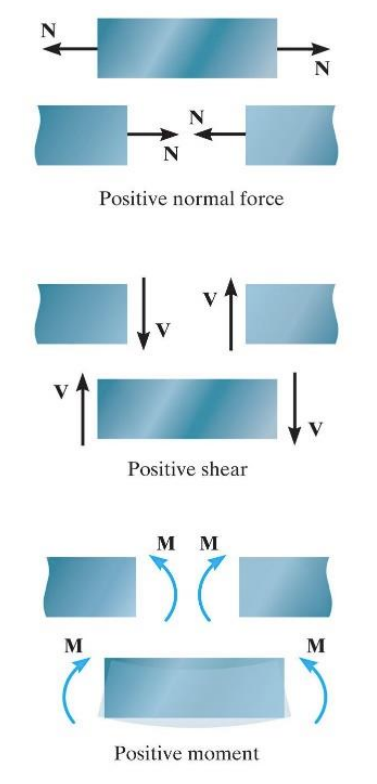
Here are the conventions for the positive direction for internal forces: