ENSC2004 - Lecture 8
Bending Moment & Shear Force Diagrams - Slides
Goal: Construct shear force and bending moment diagrams for beams for help in analysing critical sections in engineering design
Generalising Internal Forces
- We want a diagram that shows shear force at every point along beam
- We can do this through using functions:
- Make imaginary cut at distance away from
- is a variable, meaning we solve for & in terms of
- We end up with a function of and :
Shear Force and Bending Moment Diagrams
-
We can plot this data on a SFD or BMD
- SFD shear force diagram
- BMD bending moment diagram
-
On your diagram, you must include key points!
- Label function
- Label max/min
- Label endpoints
-
A shear force diagram is simply a plot of the shear force function
- e.g. for :
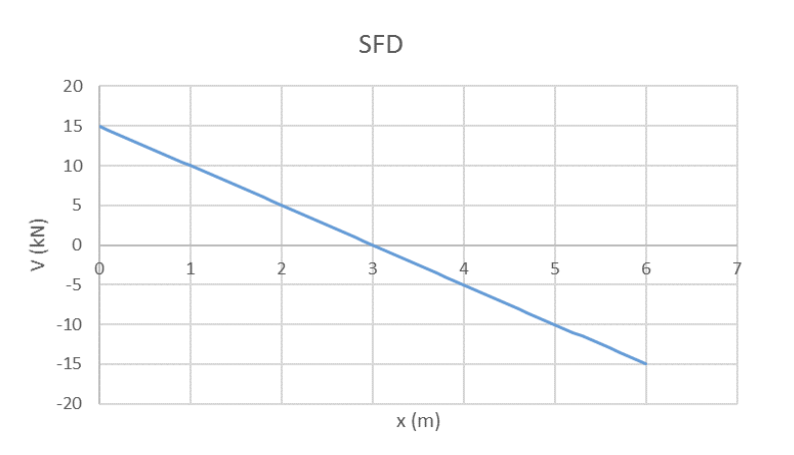
- e.g. for :
-
Bending moment diagrams sometimes plotted positive moments down
- i.e. the vertical axis is flipped (not always though!)
e.g. for :
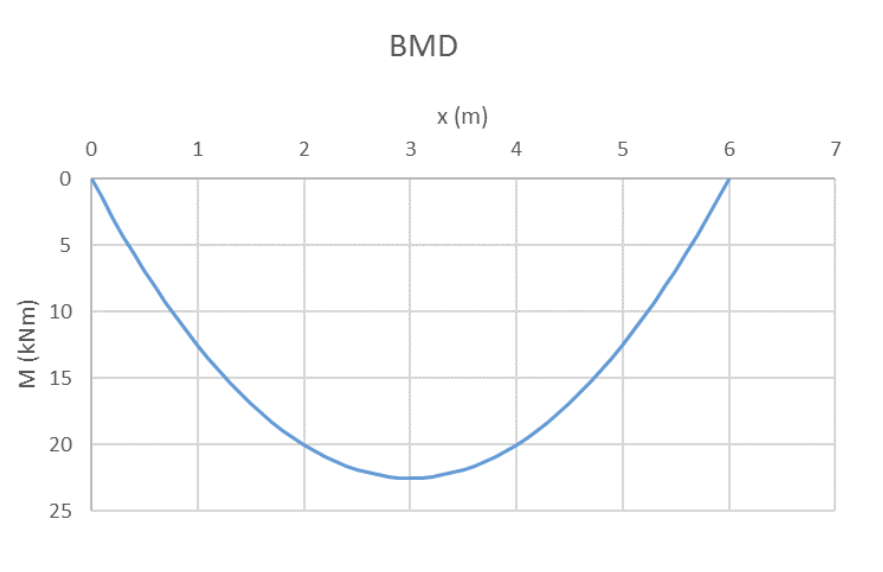
- i.e. the vertical axis is flipped (not always though!)
Sometimes we may have different functions for and over different ranges for
e.g. if a load is near the middle of the beam, both sides of the load may have different functions
- In this case, we ‘split’ the beam
For a function to be valid for a region of the beam, the distributed loading must be continuous over that region
Choosing a Beam
- Bending moments stress > shear stress
beams always break under bending moments- on our BMD is the critical section
- We need to choose a beam that can hold up under the given moment
- Recap: Deformation Behaviour
- Need to limit stress within the linear area of a stress-strain graph
Internal Stresses
- When a beam is bent, top under compression, bottom under tension
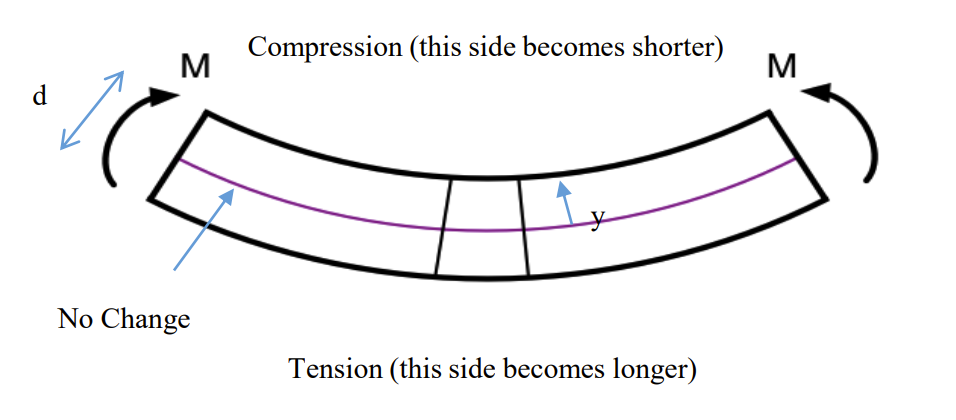
- At some point, there is neither tension nor compression
- This point is known as the neutral axis (N.A.)
- Located at centroid of cross-section
- Therefore, the bending strain is proportional to coordinate
- is the distance from the neutral axis
Bending stress () related to bending strain through Young’s modulus
- This implies that the bending stress is also proportional to the distance from the N.A.