2D Equilibrium
- When forces act in one 2D plane, it is known as a coplanar force system
- If forces all act through the same point, they are all concurrent
e.g. all the forces below act on the same point
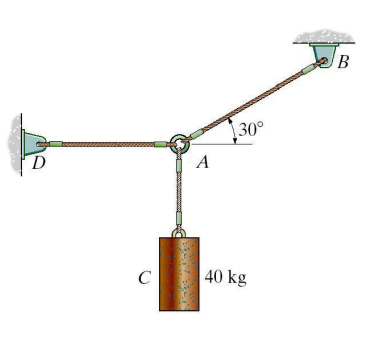
See: Definitions - As seen in High School, static equilibrium is when the sum of all forces acting on a stationary particle are zero
Recall Newton’s First Law: A body will remain at rest, or continue moving with a constant velocity, unless acted upon by a net force
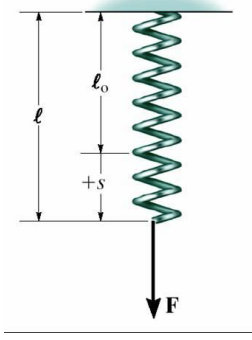
Simple Springs
- Spring force = spring constant deformation of spring
Cables and Pulleys
- With a frictionless pulley and cable:
i.e. the tension in both sides of a frictionless pully is constant
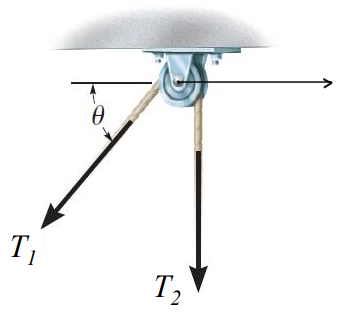
- Cable can support only a tension or “pulling” force, and this force always acts in the direction of the cable
Smooth Contact
- If an object rests on a smooth surface, then the surface will exert a force on the object that is normal to the surface at the point of contact
For problem solving systems of equilibrium, it is recommended to always draw out a free body diagram and then use your knowledge of vector addition to solve for each force
Moment of a Force
- A force may cause a body to move in the direction of its application
- It may also cause a body to rotate about an axis
- The moment of a force about a point provides a measure of its tendency to cause rotation about that point
- Also known as torque
- See also: Torque
- Also known as torque
- We can notate a moment of force around point as
- is the perpendicular distant from point to the line of action of the force (i.e. the line of direction in which the force acts)
- Torque is given either a clockwise or counter-clockwise direction in 2D
- Counter-clockwise is considered positive