Moment of a Couple
- A couple is when two parallel, equal and opposite forces separated by perpendicular distance '', creating torque without producing net force
- This results in a body being rotated, but not moved
- The moment of a couple has a magnitude of:
is not required as the position does not matter (see below) - It is important to note that a moment of a couple is a free vector
- This means its position can be moved anywhere in space without changing its effect on a body
i.e. only direction and magnitude matter
- This means its position can be moved anywhere in space without changing its effect on a body
Sometimes it is easier to resolve the forces in and -directions when the value of is not straight forward (example in slides)
Combining Forces
If you want to simplify multiple force vectors acting upon a rigid body (at different points) into a resultant force vector at a point, the two equivalent systems must produce the same moment around any arbitrary point.
-
Could we replace the three forces on the rigid frame with a single resultant force and if so, where would it act?
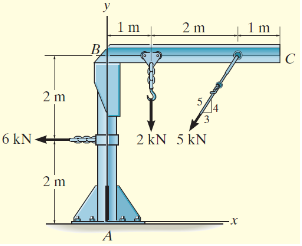
Reminder: if all forces pass through the same point, than the resultant force will just pass through that point as well
To solve the above problem:
- Find the magnitude and direction of the resultant force ()
- Calculate the moments of all forces around a point
- You may choose any point, here, would be a good choice
- Set up an equation where the total moment of is same as above
-
Make sure to split into perpendicular components!
i.e. -
Assume that lies on either or
Change this to whatever structural lines are present
You can do this because of an important principle below ↓ -
You will get an equation that looks like this:
is the horizontal distance between and
is the vertical distance between andEither or should be replaced by a known value. If you chose to place on , then would be equal to . If you chose to place on , then would be equal to (see dimensions).
We can now solve for the other unknown variable to find the exact position of .
-
Transmissibility
- Earlier, we said that you could choose either position for , both options would result in two different, but correct answers
This demonstrates the important principle of transmissibility:
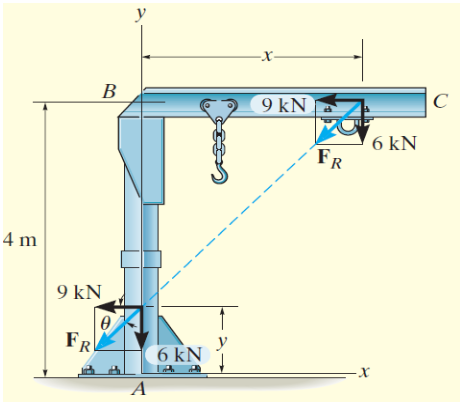
Transmissibility, states that a resultant force can act on a body at any point along its line of action, without changing the external effect
- For fixed objects, external effects refer to reaction forces at supports
- e.g. we would end up designing the same bolt group at , regardless of where we put on the dashed line
- When a vector is transmissible, its called a sliding vector
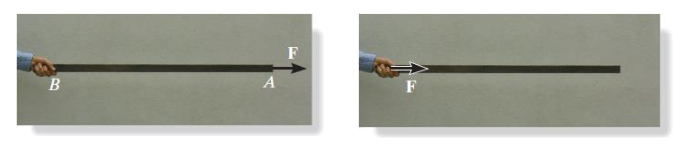
- Remember that the internal effect on the body still depends on where the force is applied
Simplifying Force Systems
-
When a force is moved, but not along its line of action, there is a change in its external effect (as shown below)

-
Moving a force from point to (as shown above) requires creating an additional couple moment to preserve the external effect
- Since this new couple moment is a free vector, it can be applied at any point on the body
By using this principle, we can move forces around without affecting the external effect as long as we add a couple moment
-
When several forces and couple moments act on a body, you can move each force and its couple moment to a common point
-
This is done by adding all the forces, working out the moments these forces create about () and summing couple moments ()