Distributed Loads
- A distributed load is a force spread over an area, rather than being concentrated at a single point
- Forces in real life are distributed loads
- Normally, when doing physics problems, we only consider forces that are concentrated at a point
- We need a way to translate a distributed load to a point force
i.e. we need to find the resultant force
- We need a way to translate a distributed load to a point force
Magnitude of Resultant Force
- Typically, a distributed load is represented using a function
- is a function of and has units of force per length
- The force magnitude acting on it is given as:
- Which can be written as:
is the area under the loading curve
Location of Resultant Force
- The force will produce a moment of about point
- The total moment about point is given as:
- Assuming that acts at , it will produce the moment about point as:
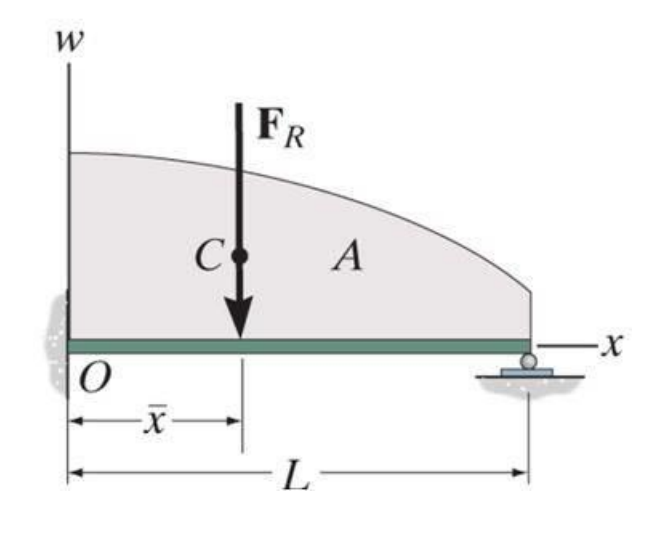
- Comparing and simplifying the last two equations we get:
acts through a point “,” which is called the geometric centre or centroid of the area under the loading curve
Centroid Table
- The location of the force is always at the centroid of the load distribution (diagram)
- We can use a centroid table to find the centroid (geometric centre) of a composite shape
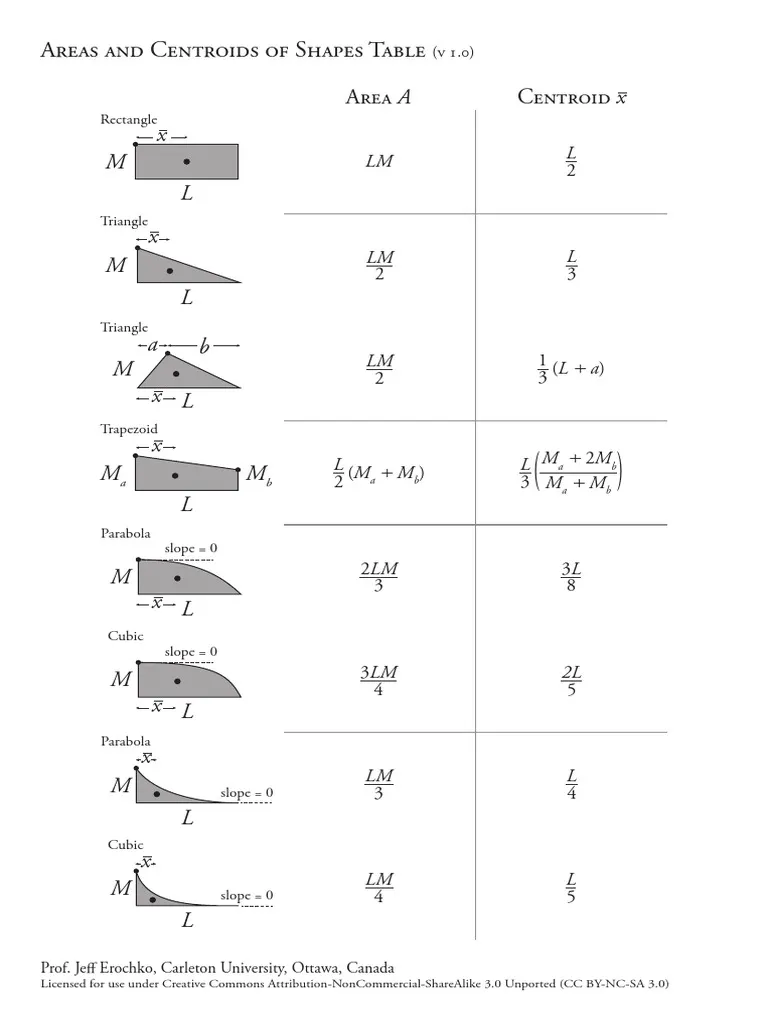
Note: for triangles, the values for centroid are going from the wide end. To go from the narrow end, the formula is .
- Using the centroid table may make the process easier, however, the method is mathematically the same
Equilibrium of Rigid Bodies - Slides
Recap: Basic Force Vector Techniques & Resultant for Point Loads
Conditions for Rigid-Body Equilibrium
- For a rigid body to be in equilibrium:
- Net force = 0
- Net moment around any point = 0
- All physical bodies are 3D, however, we can treat many of them in statics as 2D when forces are applied or projected in the same plane
Conditions for 2D Equilibrium:
Support Reaction in 2D
- If a support prevents translation of a body in a given direction, then a force is developed on the body in the opposite direction
- Similarly, if rotation is prevented, a couple moment is exerted on the body in the opposite direction
Solving Rigid-Body Equilibrium Problems
- Create idealised model
- Model that approximately represents the real situation as closely as possible
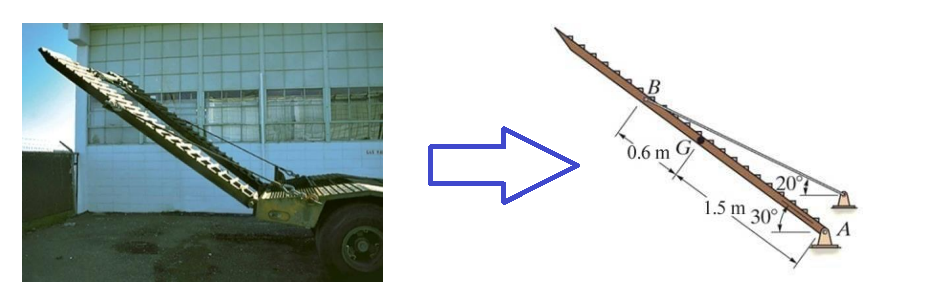
More examples on slides
- Model that approximately represents the real situation as closely as possible
- Draw free-body diagram showing all external (active and reactive) forces
- Make sure to include dimensions between all key points
- Apply equations of equilibrium to solve for any unknowns
As an engineering in the real world, you need an idealised model to represent your scenario! Creating idealised models is a key skill to become an engineer.