A clock is a periodic signal that alternates between logic 0 and logic 1 at a fixed rate. In synchronous digital circuits, it acts as the timing reference that coordinates when memory elements are allowed to update.
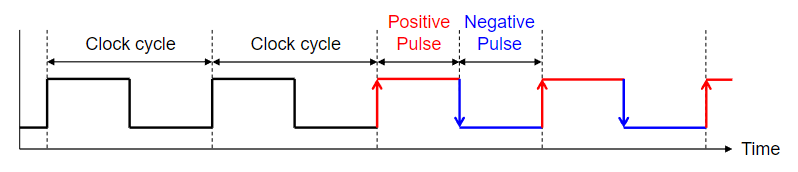
Key Parameters
- Clock cycle: (or period) time duration for each pulse, in seconds
- Clock frequency: number of cycles per second, in Hertz ()
- Duty cycle: the fraction of one period the signal is HIGH
Clock Edges
The transition points of the clock are known as clock edges. A clock edge can either be rising (0 -> 1) or falling (1 -> 0). Most components act upon clock edges, see level & edge-triggering for the distinction in the two types of component behaviour.
Using a clock edge transition helps keep circuit behaviour predictable. Output change at one defined moment instead of continuously. The majority of all modern circuits designed will use a clock and edge-triggered components.
await dv.view("Scripts/topic-backlinks");