Generalised Hooke’s Law
- Normal stress causes shear strain on certain planes:
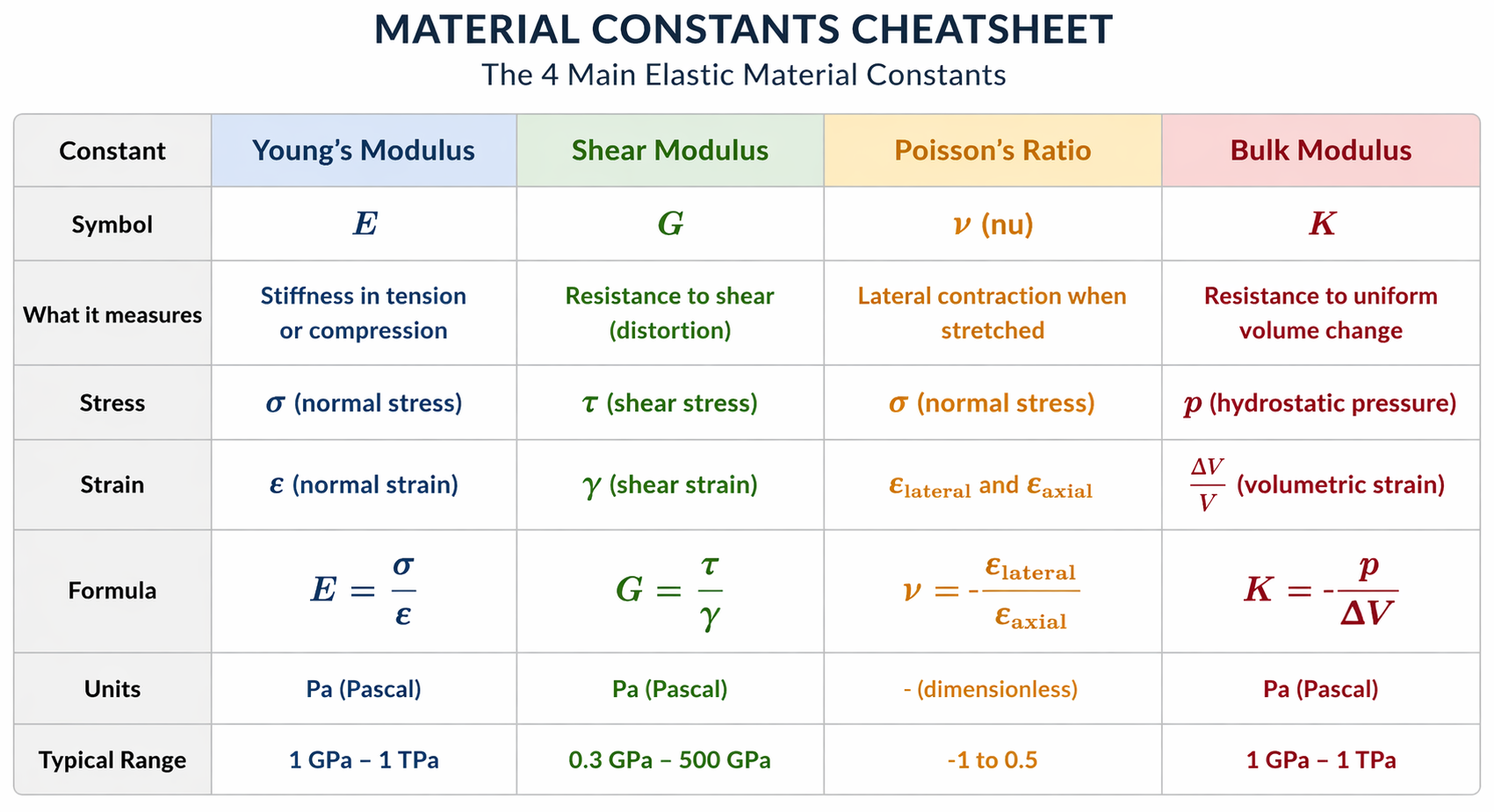
- There must be a relationship between Young’s modulus , Poisson’s ratio and shear modulus
- This is established through generalised Hooke’s law relationship between stress and strain in 3D (multiaxial loading)
- Multiaxial loading application of stress in multiple directions
Assumptions:
- Linear elasticity (no permanent deformation)
- Small strain → see Small Deformation Theory
- Isotropic material same properties in all directions
Given an object undergoing multiaxial loading:
- Stress in direction → direct strain
- Stress in and direction → still creates strain in direction
- Think Poisson’s Ratio → lateral contraction when stretched
- Think Poisson’s Ratio → lateral contraction when stretched
- Total normal strain in direction:
- This can be repeated for normal strain in and direction
Now for shear strain:
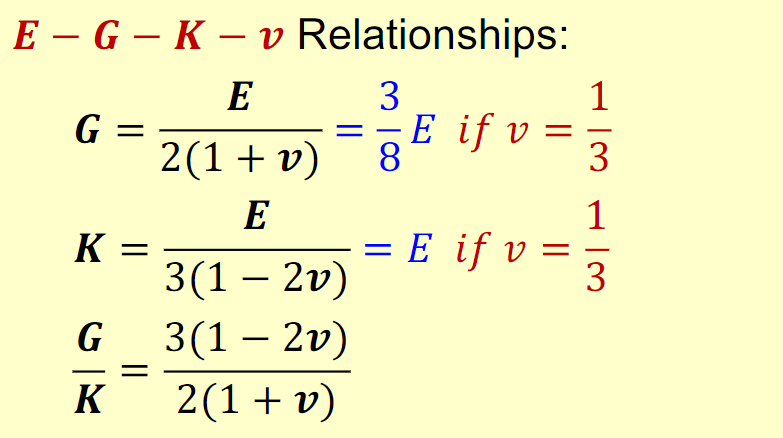
It is important to note:
> Normal stresses → normal strains and lateral strains (Poisson)
> Shear stresses → shear strains onlyAdditionally:
> Volume change (bulk behaviour)
> Shape change (shear behaviour)
All of these equations can be expressed using Einstein Notation as:
Kronecker Delta Property
The Kronecker delta () is a tool used to compare two variables. It acts as a ‘switch’ in an equation.
In the case above, for normal components and for shear components. When , delta becomes 0 (), removing the term.
Lamé Constants
Lamé constants are another way to describe the elastic behaviour of an isotropic, linear elastic material (just like our conditions above)
- describes how normal strains in one direction influence stresses in other directions
- (shear modulus)
These constants are useful because they make generalised Hooke’s Law more compact as seen below:
Use in Hooke’s Law:
Also used for normal stress:
Principal Axes
- Principal directions are special directions where shear stress disappears
- Stress becomes purely normal
- Principal axes theorem states that for any state of stress at a point there is a set of three perpendicular axes where all shear stresses vanish
- Calculations become much easier when shear vanishes
- 3D questions are much harder and unlikely to be covered
- Thus, we will focus on the method for 2D
- This method can also be used to find maximum normal stress
Finding principal axes:
- Write stress matrix
- Use formula to solve for
- Rotate axes (mentally)
- New axes = principle axes; shear becomes zero
Principal stress formula:
- ? Use this method when question asks for:
- Principal stress
- Maximum normal stress
- Orientation/angle where shear
Material Stiffness vs Strength
- Young’s modulus measures stiffness
- Slope of elastic region on stress-strain curve
- Yield stress/UCS measures strength/failure
- UCS → Unconfined Compressive Strength
These are different material properties
- One cannot be inferred from another
- Stiffness strength