Einstein Notation
- Einstein notation is shorthand that simplifies expressions by removing summation symbol when an index is repeated within a single term
- Used very widely, but here we will use it in the context of stress
For the traction vector acting on surface with unit normal vector :
- The index is repeated → implicitly summed over 1, 2, 3
For first component , this equation expands to:
- We can repeat this pattern for and
As we can see, using: simplifies what would otherwise be three longer equations into one short equation → very compact notation
What this notation means verbally → take stress contributions from all directions , project onto direction
You can also think of the equation as matrix multiplication:
- This is really helpful if you are given the stress tensor and the normal vector of the surface to calculate traction vector on
Stress on Arbitrary Surfaces
Given a stress tensor and a surface, how to find stress acting upon it?
- If surface and stress aligned → no shear stress
- Normal stress equals full stress, no calculations needed!
- If they aren’t aligned → use stress tensor to find traction vector
Full Method:
- Identify stress tensor and surface orientation (normal vector)
- To find traction vector → use Einstein Notation
- Calculate normal stress:
- Calculate shear stress:
Small Deformation Theory
- When you push/pull an object, every point in the object moves a bit
- Displacement gradient indicates how quickly the movement changes from one point to the next
- This equation means displacement gradient is much smaller than
- is displacement in direction
- is the coordinate
Small deformation theory assumes that any displacement of a materials particles are infinitesimally smaller than any relevant dimension of the body
- Its geometry and properties (such as density and stiffness) are unchanged by the deformation
- Also known as infinitesimal strain theory
This theory helps simplify equations:
- Can ignore complicated terms, such as squaring small numbers
- We can use our linear equations, (e.g. Hooke’s law)
- Can treat shape of object as the same before and after loading
- Valid for most problems
If an object, such as a ruler, bends a lot, our simple formulas for stress would be wrong → theory doesn’t apply; cannot ignore deformation
- We can apply this theory when objects deform only a tiny fraction of its original size (e.g. tensile/compressive tests, slight beam bend, etc.)
Small Deformation (Strain) Tensor
-
Strain is change in geometry per unit length → dimensionless
- Like stress, we use a tensor to represent it in 3D
- It comprises of elements
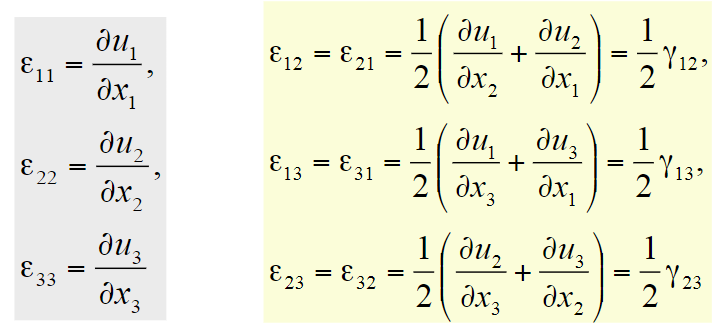
Interpretation of small deformation:
-
Diagonal terms: () normal strains
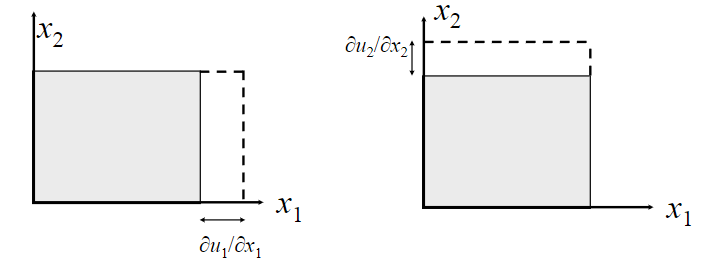
- Represents change in length per unit original length
-
Off-diagonal terms shear strains
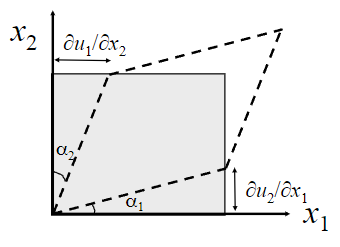
- Represents one-half the angle change between two line elements originally at right angles to one another
Volumetric Strain
- Volumetric strain is the sum of normal strains:
is also known as dilation - Represents change in volume of a small element
- Higher order terms are ignored as strains are small ()
- i.e. product of strains →