### 2D Stress Transformations - A given stress tensor tells us the stress acting on planes whose normals are aligned with the coordinate axis - However, in many circumstances we would want to calculate stress acting upon a different plane:
![[2DStressTransformation.png|420]]
In this scenario above, we have two pieces of wood glued together that are under tension, the glue is the likely point of failure:
- So how do we calculate stress acting on the glue plane?

We need our original stress tensor to align with the glue:

![[2DStressTransformation2.png|431]]
Luckily our original tensor can give stress information for all planes, it just needs to be rotated so that we can easily extract that information for our angled plane.
In 2D, we have these transformation equations:
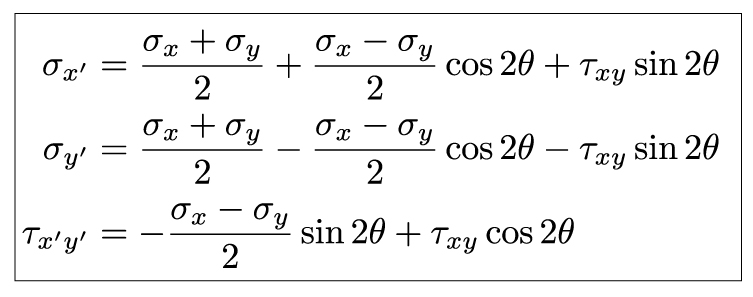
- Using these equations we can find the new stress tensor that is aligned with our angled plane
- These equations come from the matrix transformation rule:
Additionally, we use trigonometric identities to simplify - for any rotation of degrees:
Transposing a 2x2 matrix swaps the diagonals
Stress on an Oblique Plane
-
Lets revisit our oblique plane example
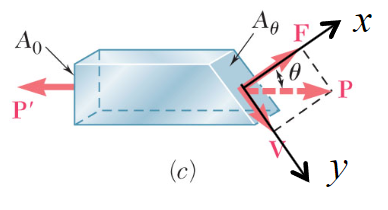
We can use a simpler method to find the stress acting upon the oblique plane, given that some conditions are met
-
We can resolve tension force into components normal and tangential to the oblique section:
-
The average normal and shear stresses on the oblique plane are:
We can use these equations when the stress state is uniaxial, i.e. only one normal stress component is non-zero and all shear stresses are zero
Why do we Need an Area Projection for Oblique Planes?
When we look at stress on an oblique plane, you might think that force can be resolved into components in order to find stress on this plane
- This is not the case!
The oblique surface is actually larger than a straight cut :
This is where our extra cosine comes from in our equations above
In this scenario, our stress tensor would look like this:
This corresponds to scenarios like:
- A straight bar in tension
- A tensile test specimen
- A rod pulled by forces at both ends
Maximum Stresses
- Maximum normal stress occurs at
i.e. when the plane is perpendicular to the axis
Most ductile materials often fail along diagonal planes
- This is because maximum shear stress occurs at a 45 plane:
when
Choosing a coordinate system is important because stress is a directional property. If you choose a left-handed system, than your shear stress will be negative → using 3D transformation rule for right handed coordinate systems will give you the correct sign.