The Stress Tensor
We know that stress is force per unit area that acts upon a surface:
Remember stress is measured in Pascals ()
However, inside a real material, there are infinitely many possible planes passing through a point → each plane experiences different forces
-
‘Stress’ vectors are in reality known as traction vectors
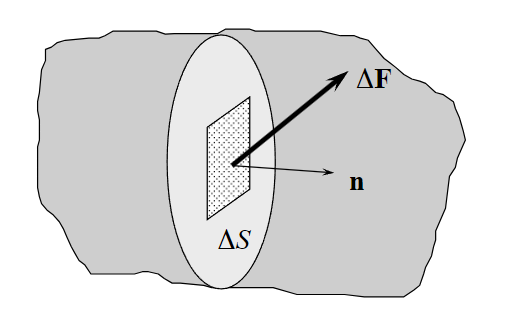
This vector captures the normal stresses (perpendicular to the surface) and the shear stresses which are non-perpendicular
-
A traction vector simply is a representation of stress acting upon a particular surface → two components to account for normal + shear
- i.e. traction vector → total stress acting upon that face
For each surface orientation, you would get a different traction vector
- We use a 3x3 matrix, known as a stress tensor, to store the information to generate these traction vectors for infinitely many planes
- Each face experiences normal stresses and two shear stresses:
Normal stress → outward from surface
Shear stresses → along surface and perpendicular to each other
- Each face experiences normal stresses and two shear stresses:
Stress tensor → gives for any surface direction!
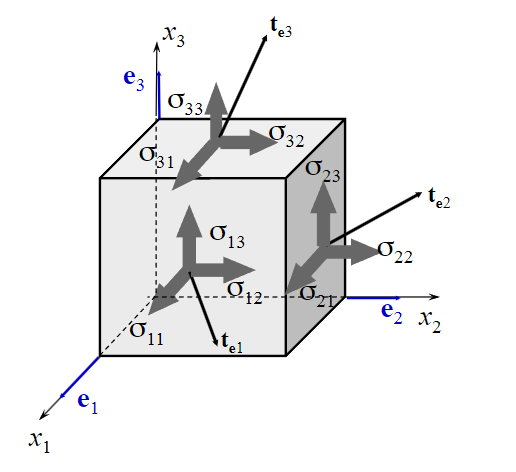
You are expected to know the direction of each stress component, the diagram above has the correct labels used for this unit
stress tensor notation for this unit:
- direction of outer unit normal
- direction of traction
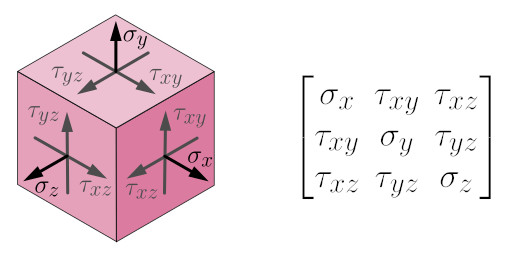
In this unit, stress (and strain) are symmetrical, this means:
Essentially, since the stress tensor represents internal forces acting upon an infinitesimally small cube in the material, this cube cannot spin independently otherwise the solid would ‘crumble’ and behave like a liquid. We need to equal out the ‘spin’ as we assume the solid is a continuum.
Internal Forces in Solids
- Our traction vector gives us force per unit area on a surface
→ To get force, we multiply traction by a small area:
When you cut a beam cross-section, internal stresses act across area - We end up with:
- Normal force from normal stress
- Shear stresses from shear stress
- Bending moment from distribution of normal stress
- Torsion from distribution of shear stress
- We can calculate these values by integrating stress
Normal force:
Shear force:
shear stress =
Bending moment:
is distance from the neutral axis
For you use , but for and , use and respectively
- Bending happens because normal stresses vary across the cross-section
Torsional moment:
is the distance from centre
- Each shear stress creates small force → each creates a twisting moment
Stress Transformations
- Lets say our coordinate system changes:
- Material stress state → remains the same
- Numbers in tensor describing it → now change
- We can transform a stress tensor to work in the new coordinate system
For this example, we will be using
If the coordinate system rotates, the stress tensor transforms as:
→ original stress tensor, → stress tensor in rotated axes
→ rotation matrix, → transpose of rotation matrix
Transpose → swap rows and columns
For a rotation, we can find by solving this matrix:
→ cosine of the angle between new axis and old axis
e.g. for a 45 rotation about , the angle between is 45 which is also true for . For , the angle remains at 0.
- The angles you are going to get are going to be multiples of the rotation (in this case 45) and you can calculate it in your head
- We multiple each row of left matrix by each column of right matrix to do matrix multiplication