Introduction
MATH1012 Chapter 3 Goals
- Understand the operations of matrix algebra and identify the similarities and differences between matrix algebra and the algebra of real numbers
- Describe, and find bases for, the row space, column space and null space of a matrix
- Find the rank and nullity of a matrix and understand how they are related by the rank-nullity theorem
- Compute determinants and understand the relationship between determinants, rank and invertibility of matrices
- Intro Video - 3Blue1Brown:
- Textbook → Cambridge Matrices
- Matrices are a rectangular arrangement of numbers into rows and columns
- Matrices are used to represent linear transformations
- Vectors can be thought as matrices with one column
- Numbers can be thought as vectors with one component and thus vectors can be thought as matrices with one column
Transclude of matricescircle
- Matrices are used to represent linear transformations
Matrix Rules
- A matrix is a rectangular array of mathematical objects (usually numbers)
- E.g.
- Matrices are represented with capital letters, such as
- If it has rows and columns, it is called a matrix
- The matrix above is a matrix
- Entries in can be indexed using subscripts for the row and column
- E.g. in the matrix above
- is the row, is the column
- A lower case letter is used for a term
- E.g. in the matrix above
- Matrices are only equal if they have the same number of rows and columns and all corresponding entries are equal
- E.g.
Matrix Algebra
Matrix Addition and Subtraction
- Two matrices can be added or subtracted by adding or subtracting the corresponding entries
- Example:
- If and
- Then
- Matrices can only be added/subtracted if they are of the same size
- Example:
The Zero Matrix
- The with all entries equal to zero is called the zero matrix and will be denoted with
- For any matrix and the zero matrix , we have:
- and
Scalar Multiplication
- To multiply by a scalar, multiply each entry by the scalar
- Scalars are real numbers
- Example:
- If , then
Matrix Multiplication
- Matrix multiplication is more complex than the other topics we have seem so far
- Example of matrix multiplication:
- Let and
- Matrix multiplication takes the values in going across in each row and multiplying them by the values in going down the corresponding column
- These values are added together to get the value in matrix
- Example of matrix multiplication:
- has dimensions and has dimensions , if they can be multiplied
- The resultant matrix is in size
- e.g. a matrix of size multiplied by a matrix will have a size of , the like terms are removed similar to vector addition
- Matrices can only be multiplied if the number or rows for = the number of columns for
- The resultant matrix is in size
- The order is very important for matrix multiplication
-
- e.g. let be size and be size , will be size but will be size
-
- We can find any value of any term in the resulting matrix using this formula:
Identities
- Matrices whose size defined by and are known as square matrices
- Their size can be denoted with
- These square matrices have a special multiplicative index for each value of
- For matrices, the identity matrix is
- An identity matrix is composed of only zeroes except for the diagonal line from the top left corner to the bottom right corner which is filled by ones
- e.g. a identity matrix is
- Identity matrix are special because for a square matrix of the same size, matrix multiplication in any order gives the same square matrix
Matrix Inversion
- Earlier we discussed the existence of identities, however, each square matrix also has an inverse matrix which when they are multiplied together, give the identity matrix
- The inverse of a matrix is denoted as the unique matrix with the property that
- Inverse matrices are unique, there is only one for a given matrix and it also is the inverse for only one matrix
- The order for inverse multiplication always gives the same result,
- The inverse of a matrix is denoted as the unique matrix with the property that
- A matrix is invertible if:
- has full rank (i.e. rank = #rows)
- The rows and columns of are linearly independent
The Inverse of a 2 × 2 Matrix
- If , than the inverse of () is given by:
-
Invertible Matrix Theorem
- Go look on slides
The Determinant
-
The quantity in the inverse formula is called the determinant
- Notated as )
-
If ) = than does not have an inverse
-
The determinant tells us information about a transformed shape:
- If the determinant is (), then the transformed shape’s area will be multiplied by
- If the determinant is negative, then the orientation of the transformed shape will change
- The transformation involves a reflection
-
-
If has a row of zeroes then
-
Read Unit Reader
Computing the determinant of size requires computing the determinant of matrices of order
Properties of Determinants
- is invertible if and only if
Determinant is Multiplicative
Determinants of Larger Matrices
- DeepSeek 3x3 Matrix Example:
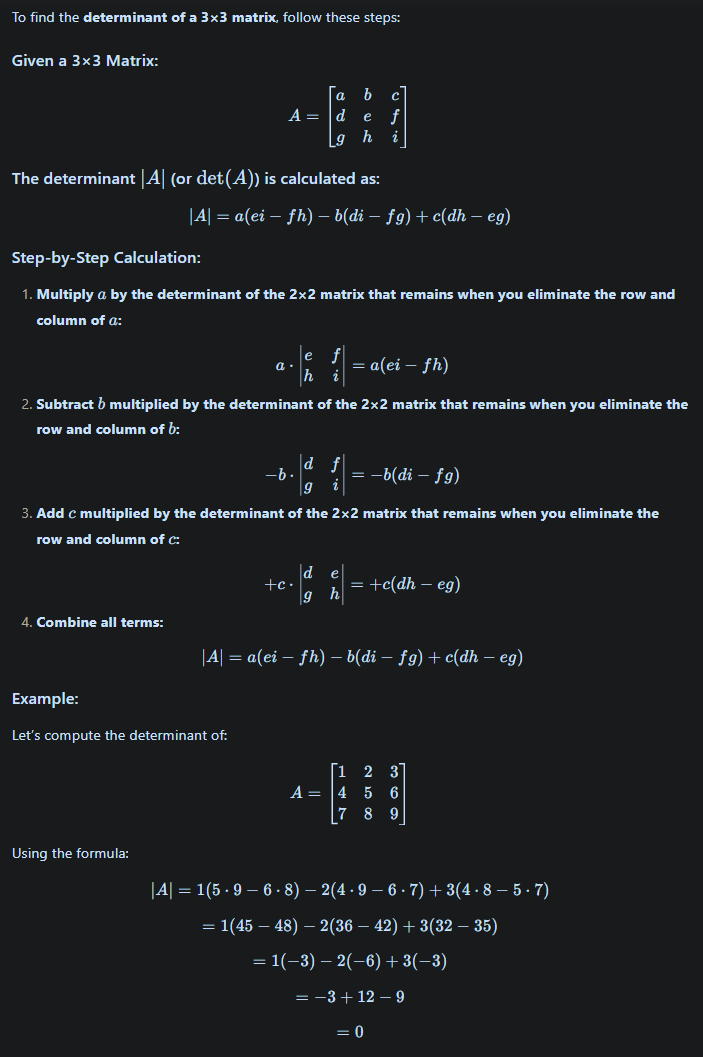
- Comprehensive General Equation:
where is the matrix obtained from by deleting the th row and th column
- Computing the determinant of one matrix requires computing the determinant of matrices of order
- We must use other techniques to compute larger matrices
- Thus, we use row-reduction to create upper-triangular matrices
- Finding the determinant of matrices in row-echelon form is easy
Simultaneous Equations Using Matrices
- Cambridge Matrices - 15E
- Simultaneous equations can be written and solved as a matrix multiplication equation
- Using matrices we can treat the simultaneous equation as one equation and then cancel out matrices on either end until we solve for the desired values
- For example, consider the pair of simultaneous equations:
- This can be written as a matrix equation:
- Let = . The determinant of is .
- Since the determinant is non-zero, the inverse matrix exists:
- Remember that the coefficient for the inverse is not always 1! Use the full formula to find the inverse matrix
- Now multiply both sides of the original matrix equation by :
-
- Since
-
- Since
- When the determinant for the given matrix is not , than the equation can be solved by isolating the matrix with unknown variables by multiplying both sides by the inverse of the given matrix
- If the determinant than the simultaneous equations have no solution
- e.g. has no solution as the discriminant of the matrix is equal to 0 and so the matrix has no inverse
Types of Matrices
Transposing Matrices
is the transposed matrix of and is formed by transposing the rows and columns (flipping the matrix over a diagonal)
e.g. if then
Special Square Matrices
- A matrix is symmetric if
- A matrix is skew-symmetric if
- A matrix is upper-triangular if for
- A matrix is lower-triangular if for
- A matrix is diagonal if for all
An matrix has rows and columns
Upper Triangular
- An upper triangular matrix (all numbers below the diagonal are zero) has an easy determinant to compute, equal to the product of all values across diagonal
- It is easy to solve determinants of matrices in row echelon form
Solving Determinant Using Row-Echelon Form
- When reducing a matrix to solve its determinant, keep track of the changes you make to the original matrix ()
- Thus, when you solve the , you can transform it into
- The effect of each change is here
- does not necessarily equal !
Subspaces from Matrices
Row and Column Space
- Row space is the span of all rows of a matrix
- Column space is the span of all columns of a matrix
- Null space is all solutions to for given matrix
- To check if a matrix, , is in ‘s null space, solve
- Check if it equals 0
- To check if a matrix, , is in ‘s null space, solve
Row and Column Rank
- Row/column/null rank is the dimension of the row/column/null space
- The dimension of a matrix is equal to the # of non-zero rows/columns in row echelon form
- Row rank is equal to column rank
Rank-Nullity Theorem
If is an matrix, then:
i.e. ‘rank + nullity = number of columns’Every column is either basic or non-basic:
- Basic contributes to rank
- These are columns with leading entries in row echelon form
- Non-basic contributes to nullity
Explanation of Sowiso Assignment 2 (Q5) in lecture recording