Complex Stress-Strain States
- In real life situations, there are many other stress-strain states
- They can all be described by the three basic states, including:
- Biaxial tension or compression
- Bending, which is a combination of tension and compression
- Torsion, which is a shear
- Any combinations of above
- Biaxial stress
- Occurs when two perpendicular normal stresses act on a material’s surface within the same plane
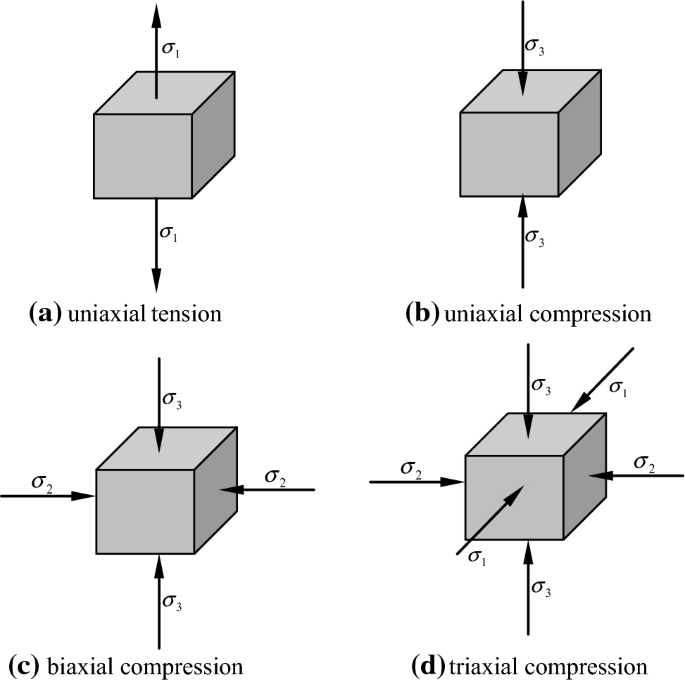
* Note: this diagram only features one instance of biaxial stress
- Occurs when two perpendicular normal stresses act on a material’s surface within the same plane
- Bending
- A beam in bending experiences tension on one side and compression on the other with the middle line being strain neutral
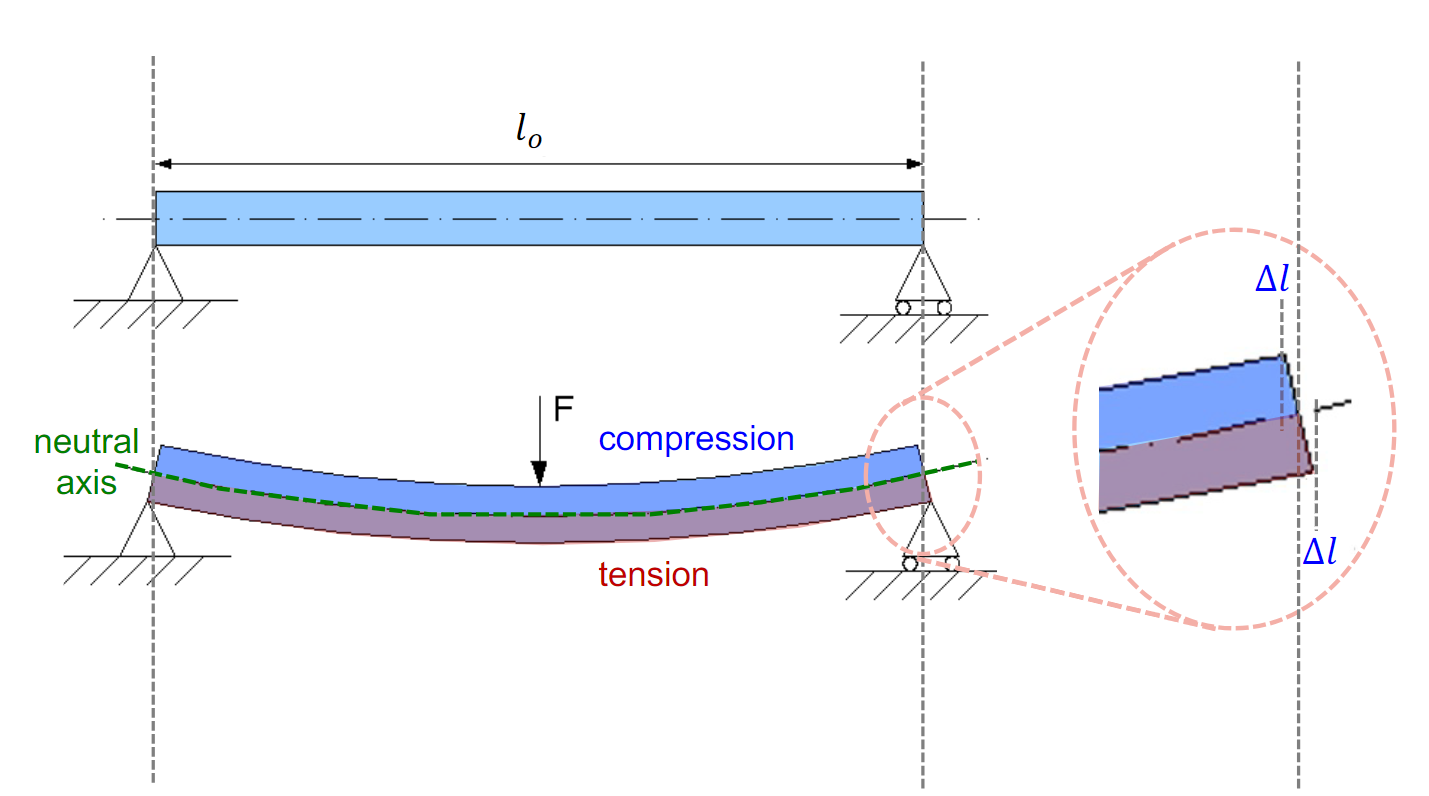
- Stress and strain are non-uniform across cross-section of a beam
- A beam in bending experiences tension on one side and compression on the other with the middle line being strain neutral
- Torsion
-
Torsion is a form of pure shear
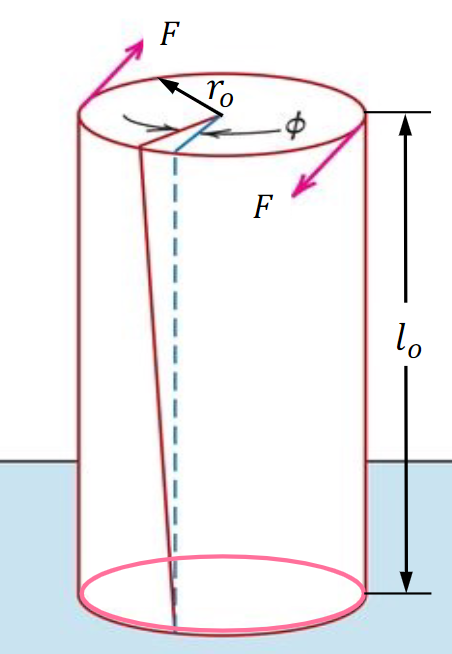
- Stress and strain are non-uniform
-
Shear strain:
-
Shear stress:
-
Poisson’s Ratio
-
When a bar is stretched longer by tensile stress, it usually becomes thinner at the same time
-
The ratio of the lateral strain to the axial strain is found to be a material’s constant, known as Poisson’s ratio
Note: ve sign is included for convenience of making a ve value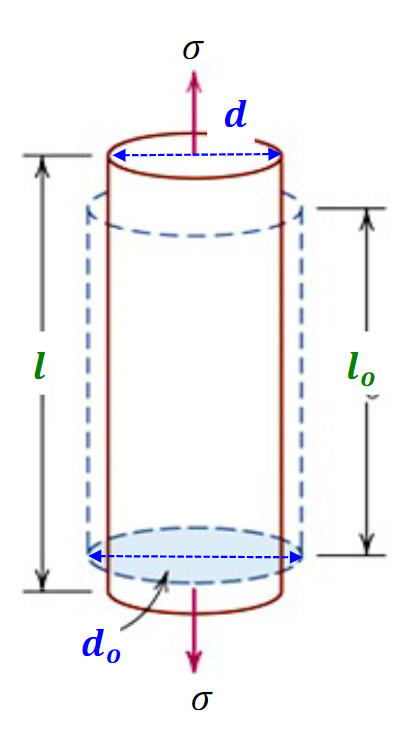
- For a cylindrical rod shown here:
Therefore:
- For a cylindrical rod shown here:
-
More examples are on the slides
What does the value of Poisson's Ratio tell us?
- When , the volume of the material does not change
- If , the volume increases
- Most real life materials fall in this range
- If the volume decreases
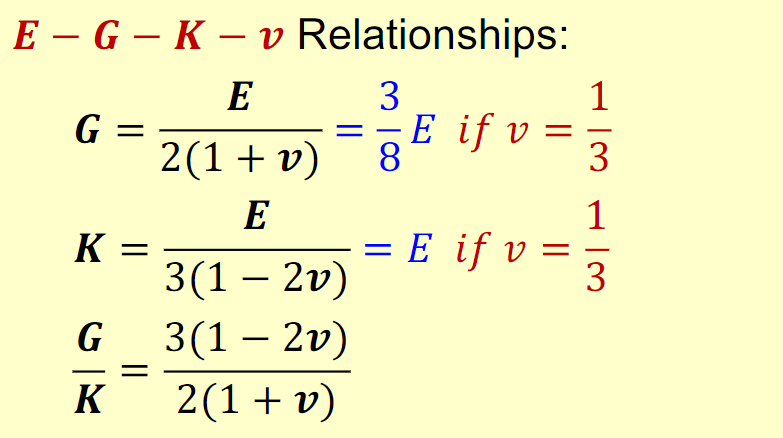
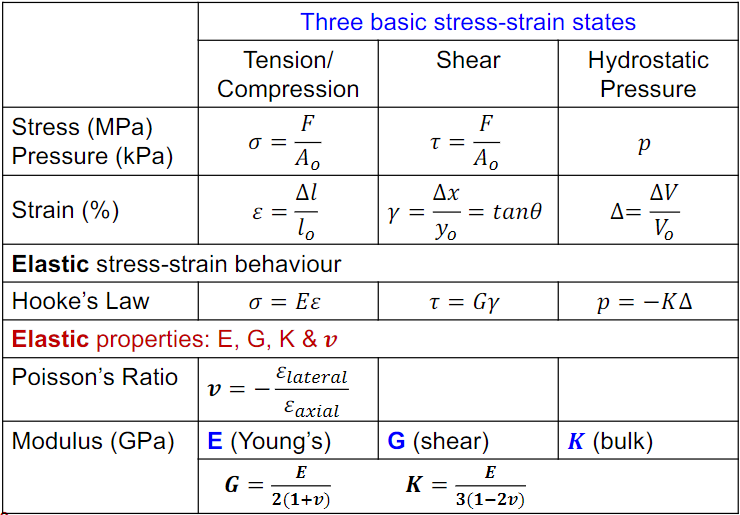
Elastic Properties of Materials
- Young’s modulus, 𝑬
- Shear modulus, 𝑮
- Bulk modulus, 𝑲
- Poisson’s ratio, 𝒗