ENSC2003 - Lecture 12
Phasor Representation of Circuit Elements - Slides
Phasor Representation of Circuit Elements
-
Phasor analysis only applies to / in sinusoidal steady state
- Circuit has been running for a long time → steady state
- Assumed for all AC questions
-
Phasor analysis simplifies calculations for complex AC circuits
- Replaces differentiation/integration with multiplication/division
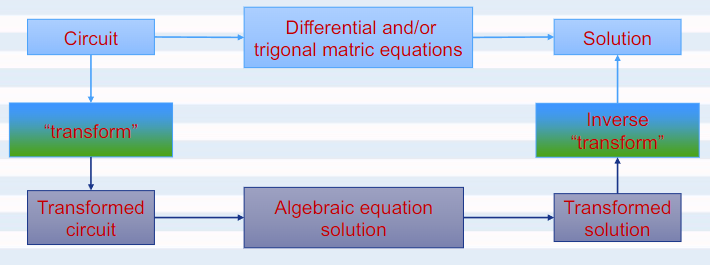
Phasor analysis assumes entire circuit operates at angular frequency
- A sinusoidal time-varying voltage can generally given by:
With:
Phasor form:
- Time part is removed → simplified equations
Must convert sine function to cosine before converting to phasor: Thus in the case where function is given in sine:
Phasor for Circuit Elements
- Voltage source:
- Current Source:
- Resistor:
- Time domain:
- Voltage and current are in phase → unchanged relationship
- Capacitor: → must know
- Inductor:
Impedance
- Restate Ohm’s Law in phasor representation in terms of impedance ():
- Units of Ohms ()
- Similar to conductance, inverse of impedance is admittance ()
- Units of Siemens ()
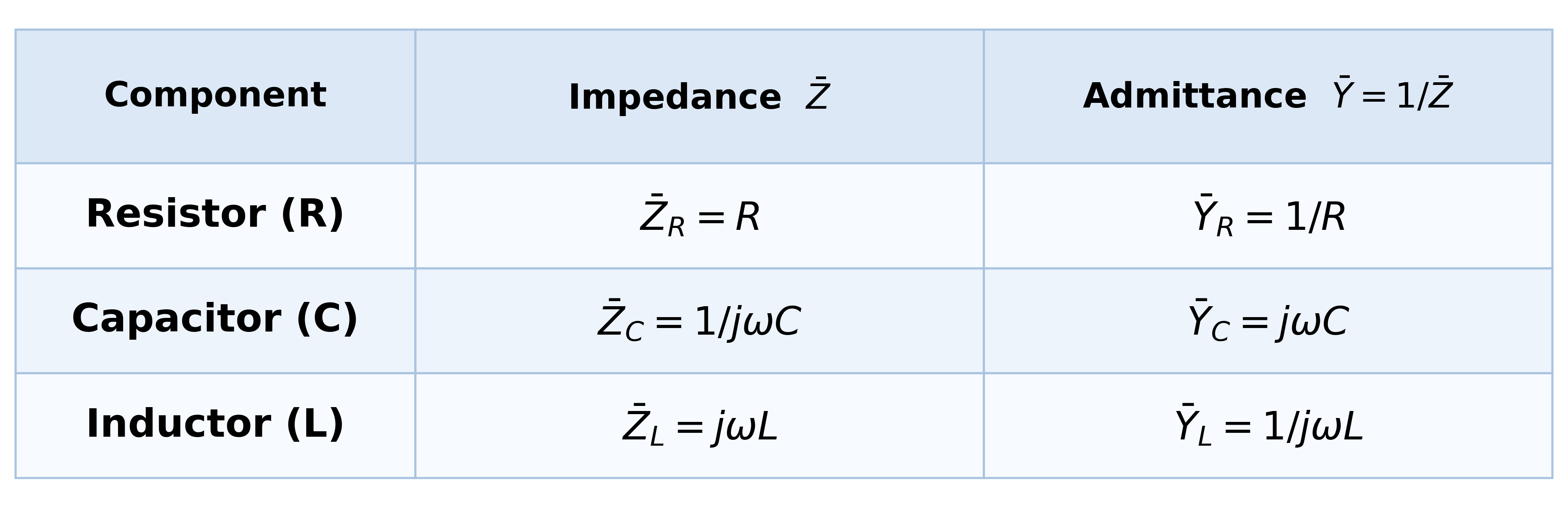
- You can use DC Circuit Analysis Methodologies now with this version of Ohm’s Law for AC circuits (e.g. KCL, KVL, mesh, etc.)
Combining Impedances
Series combination of impedances:
Parallel combination of impedances:
General equation:
Circuit Analysis Using Phasors
- As said above, we can use our DC methodologies after converting functions into phasor notation
- When we do this, we assume all sources are at same frequency
- If sources have different frequency in circuit:
- Do circuit analysis for just one source present in the circuit
- Replace other voltages sources by a short circuit and other current sources by an open circuit
- Convert the result for the one source from the frequency domain back to the time domain
- Each result is sinusoid with potentially a different frequency
- Repeat steps 1 and 2 for all the sources
- Via superposition we can add up the results of step 2 to find the final answer for the potential difference or current
- Do circuit analysis for just one source present in the circuit
This is extension (different frequencies), we will not be required to do this!