Review: AC & DC
- DC direction current → direction of current doesn’t change
- We have currently been working in DC circuits
- AC alternating current → direction of current changes regularly
Sinusoidal Sources
-
Trigonometric functions are used to model waveforms
- Sine and cosine functions used widely for modelling
-
Example: mains AC power (single phase)
- 240 V RMS, at 50 Hz → sinusoidal waveform
- Frequency Hz
- Period ms
- RMS amplitude of 240 V
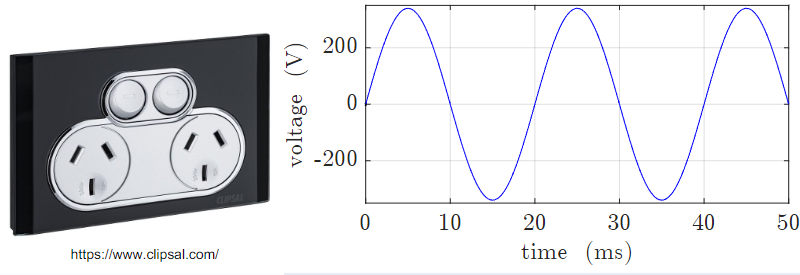
- 240 V RMS, at 50 Hz → sinusoidal waveform
-
Root mean square (RMS) effective power of an AC voltage that would be delivered by equivalent DC voltage
Sine waveform:
Cosine waveform:
- amplitude
- angular frequency in radians/seconds
- where is frequency in Hertz (Hz)
- phase angle in degrees or radians
Review: Calculus Y12 > Derivative of Trigonometric Functions
- You should understand the sine-cosine relationship and be able to differentiate and integrate trigonometric functions
Complex Numbers
- Review: Complex Number Y12
- is an imaginary number
- Needed to solve equations with roots of negative numbers
- Needed to solve equations with roots of negative numbers
- Complex numbers are a tool to move from DC → AC analysis
Why is symbol used instead of ?
To avoid confusion, the symbol is used in electrical engineering to represent complex number component ():
List of Key Complex Number Equations:
- Cartesian Form:
- Modulus:
- Argument:
- Polar Form:
- Conjugate:
Euler’s formula:
- This gives us exponential formula:
Review: Polar Form Equations
Polar form is used for easier use of multiplication and division
- Multiplication:
- Division: