Power in Resistor-Only DC Circuits
- Resistors always consume power
Maximum Power Transfer Theorem
Given: voltage source with internal resistance + load
- Max power over load occurs when:
- Max power when condition is met:
- Max power dissipated by and are the same ()
- i.e. is using only half of the total power supplied
Maximum power transfer theorem shows a very low power efficiency (at most 50%) in DC resistor-only circuits
Power in AC Circuits
- Instantaneous power is a function of time in an AC circuit:
- Power is always greater than zero
- For a resistor:
Average and Peak Power
- Average power:
- Peak power:
- Power of squared sinusoid:
- Cosine term equals 1 or -1
Root Mean Square (RMS)
-
Effective (DC-equivalent) value of AC:
-
Power using RMS:
- This is the main formula to be used in exams
-
RMS current:
Average voltage/current is constant; it does not depend on time
Power in Different Elements
- Capacitor: no net power consumed →
- Stores energy in electric field but then returns it
- Inductor: no net power consumed →
- Stores energy in magnetic field and then returns it
Power in AC Steady-State
-
Accounting for phase difference between and :
- → phase difference
-
This equation above now works for all components:
- Resistors work as normal as and are in phase
- Capacitors and inductors consume power (see below)
- Resistors work as normal as and are in phase
and are out of phase for capacitors and inductors:
- Capacitors/inductors do not dissipate real power, but they still reduce the real power dissipated by a resistor in the circuit
- This can be seen in equations when using:
- Capacitors/inductors affect impedance
Complex and Real Power
Complex power is defined as:
- Has unit of Volt-Amperes (VA)
- is real component, is imaginary component
Real power is the real component of :
- Has unit of Watt
- Only resistors can consume real power
- Real power is equal to
- Also known as active power
Reactive power is the imaginary component of :
- Has unit of Volt-Amperes, Reactive (VAR)
- Only capacitors and inductors can consume reactive power
Apparent Power is the magnitude of complex power :
- Has unit of Volt-Amperes (VA)
- Total “supplied” power
Power Factor
-
Power triangle diagram:
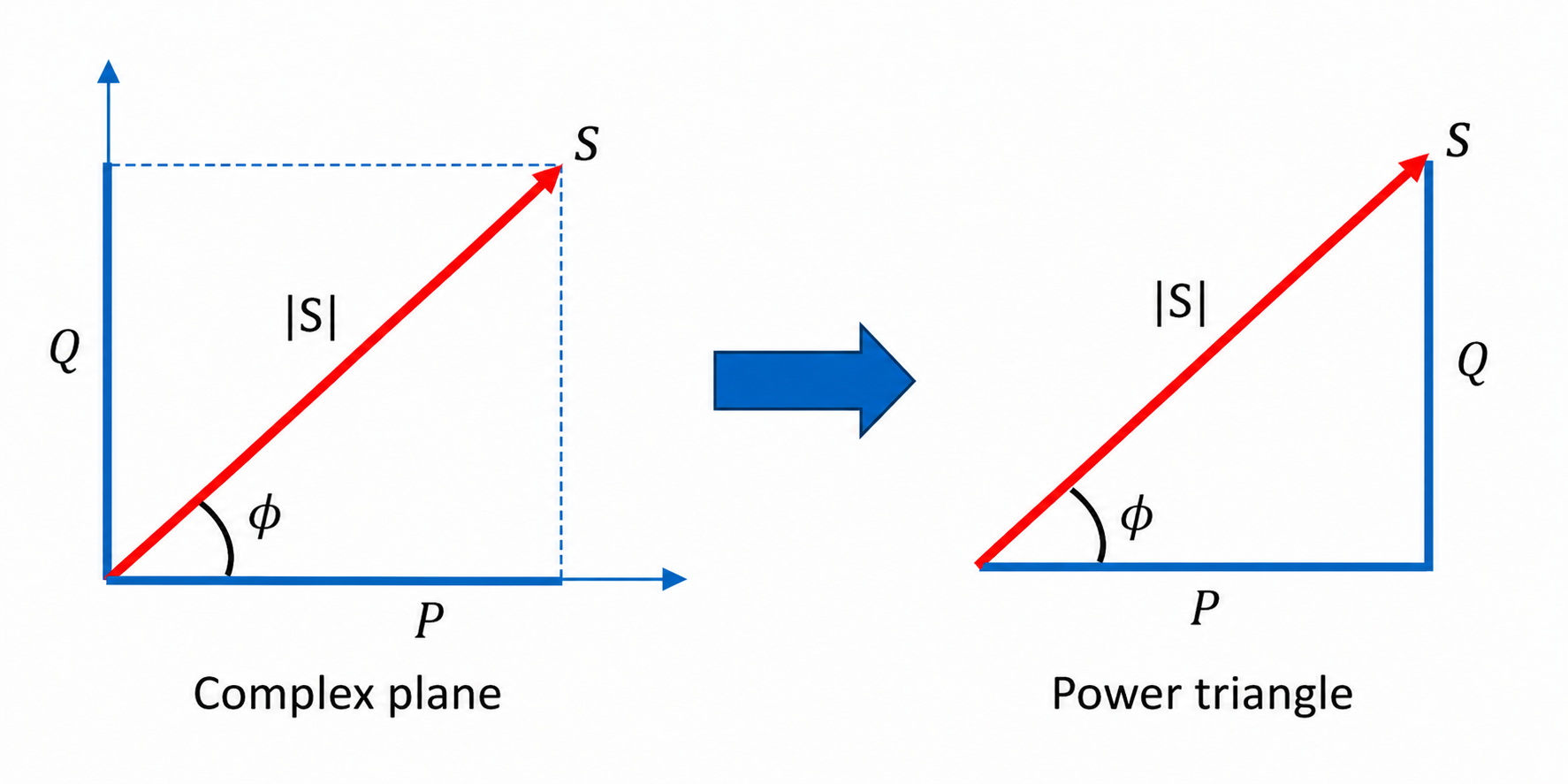
→ angle of power triangle -
If , then → current leads the voltage (leading)
-
If , then → current lags the voltage (lagging)
The ratio of to is called the power factor, denoted by :
- Leading or lagging status must be indicated in calculation
- -> we do not know if is +ve or -ve
- Thus we must indicate alongside more information
- Low power factor → inefficiency
- More current needed → greater power loss
- You want to maximise real component of complex power