Breadth-First Search
- Breadth-First Search (BFS) is a traversal technique that explores rooted trees and graphs layer by layer
- Vertices are separated in different levels
- Begins at a starting vertex
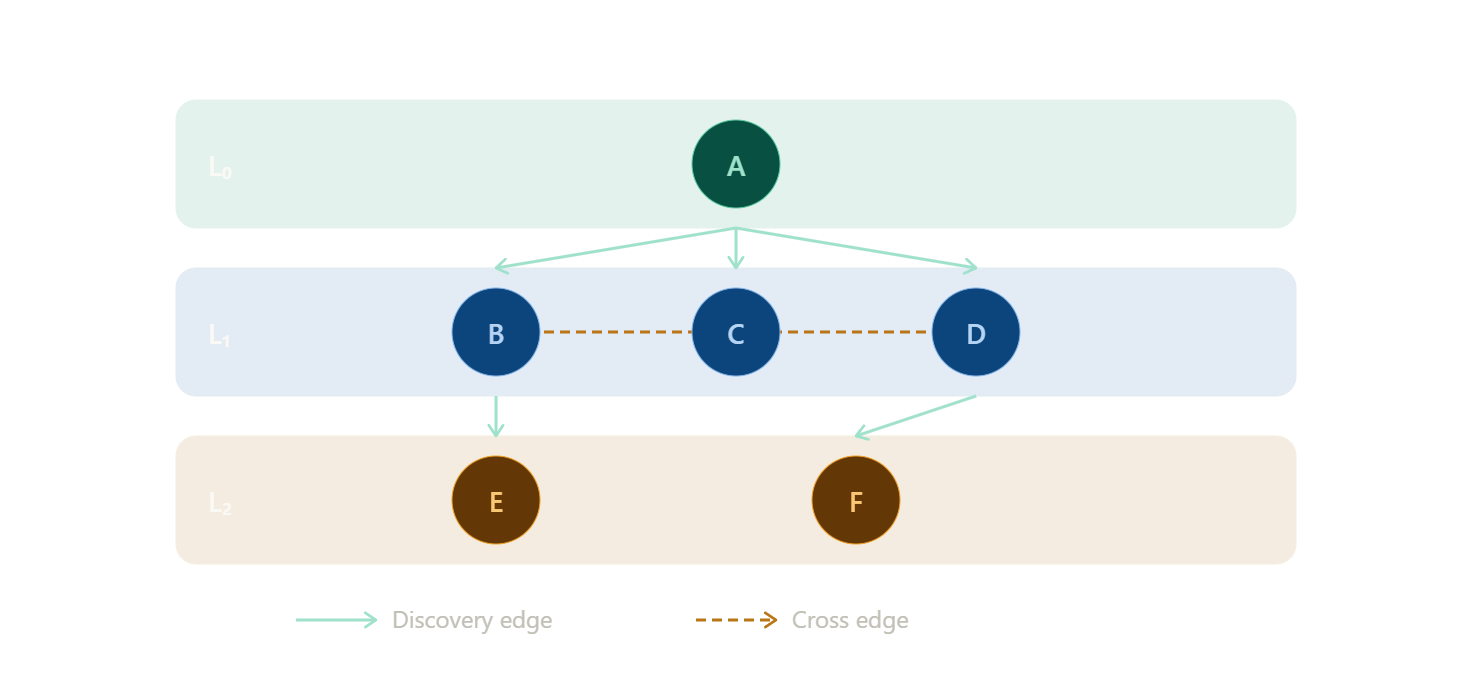
As BFS explores, edges get classified:
- Discovery edge leads to an unexplored vertex
- Cross edge connects two already-visited vertices at the same or adjacent level
Properties of BFS
- Property 1 visits all vertices and edges in the connected component of
- Property 2 discovery edges form a spanning tree of connected component of
- Property 3 every vertex in has a shortest path of exactly edges from ; BFS guarantees shortest paths between vertices
- Level
Complexity Analysis of BFS
Assuming we are using an adjacency list representation:
| Operation | Cost |
|---|---|
| Label a vertex or edge | |
| Each vertex labeled twice (UNEXPLORED → VISITED) | total |
| Each edge labeled twice | total |
incidentEdges called once per vertex | total |
| Total | |
| Identical to [[CITS2200 - Lecture 20#Depth-First Search | DFS]] |
Applications of BFS
- Shortest path given two vertices, find the path between them with the minimum number of edges or report no path exists
- Find a simple cycle or report that graph is a forest
DFS vs BFS
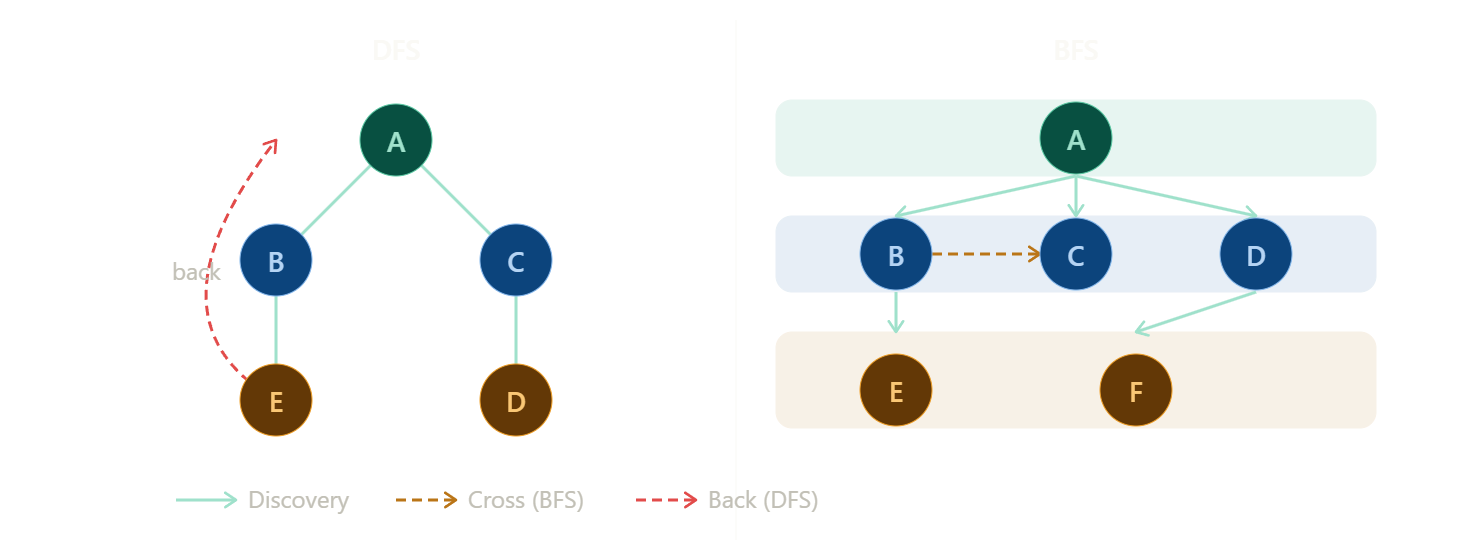
- DFS follows the path as deep as possible
- Back edges indicate cycles
- BFS spreads level by level
- Cross edges connect vertices at same or adjacent levels
- Finds the shortest path (by edge count) between vertices