Graphs
- A graph is a pair where:
- is a set of nodes (called vertices)
- is a collection of pairs of vertices (called edges)
- Both vertices and edges can store data
Terminology
- Endpoint two vertices an edge connects
- Adjacent two vertices sharing an edge
- Degree number of edges touching a vertex
- Parallel edges two edges with the same endpoints
- Self-loop edge where both endpoints are the same vertex
Applications
- Electronic circuits (e.g. PCBs)
- Transportation networks
- Computer networks (e.g. local area network, internet, etc.)
- Databases
Edge Types
-
Directed edge ordered pair of vertices
- → origin
- → destination
-
Undirected edge unordered pair of vertices
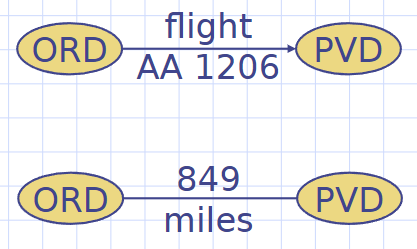
A graph where all edges are directed is called a directed graph
A graph where all edges are undirected is called an undirected graph
Paths & Cycles
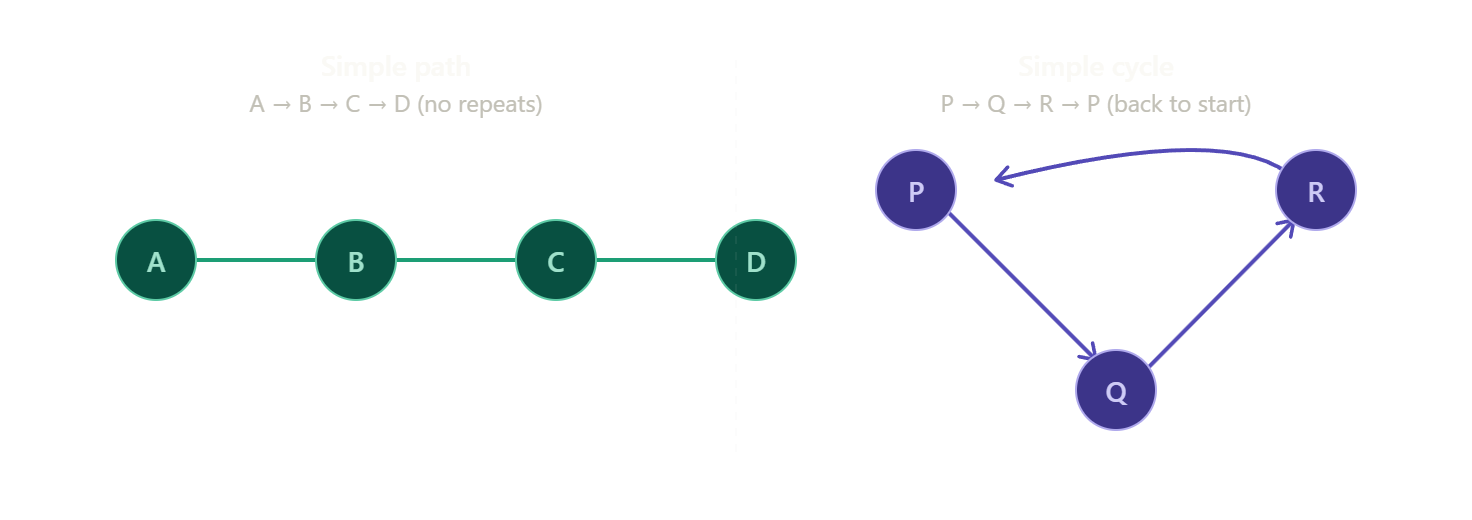
Path sequence of alternating vertices and edges
- Starts and ends at a vertex
- Simple paths have no repeated vertices or edges
Cycle path that starts and ends with the same vertex
- Simple cycles have no repeated vertices or edges
Key Properties of Graphs
Property 1 sum of degree of every vertex equals twice the # of edges
- number of edges
Property 2 in an undirected graph with no self loops:
- number of vertices
- Each vertex can connect to at most others
Graph Representations
Three ways to store a graph in memory:
- Edge list simple but slow for lookups
- Adjacency list most common python implementation
- Adjacency matrix fast checking of adjacent vertices, but wastes space
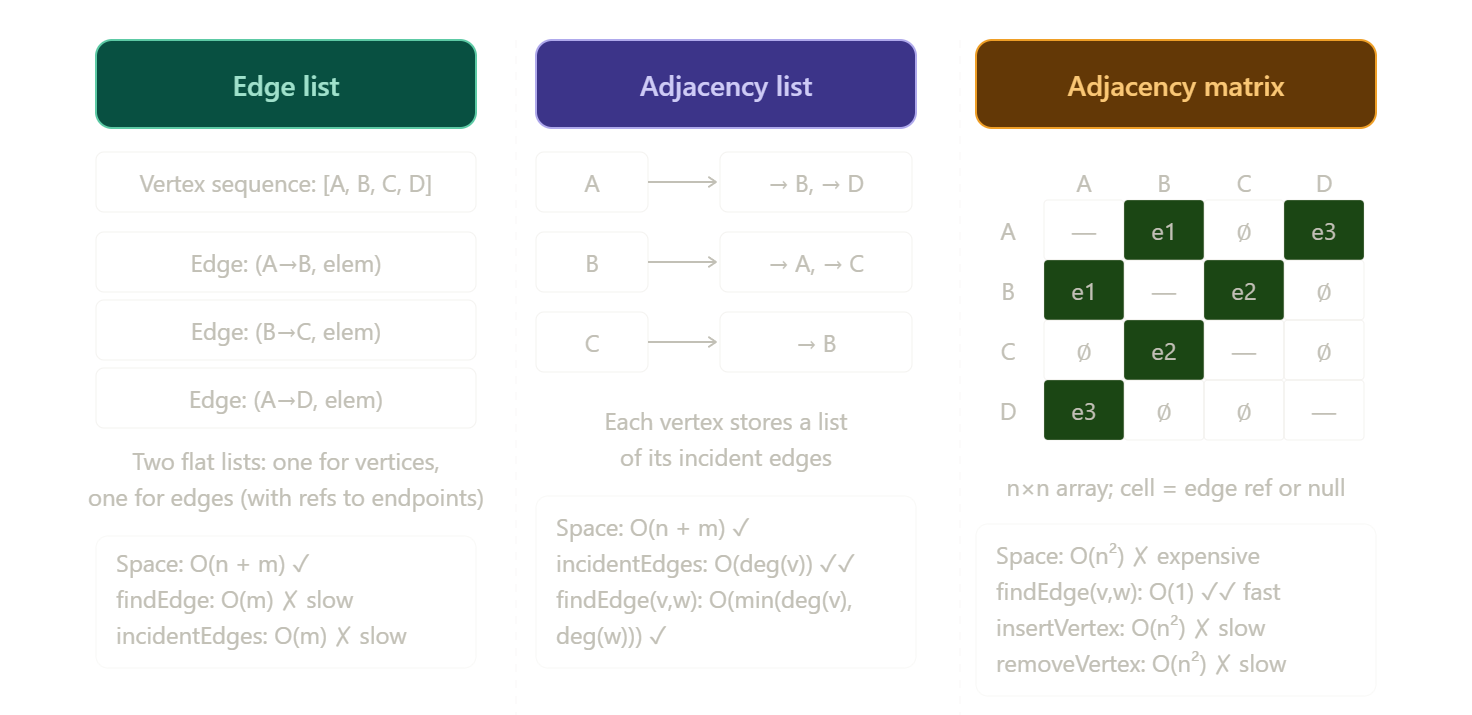
All options have different trade-offs:
| Operation | Edge List | Adjacency List | Adjacency Matrix |
|---|---|---|---|
| Space in memory | |||
incidentEdges(v) | |||
areAdjacent(v,w) | * | ||
insertVertex | |||
insertEdge | |||
removeVertex | |||
removeEdge |
*