ELEC1303 - Lecture 2
Describing Logic Circuits - Slides
Read: Combinational vs Sequential Logic
Digital Circuits/Logic Circuits
- Digital circuits are also known as logic circuits
- This is because they obey a set of logic rules
- The manner in which a digital circuit responds to an input is referred to as the circuit’s logic
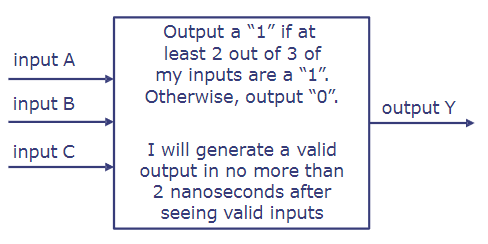
Combinational Device
- A combinational device is a circuit element that has:
- One or more digital inputs ,
- One or more digital outputs ,
- Functional specification
i.e. specific output for every possible input combination - Timing specification (at minimum, propagation delay ())
is the time for a signal to travel from the input of a system to its output
Functional Specifications
- Besides language, there are other ways to specify and represent the function of a combinational device
- These are three examples:
- Truth table
- Boolean expression
- Schematic
- You can convert between these three representations
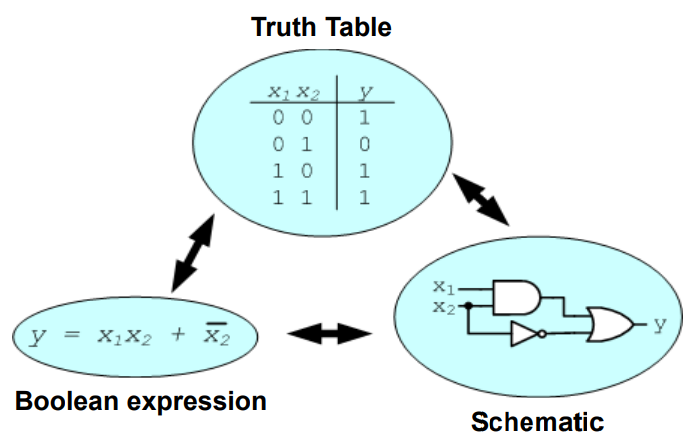
- Truth table is the only unique representation
- i.e. there are many ways to make an expression or schematic for a given circuit that all mean the same thing
- See slides for more information
Boolean Expressions and Logic Gates
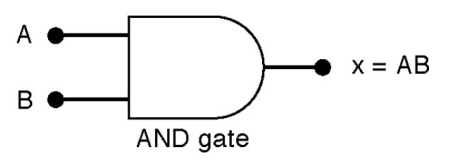
x equals A and B →
- The dot is implicit and may be left out
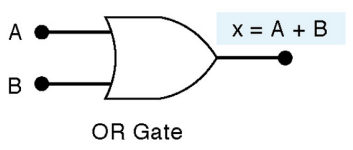
x equals A or B →
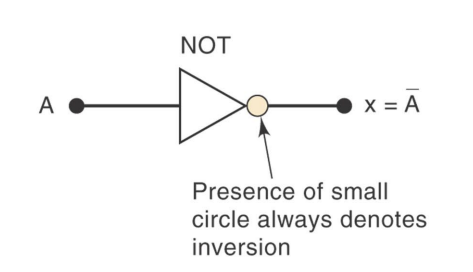
x equals NOT A → or
- NOT circuit commonly known as inverter
Duality Principle
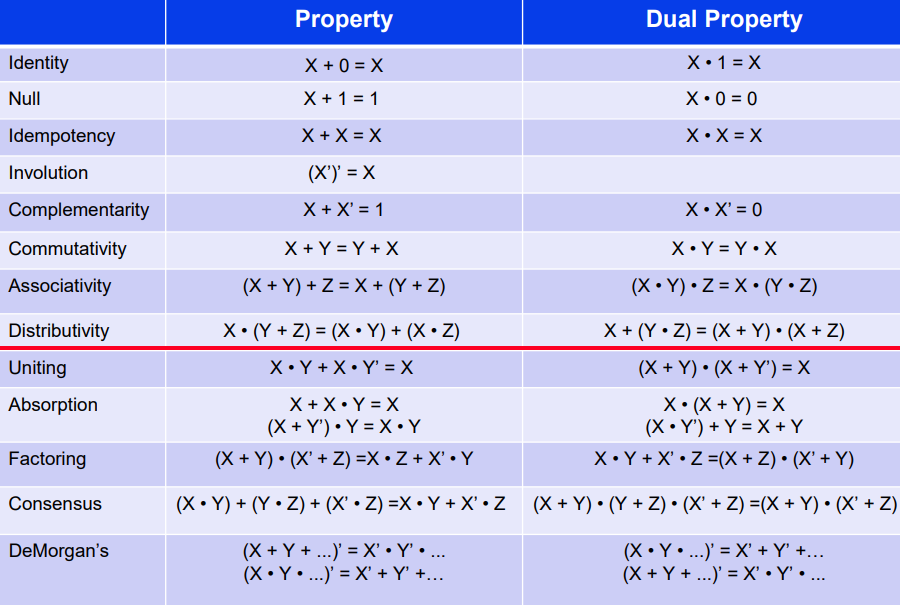
- The dual of a Boolean expression can be obtained by:
- Interchanging AND () and OR () operators
- Interchanging constants 0’s and 1’s
- The complement operator does not change
- The properties of Boolean algebra appear in dual pairs
- If a property is proven true then its dual is also true
- The “dual” is NOT equal to the original expression
- This helps us derive new theorems quickly from existing ones
- We do not require additional proofs
Example: the dual of is
De Morgan’s Theorem
- The complement of the logical AND of two or more variables is equal to the logical OR of the complements of those variables
- The complement of the logical OR of two or more variables is equal to the logical AND of the complements of those variables
(x + y)' = x'y'$$$$(x\ y)' = x' + y'
- Complement ?
Answer:
Boolean algebra allows us to simplify a function so that it contains the smallest number of literals