Digital vs Analog
- Digital information is represented by signals which take on values that correspond to a finite number of discrete information values
- Analogue a continuous range of signal values correspond to a continuous range of information values
What is a Digital System?
- A digital system takes in digital values and then outputs digital values
Digital Systems use Binary Values
- Each binary digit (called a bit) is either 1 or 0
- Bits have no inherent meaning
- Binary is popular because:
- Transistors, the basic digital electric components, operate as switches (on/off) using only two voltages (high/low)
- Storing/transmitting one of two values is easier than three or more (e.g., loud beep or quiet beep)
Better Noise Immunity
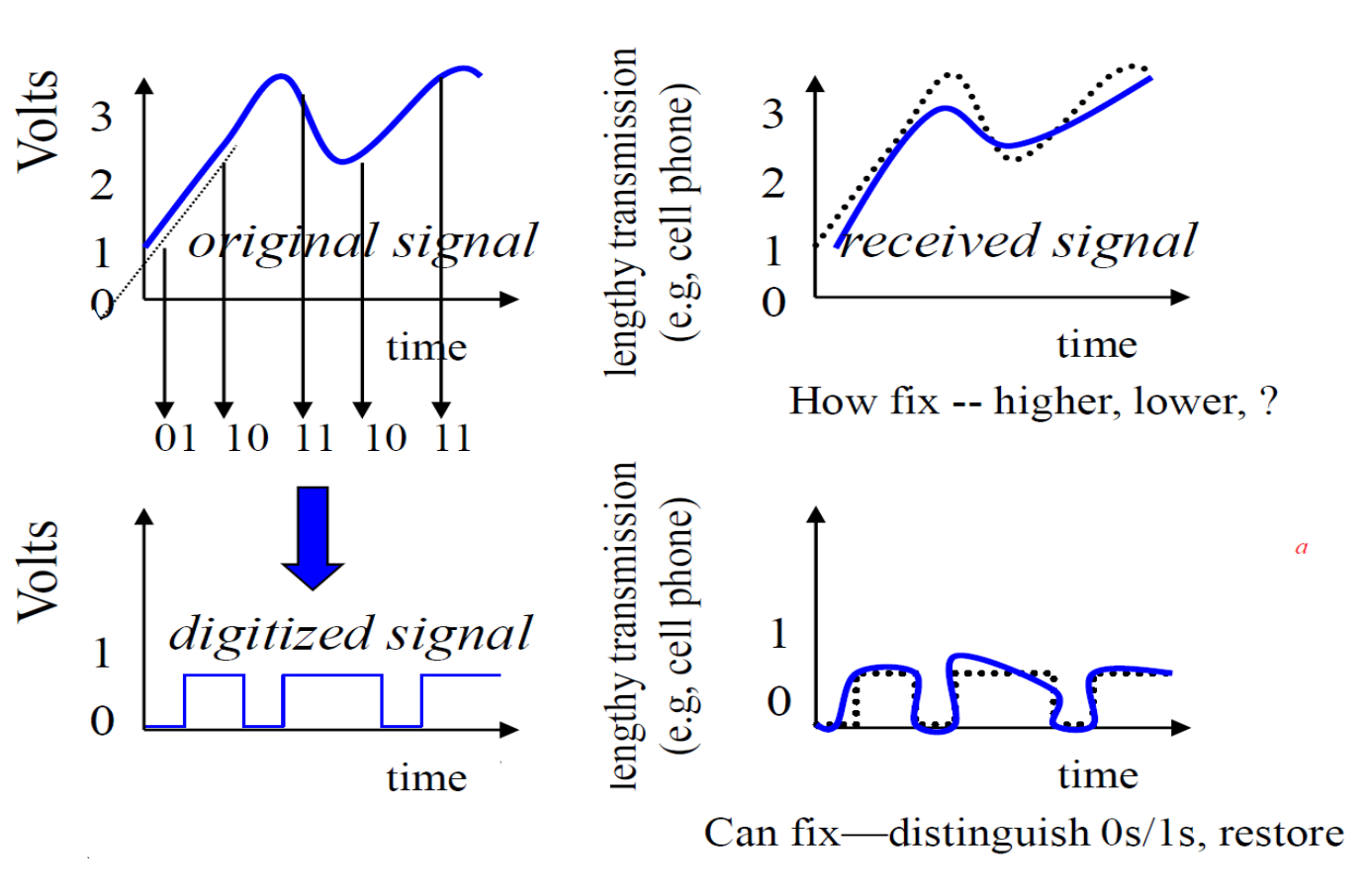
Analog to Digital Conversion
- Real world is analog but analog signals can be converted to digital
- e.g. a microphone taking your voice as input
- This is done by taking measurements or “samples” of the continuously varying signal at regular intervals
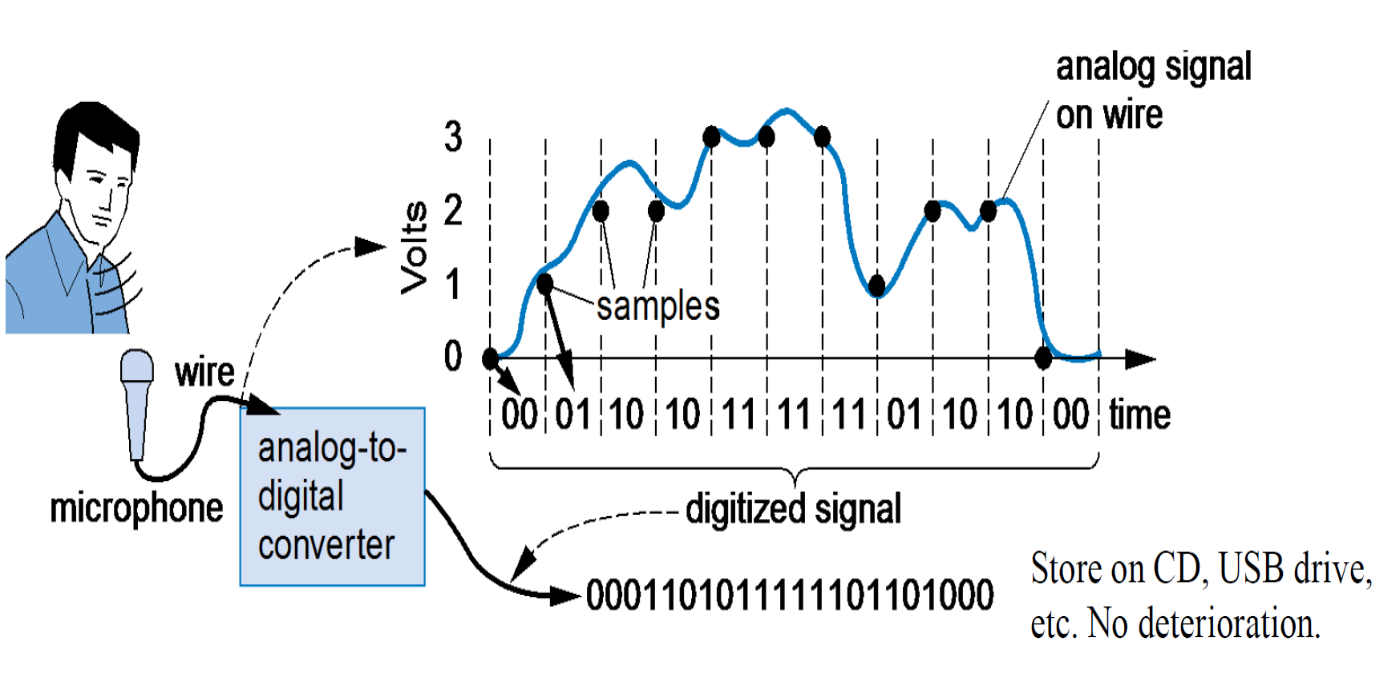
- Amplitude Quantization
- Quantization noise leads to an irreversible corruption of the signal
- More quantization levels → more closely original signal is reproduced
- Encoding
- Assign a unique binary code to each quantization level
- 2 bits required for quantization levels
e.g. 00, 01, 10, 11, etc. - N-bit code can represent quantisation levels
- 2 bits required for quantization levels
- Assign a unique binary code to each quantization level
Really easy trick for binary pattern in lecture recording
Brief recap:
- Each column follows a pattern with 0’s followed by 1’s that repeat
- for the column with the th position
- e.g. the first column of binary has
i.e. the pattern is one 0, then one 1, before repeating
Digital Number Systems
- Radix is another word for base
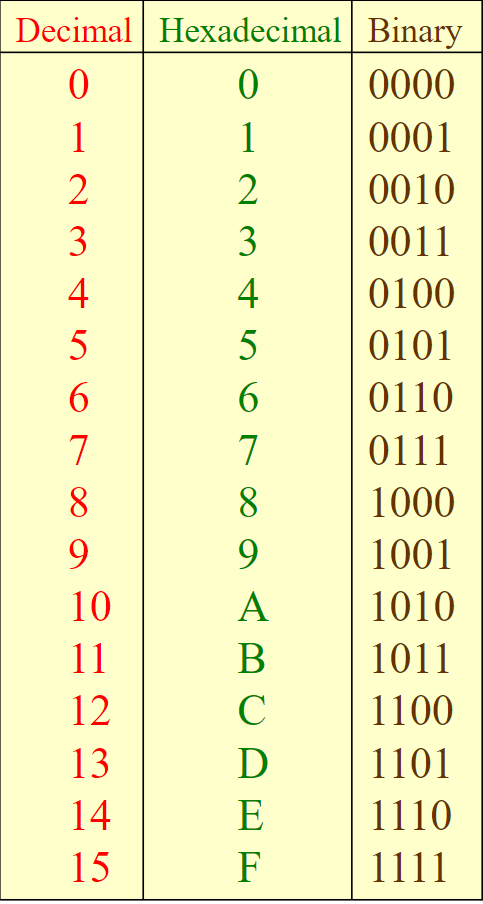
- Hexadecimal (base 16) is used to represent large binary numbers
- Goes from 1-9 and then followed by A-F
- Group bits 4 at a time starting from the right
Express in decimal:
Start by writing the column weights:
Multiply by digit:
Two Types of Digital Systems
- Combinational systems are memoryless
- Output depends only on present inputs
- Sequential systems have memory
- Outputs depend on the present inputs and on the previous inputs
- Memory content can also change as the circuit runs
- e.g. combination locks, elevators, traffic lights and computers!
Microprocessor
- Most sophisticated digital system available
- Found in a wide range of products
Transistor as Switches
- Modern digital systems are designed in CMOS technology
- MOS stands for Metal-Oxide on Semiconductor
- C stands for complementary because there are both normally-open and normally closed systems
- MOS transistors act as voltage controlled switches:
- NMOS
- If voltage is “1” (sufficiently high) then conducting path established
- PMOS
- If voltage is “0” (sufficiently low) then conducting path established
- NMOS/PMOS transistors act as complimentary switches
- NMOS
Benefits of Digital Circuits
- Tolerance to noise
- Reproducibility of information
- Flexibility and functionality
- Easier to store, transmit and manipulate information
- Shorter time to market
- Easier to design
- Digitisation results in smaller, faster and cheaper circuits