Diodes and Models
-
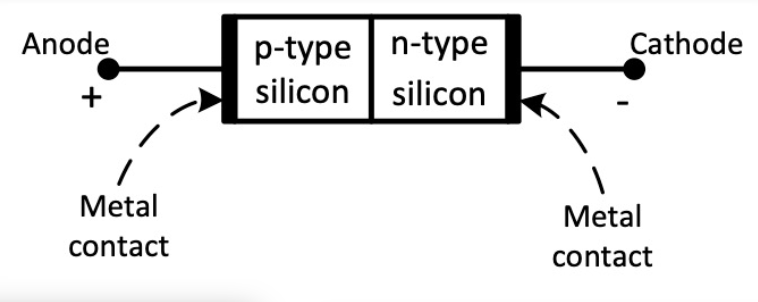
Diode made of two semiconducting materials:
- p-type + n-type -> they form a junction
-
Two terminals of a diode -> anode and cathode
- A silver line on a power diode indicates the cathode end
-
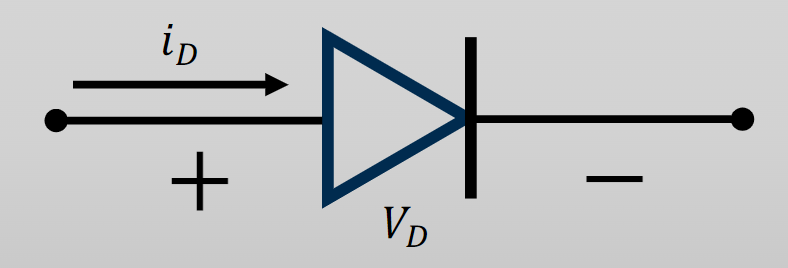
Diodes are passive elements, so current enters the ve end
Exponential Mode of Diodes
-
Diodes are non-linear elements
- Do not use superposition when a diode is present
- Do not include diode in Thevenin and Norton simplification
-
Direction of diode is important as the current vs voltage behaviour depends of its orientation in circuit
-
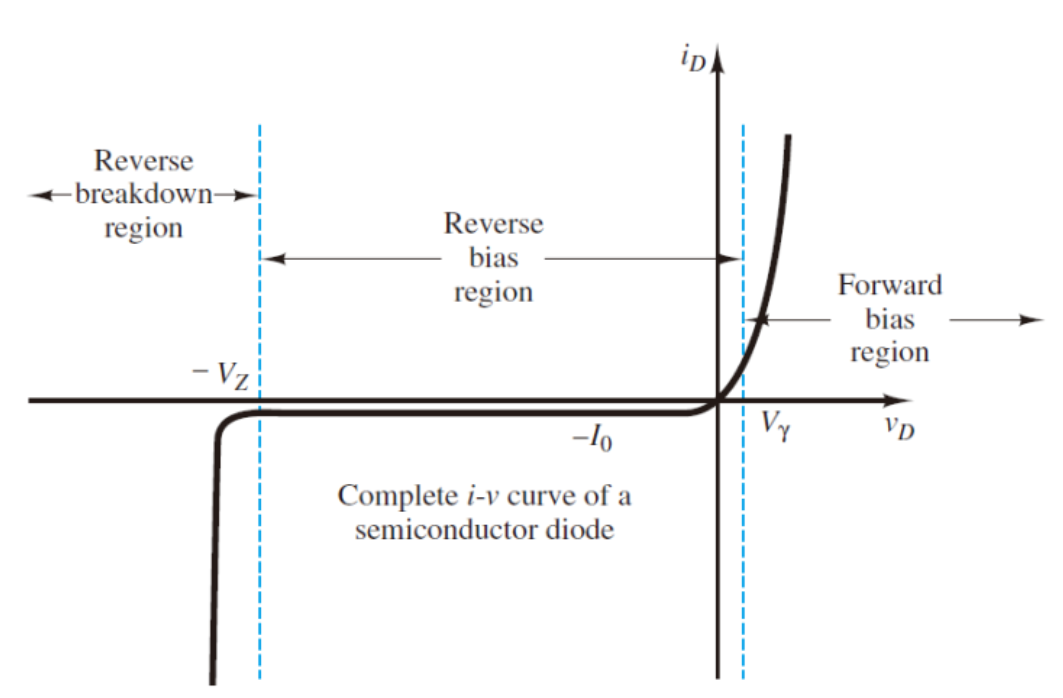
! The current-voltage characteristic of a diode is exponential
Our graph is split into three regions:
- Forward-bias region exponential increases in current
- Reverse-bias region small negative current flow
- Essentially minimises current flowing in other direction
- Essentially minimises current flowing in other direction
- Breakdown region significant current in reverse direction
- Diodes cannot handle this and will usually break
- This region is not covered in this unit
- is the reverse saturation current -> strongly temperature dependent
- Approximately doubles for every rise in temperature
- is the thermal voltage -> about 25mV at room temperature ()
PWL Model
-
Graphical analysis is complicated and impractical for complex circuits
- Graph model not used in this unit
-
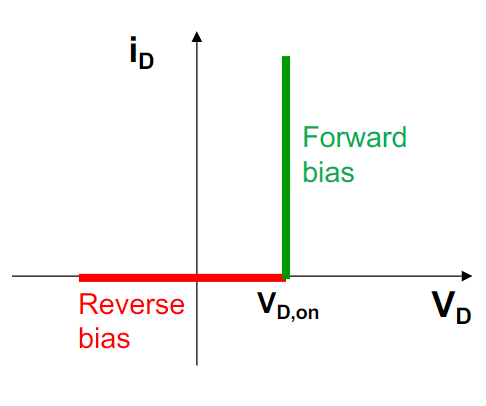
Thus, the piecewise linear model (PWL) is used instead
- It describes the gross behaviour of the device in the presence of relatively large voltages and currents
-
We treat an OFF diode as an open circuit
Only two states:
- Reverse bias -> current ()
- Forward bias -> current ()
Ideal silicon diodes have , which is always fixed
-
In calculations involving diodes, we cannot predict whether the diode is in ON or OFF mode beforehand, so we must make an assumption
-
You must include a statement such as:
- Assume diode is forward-biased (on-mode).
Thus for all positive - Then you must either prove or disprove your equations
- Assume diode is forward-biased (on-mode).
-
Replace the diode in diagram with the relevant equivalent circuit:
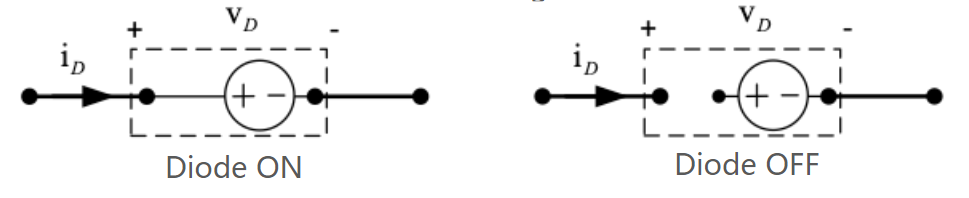
-
You can see an example in slides
Light Emitting Diodes
-
Light emitting diodes dissipates power as light emission
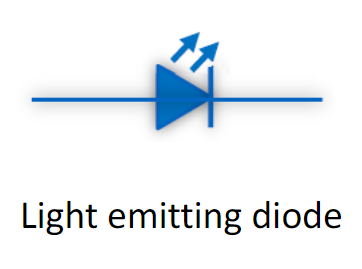
- LED behaves electrically like a diode
-
for an LED depends on emission colour
- Red-end of spectrum -> lower
- Blue end of spectrum -> higher
-
Light intensity depends on current: