Equivalent Circuits
If we are interested with only one part of the network, the remainder of the network may be replaced by a simple equivalent network
- Aim: Take a complex circuit and replace it with a similar equivalent
We can replace our complex circuit with either:
- Thevenin: Voltage source with resistor in series
- Norton: Current source with resistor in parallel
These two simple networks are the same as our practical sources!
Thevenin Theorem
- Thevenin Theorem replace network with voltage source and resistor in series
- Network must be linear
- Network only contains voltage/current sources + resistors
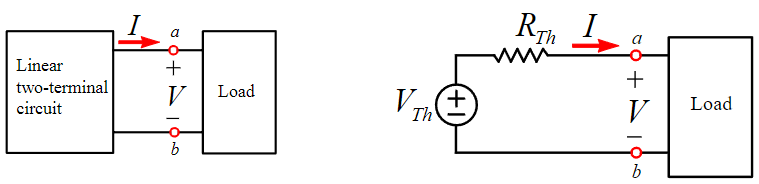
- Theorem can be expanded to fit other linear elements
e.g. capacitors and inductors
Find → equivalent voltage is the voltage difference across the open terminals with the load removed
Find → replace voltage sources with short circuits + current sources with open circuits, calculate between open terminals with load removed
Remember, a chain of resistors connected to the same node at both ends of the chain with no source (as we have removed them) do not contribute to → look for resistors that are connected in chain with the open part of the circuit
The new circuit is known as the Thevenin equivalent circuit
Norton’s Theorem
- Norton’s Theorem replace network with current source in parallel with resistor
- Network must be linear
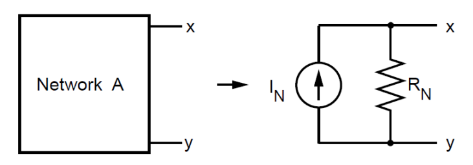
Find → replace load with short-circuit, the current flowing through short-circuit is
Find → replace load with open terminals & turn off all independent sources, calculate between open terminals with load removed