Practical Voltage Sources
-
Review: An ideal voltage source produces fixed voltage across its terminals, irrespective of current driven → see ideal voltage sources
- An ideal voltage source would have an internal of
-
A practical voltage source includes an ideal voltage source in series with an internal resistor
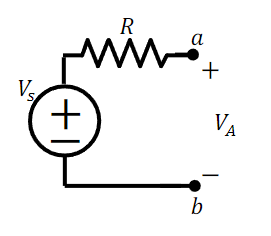
-
Part of the power generated by the voltage source is consumed by the internal resistor → reduction in the voltage generated by source
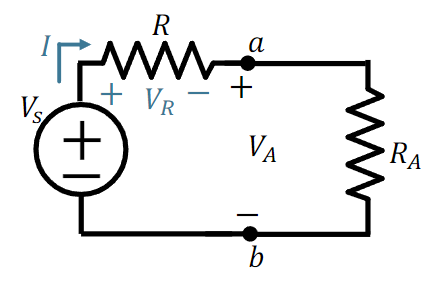
-
at output terminals is lower than voltage generated by source :
A small value of internal resistance and a large value of the load resistance are good for power transfer to load:
Practical Current Sources
-
Review: An ideal current source produces a fixed current, irrespective of voltage across its terminals → see ideal current sources
- An ideal current source has infinite internal resistance ()
-
A practical current source includes an ideal current source in parallel with an internal resistor
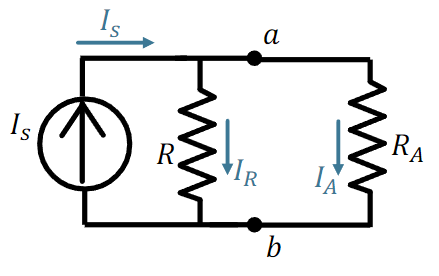
-
Part of the power generated by ideal current source is consumed by the internal resistor
-
at output terminals is lower than current generated by source :
A large value of internal resistance and small value of the load resistance are good for power transfer to load:
Superposition
- This technique applies only when your circuit system is linear
- Given is an output of a system with input , the system is said to be linear if:
- -> homogeneity
- -> additivity
Capacitors and inductors are considered linear elements
- The only non-linear elements in this unit are dials and optional amplifiers
- A circuit is linear if it contains only linear elements
Steps for superposition analysis:
- Keep only one independent source active, turn off other sources
- Replace off voltage sources -> short circuits
- Replace off current sources -> open circuits
- Repeat step 1 for each independent source
- Determine the contribution of each source on the given resistor and then sum to get the total
Read walkthrough in slides
-
Lets use this circuit as an example:
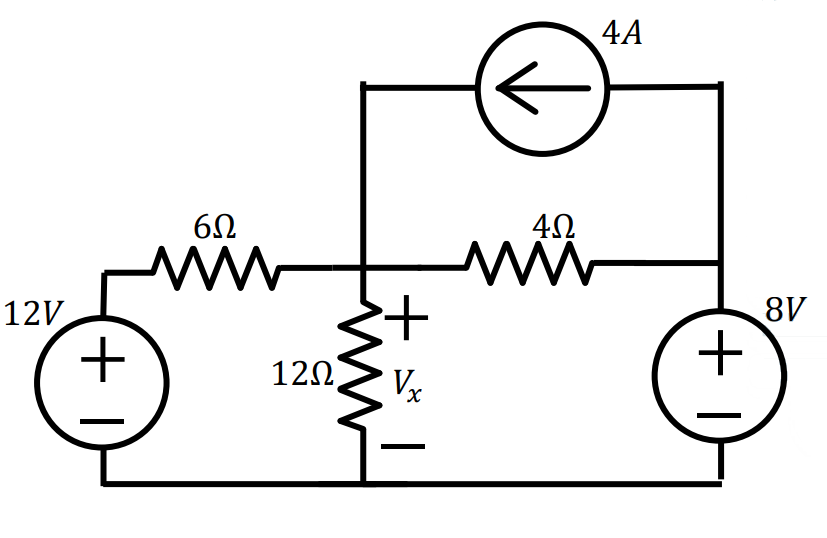
-
We need to find the value of
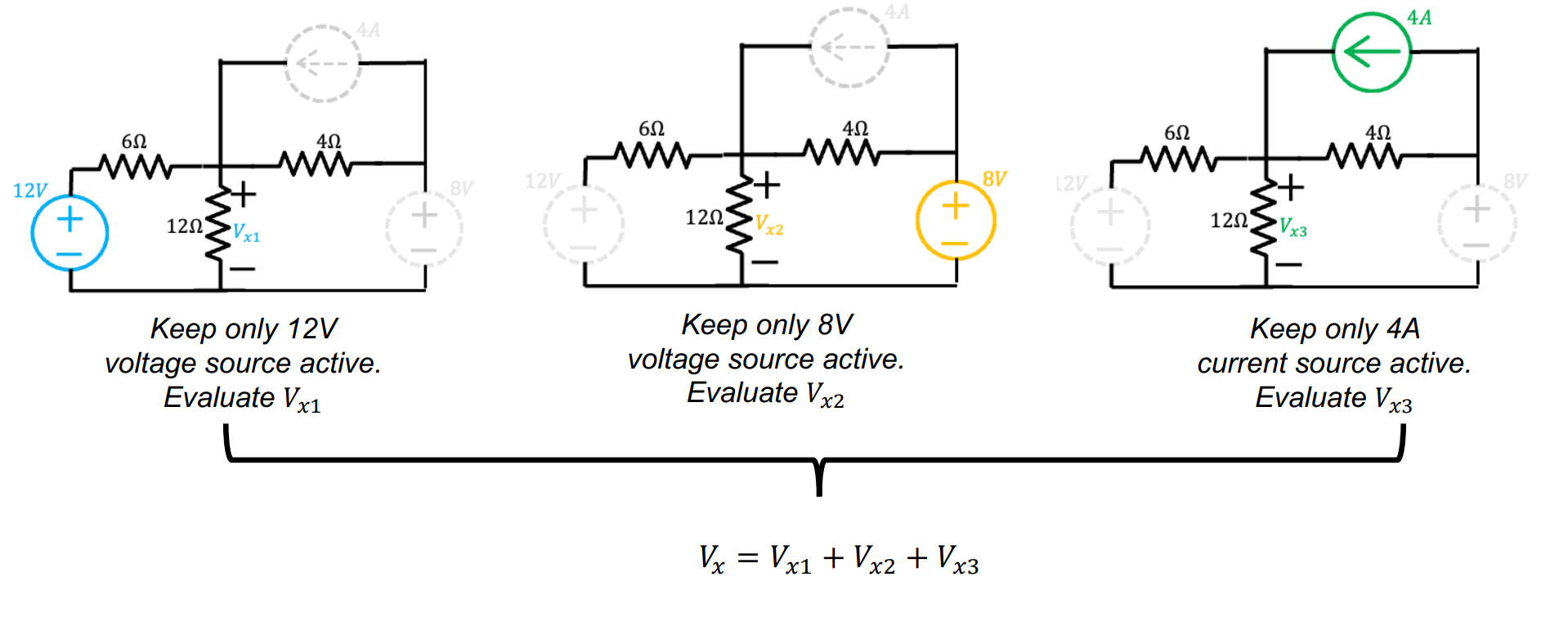
-
Example of replacing independent sources:
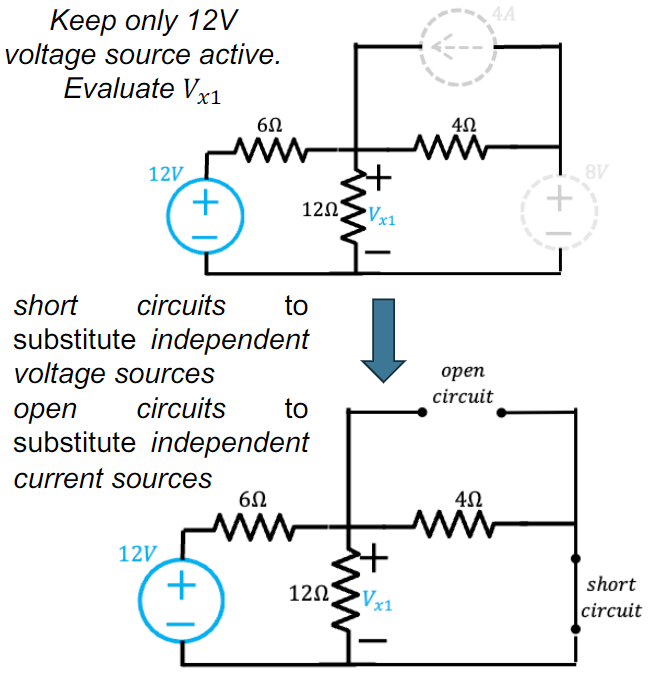
- Here, we can now use NTD to solve for
- In other cases, you can use whichever analysis technique is most efficient (e.g. VD, CD, NTD, Mesh)
- Repeat for each independent source
- Here, we can now use NTD to solve for
Source Transformation
- Consider same network “A” is attached to two separate sources
- Both sources have same source resistance
- How can we get both sources to produce the same current and voltage into network A?
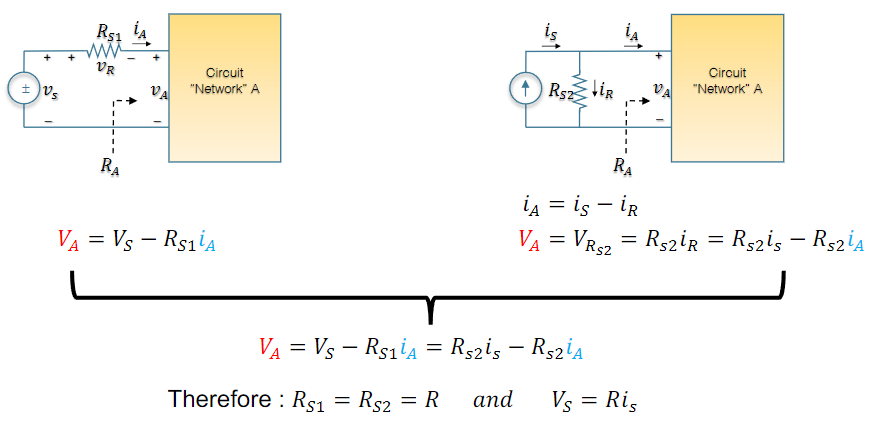
If the equation is met → both sources are identical
-
Knowing this, we can transform a voltage/current source into its alternate form in our circuit:
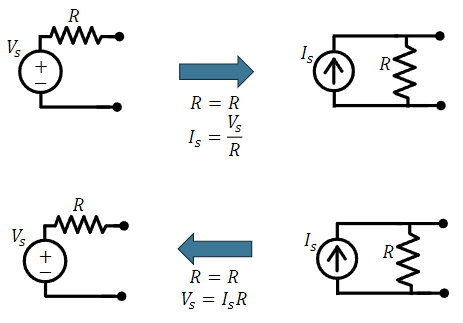
-
This is useful because we can switch a resistor from being in series and parallel in order for us to combine resistors → see slides
Source transformation is key for simplifying circuits