Power
- Power is the time rate of change of work:
- Measured in watts
Because :
For constant voltage,
We can also rearrange using Ohm’s Law:
Power associated with a circuit element can be positive or negative, depending whether element consumes or supplies energy respectively
i.e. 0.18 Watts → element supplies 0.18 Watts to the circuit
Energy
Energy:
See full derivation here
Also rewritten using Ohm’s Law as:
Lumped Circuits
- Our simple circuit theory/laws assume that electrical interactions happen instantaneously throughout a system
- We can make this assumption because if the system are physically small
- A system small enough to make this assumption is a lumped circuit
For a circuit to be lumped, wavelength of the signals travelling through the system must be bigger than the dimension of the circuit
Rule of thumb: at least 10 times →
Example Lumped Circuit Problem:
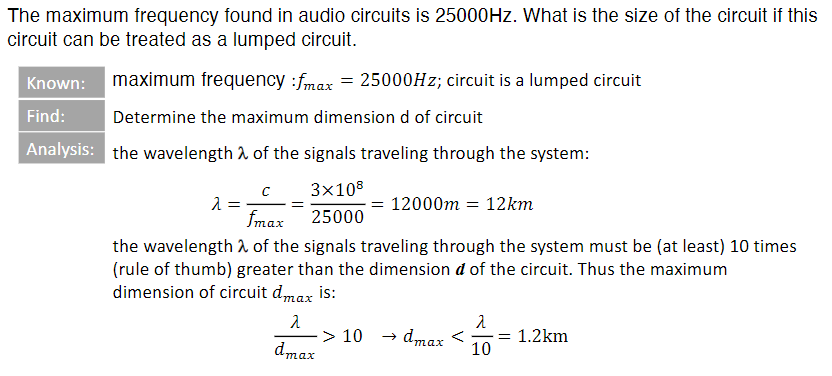
Non-lumped circuits are known as distributed circuits
e.g. modern power systems and computer networks
- A lumped circuit is one where all the terminal voltages and currents are functions of time only
- A distributed circuit is one where the terminal voltages and currents are functions of position as well as time
Circuit theory is based on the assumption that all circuit elements can be lumped, this leads to two more assumptions:
- Net charge inside system of lumped elements
- Electrical components interact solely through wires
Resistive Circuits
Different ways to connect electrical elements:
-
Series connection single node is shared by two elements exclusively
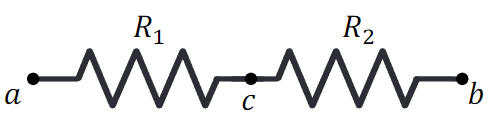
Series connection; -
Parallel connection two elements connected to same two nodes
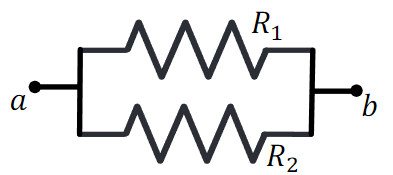
Parallel connection;
A node is defined as a point in a circuit where two or more circuit elements are interconnected
Series Connection
Two elements in series:
-
Individual voltages evaluate as and
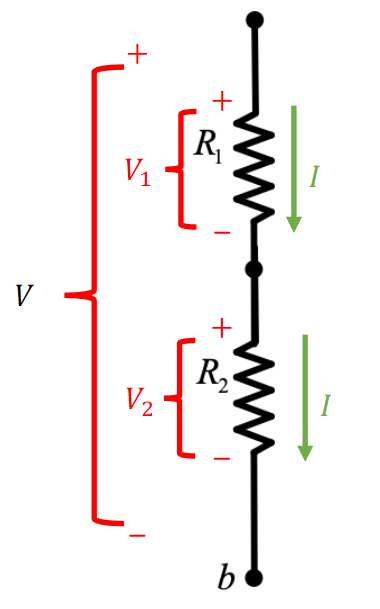
For a series connection branch (multiple parts connected in series):
- Total voltage:
- Equivalent resistance:
Voltage Division (VD)
- How do we find voltage across and ?
- Total current is:
For the voltage drop across the th resistor in series, we get:
Same current through all elements connected in series
Voltage across element is proportional to resistance
Parallel Connection
Two elements in parallel:
-
Individual currents evaluate as and
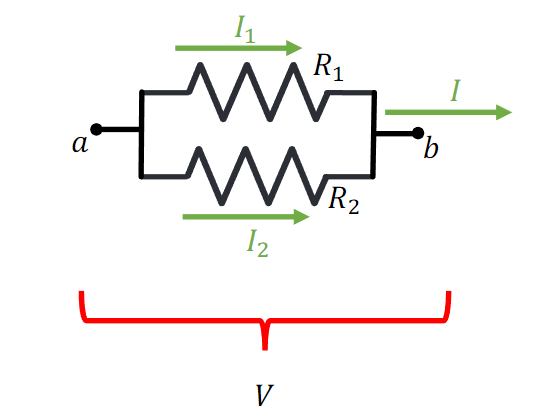
For a parallel connection branch:
- Total current:
- Equivalent resistance:
Same voltage across all elements connected in parallel
Current through element is inversely proportional to resistance
Current Division (CD)
- How do we find current through and ?
- Total voltage is:
For the current drawn by the th resistor in parallel, we get:
Complicated Circuit Simplification
- Read through: Complicated Circuit Simplification example
- There is also a good animation in the lecture recording
The aim of the simplification is to reduce the number of resistors in the circuit down by grouping series/parallel elements together
- First, identify all the nodes in the circuit diagram
- Then, group resistors that are in series or parallel
- Continue this method until you cannot reduce resistors anymore