Transformers
Recap: Transformers Y12
-
Transformers AC device used to change high voltage + low current to low voltage + high current and vice-versa without changing
-
Turn ratio () ratio of the number of turns between primary and secondary winding

- step up transformer
- step down transformer
The Ideal Transformer - Slides
Slides 42 & 50 required knowledge, slides 43-49 not needed
The Ideal Transformer
-
Current in each coil generates flux that links with other coil
- How do we quantify the flux’s direction?
-
Position dot shows whether the direction of winding of each coil are in same or opposite directions:
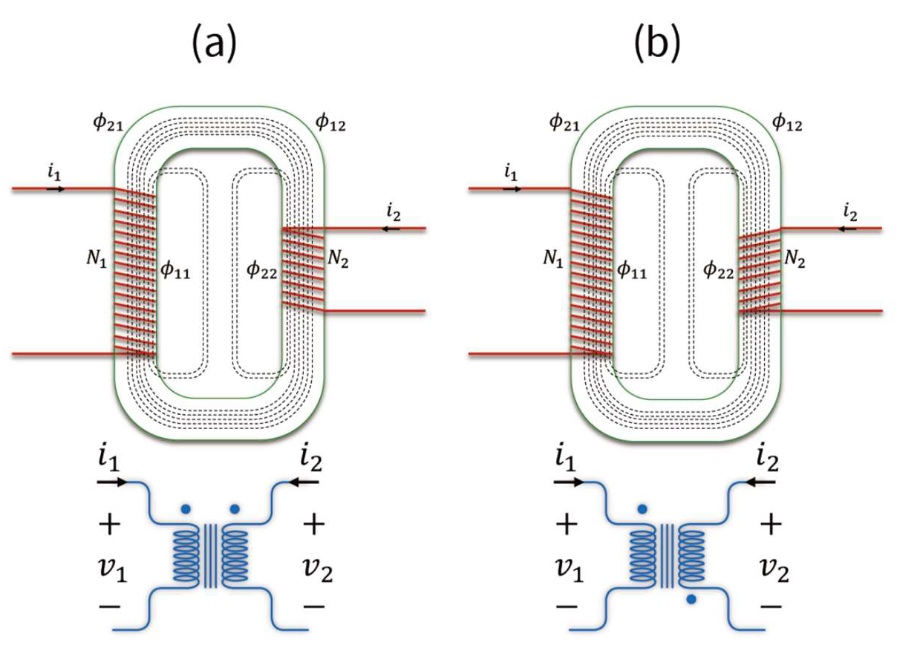
a) fluxes set up are additive, mutual inductance term is +ve- Positive → positive
b) fluxes set up are in opposition, mutual inductance terms are -ve - The voltage would actually have flipped sign for (b)
- Because of how voltage is defined above, would be negative
- Positive → positive
-
If current enters one dot, it must leave the other dot and vice-versa
Dots are aligned voltages have same direction
Dots misaligned voltages have different signs
Impedance Transformation
-
Given example setup below:
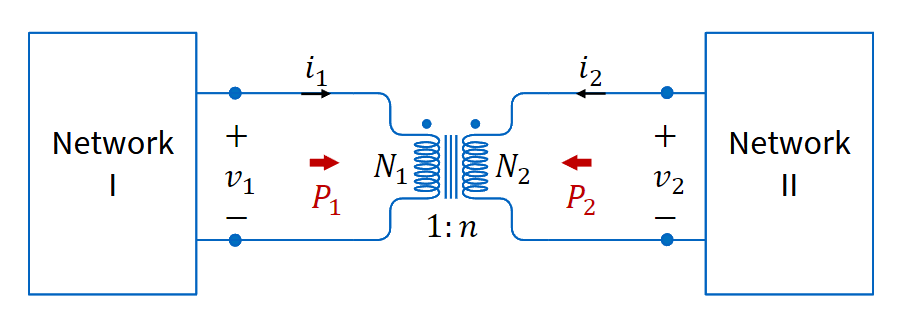
- Primary winding power:
- Secondary winding power:
-
For ideal transformer, no net power supplied to the transformer:
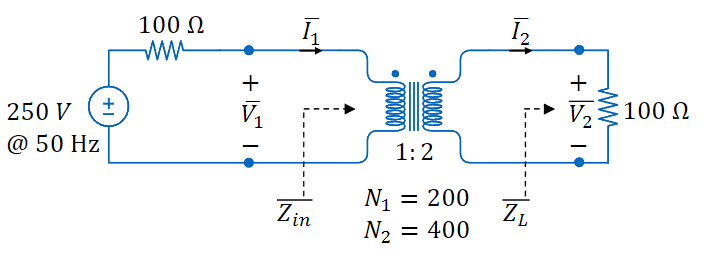
An ideal transformer can make a load impedance appear larger or smaller when viewed from the other side of the transformer
-
This is known as impedance transformation
- → transformers change voltage and current
- Thus, effective impedance can change through a transformer
Impedance Matching
- Impedance matching picking impedances to optimise power transfer
Maximum power transfer occurs when:
is the complex conjugate of the
-
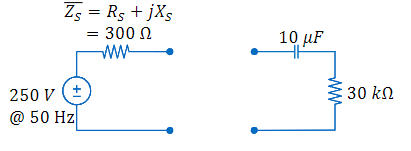
Often that real load doesn’t equal source impedance
-
We use a transformer to transform the load into desired value
-
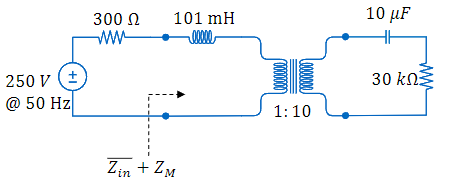
Using this equation :
- Find and choose a transformer with the correct turn ratio
- You must balance both real and imaginary components of
- Do both separately using the same equation
- To offset a capacitor, use an inductor and vice-versa
Open and Short-Circuit Loads
What happens to open/short circuits on the other side of a transformer?
- Open circuit still seen as open circuit ()
- can never truly be , always will be some very high resistance
- However, if , the very large resistance could be seen as a small value of and circuit cannot be treated as open
- Short circuit still seen as short circuit ()
- can never truly be , always will have some small resistance
- However, if , the very small value could be seen as a significant value of and circuit cannot be treated as short