Mechanical Properties
Strength how much stress can a material endure
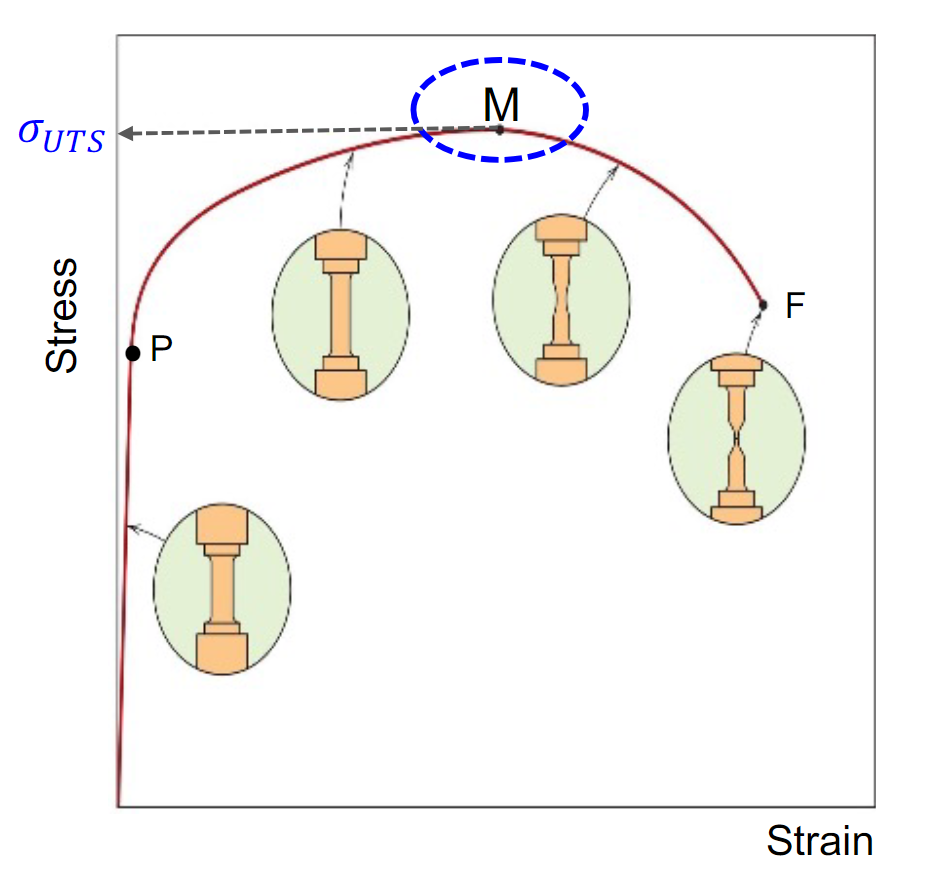
- The point where stress results in plastic deformation is known as the yield strength ()
- By convention, is defined as the stress value at 0.002 (or 0.2%) plastic strain
- Point below is known as the ultimate tensile strength ()
- Also referred to as the tensile strength,
Ductility how much deformation can a material endure
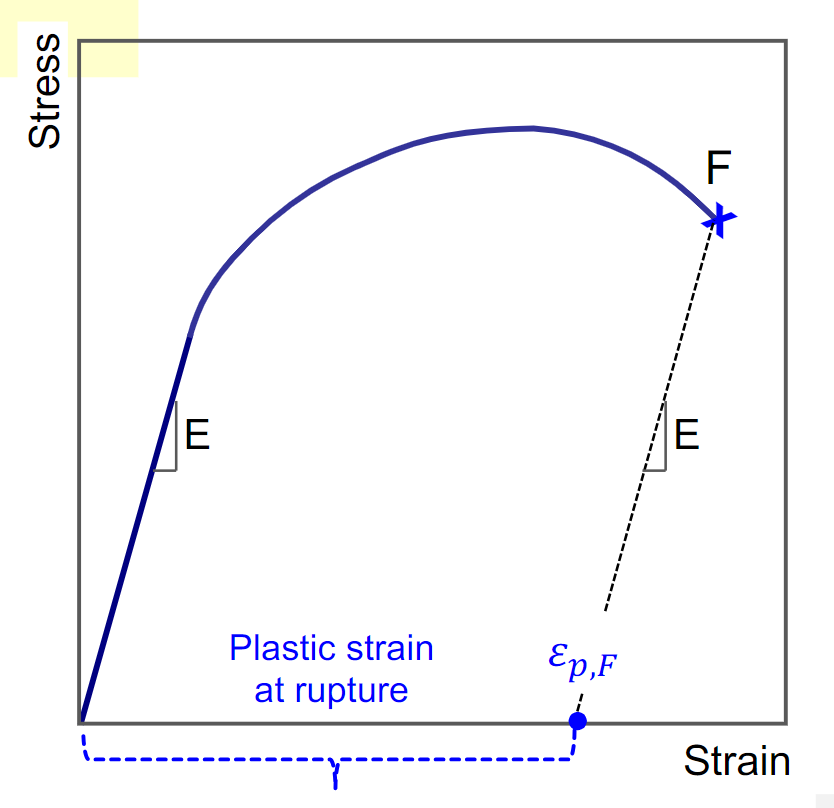
- The total plastic deformation at rupture gives us information of the material’s ductility
- Described in two property parameters:
- Percent of elongation (%EL)
- Percent of cross-sectional area reduction (%RA)
- Percent of elongation (%EL)
→ final length at rupture
→ original gauge length
→ final cross-section area at rupture
→ original cross-section area
Resilience how much elastic energy can a material store
- The material’s ability to store elastic energy is defied as Modulus of Resilience ()
- This is the area covered under the stress-strain curve in the elastic region
- This is the area covered under the stress-strain curve in the elastic region
- Has unit of (note: )
The energy of Modulus of Resilience is released when the applied stress is removed. This is the basis for the design of all springs which stores and releases elastic energy!
Toughness how much energy can a material absorb before rupture
- Measure of a material’s ability to absorb energy and plastically deform up to rupture
- It is defined as the area under the entire stress-strain curve of a material
There are graphs and data that describes what properties our engineering materials usually exhibit in the slides
Design Safety Factors
- To ensure safety against failure of design, we apply a safety factor to material property requirement in design
- This is to account for any unexpected loads and conditions
- A safety factor is simply expressed as:
is the yield strength of the material used
is the expected work stress the material is expected to endure in service