ENSC1004 - Lecture 5
Bonding & Properties of Materials - Slides
Interatomic Bonding Force
- Coulombic Attraction: the attraction force () between two oppositely charged species follows the relationship:
- the charge of species 1 and 2, respectively
- separation of the charge centres
- a proportionality constant
- You have seen this equation in Y11+12 Physics!
- However, in this context, we are applying it to charged attraction between ions at the sub-atomic level
There is always a repulsive force () from the overlapping of electron clouds and two positively charged nuclei when two charged species come too close. increases exponentially as decreases, which prevents the species from getting too close.
Our net force is therefore given by:
- When is equal to , (i.e. ), the equilibrium bond length occurs
- Attraction and repulsion are perfectly balanced
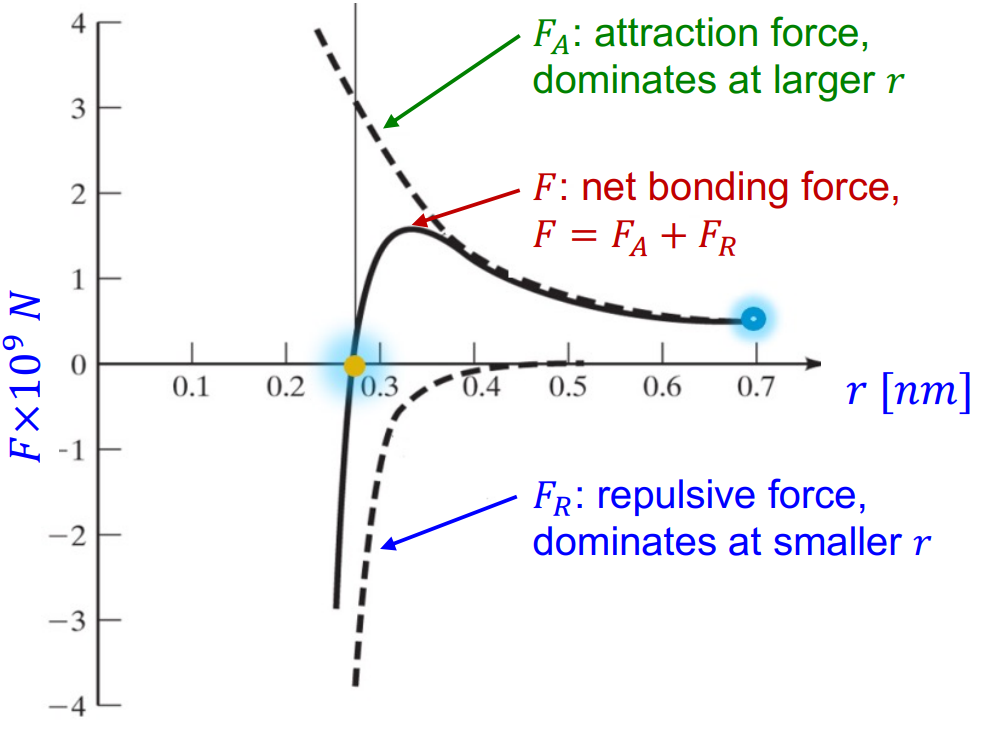
Bonding Force and Equilibrium Separation
- Atoms will stay at their equilibrium separation ()
- Pulling atoms apart → resisted by attractive force
- Compressing atoms → resisted by repulsive force
- Here is an curve:
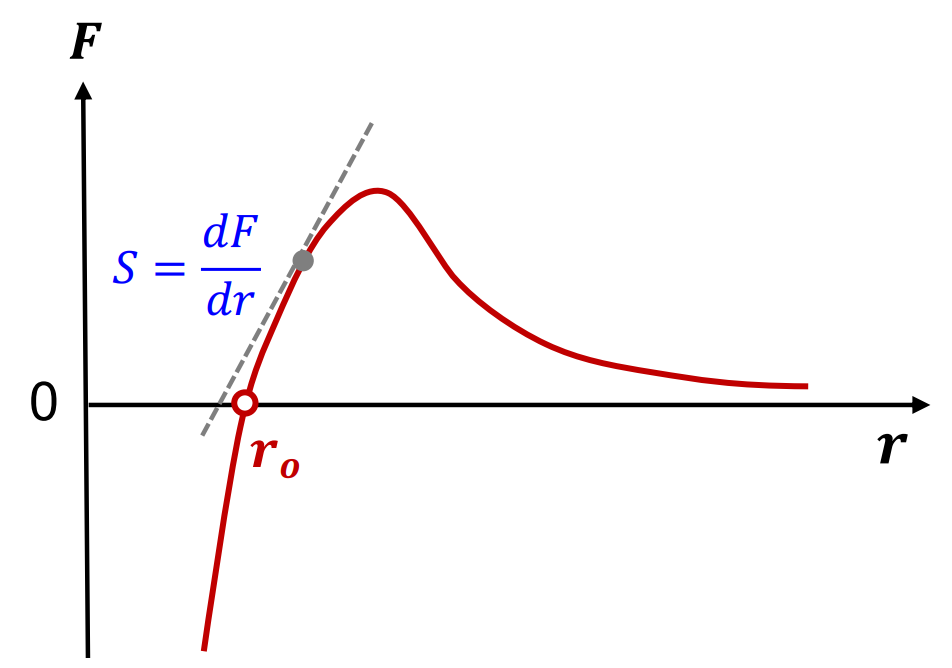
- The gradient represents the bond stiffness
- Different materials have different bond stiffness
- This is the origin of the elastic modulus of materials,
- The gradient represents the bond stiffness
- While is a function of , in practice, is very small for elastic deformation and thus is regarded as a constant
The maximum force () a bond can endure defines the theoretical strength of the material. The stronger the bonding, the higher the maximum force required to break the bond. Thus, the stronger the bonding the higher the theoretical strength of the material.
Bonding Energy
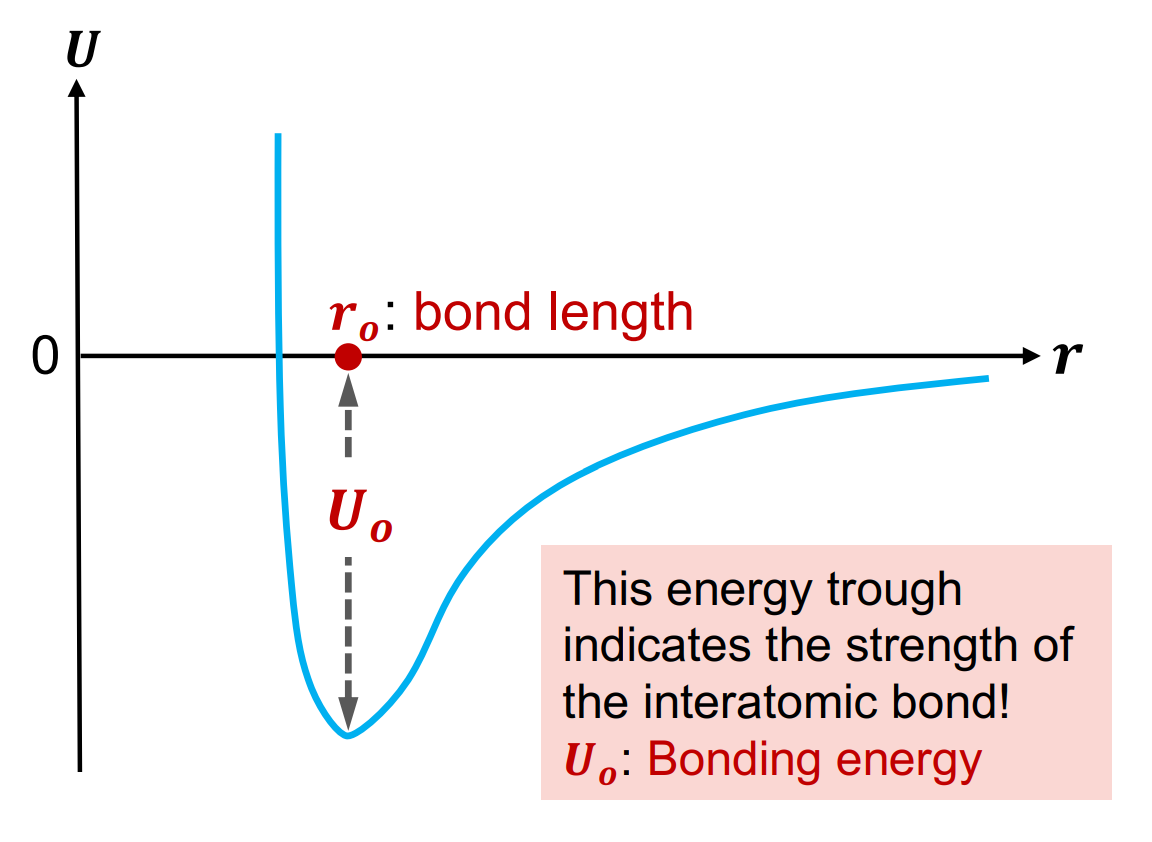
- The need of a force to pull/compress atoms implies work done
- Work is to counteract the bonding potential energy
- This potential energy () is expressed as:
Thermal Expansion
- A solid expands on heating and contracts on cooling
- Coefficient of thermal expansion gives the rate of expansion/contraction
- This is a material property
Given by:
A higher value for will mean it is easier for a material to expand when heat is applied to it
At temperatures above , atoms are energised above minimum energy state and vibrate about equilibrium position