Introduction to Non-Ferrous Alloys
- Ferrous alloys can’t always meet all of our requirements, which is why we need a wide range of different alloys all with different properties
Some non-ferrous alloy examples:
- Cu alloys
- Al alloys
- Ti and Mg alloys
- Ni alloys
- Superalloys (operate normally at high temperatures)
- Refractory metals
Alloying materials usually enhances strength and corrosion resistance or is used to stabilise a material
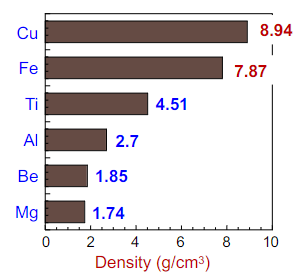
- Light alloys demand for high strength-to-weight materials has promoted the development of light non-ferrous alloys
Copper Alloys
- Two commercially available forms:
- Electrolytic tough pitch (ETP) copper
- Deoxidised high phosphorus (DHP) copper
General properties:
- High melting temperature: 1085
- High electrical conductivity (2nd highest)
- High thermal conductivity
- Soft and ductile
- Corrosion resistant
Main applications:
- ETP → high electrical conductivity
- Used as electrical conductors
- DHP → high thermal conductivity
- Used for piping, tubing and heat exchangers
Bronze
- Up to 13% Sn (Tin)
- Silicon bronze (Cu-Sn-Si, < 4%)
- Aluminium bronze (Cu-Al, 8-12%)
General properties:
- High strength
- Corrosion resistance
- Anti-marine fouling in seawater
- Excellent castability
- Good lubricated metal-metal wear resistance
Brass
- Cu-Zn alloys, up to 50% Zn
Types of Brass:
- -brass (up to ~35% Zn) → FCC, relatively soft and ductile
- Red-brass (15% Zn) → gain strength, sacrifices conductivity
- Yellow-brass (30% Zn) → strength increases and cost reduces with ↑ Zn
- Admiralty brass (30% Zn + 1% Sn) → ↑ seawater corrosion resistance
As seen above, alloying can reduce the effectiveness of some properties in exchange for improving another
Beryllium Copper
- Be-Cu (1.5-2.0% Be)
- Increases strength but does not sacrifice conductivity
General properties:
- High strength (comparable to steels)
- Corrosion resistance
- Used for springs, bearings, high-strength components
Aluminium Alloys
- Pure Al too soft for structural applications
- It is alloyed to improve strength
- Typically alloyed with Cu, Mn, Mg, Zn or Si
General properties:
- Melting temperature: 660
- High electrical conductivity (~60% of that of Cu)
- High thermal conductivity
- High oxidation resistance
Mechanical properties:
- Elastic modulus: ~ 70 GPa, low
- Yield strength: 100 ~ 400 MPa
- No ductile-brittle transition at low temperatures
- Ductile and good formability
- Easy machining
Processing characteristics:
- Castable
- Mostly weldable
- Easy mechanical processing
Other characteristics:
- Non-magnetic
- Non-toxic
- Most recyclable metal
Aluminium Alloy Applications
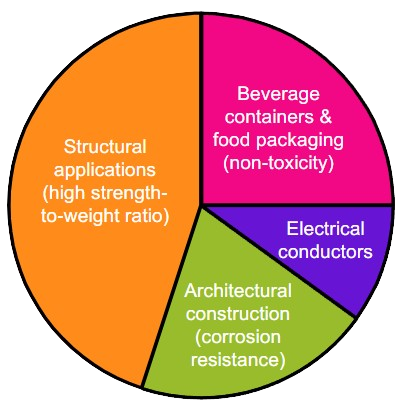
- Aluminium alloys are used mostly for four reasons:
- Specific strength (strength-to-weight ratio)
- Corrosion resistance
- Electrical conductivity
- Non-toxicity
Problems in Applications:
- Low elastic modulus
- Low fatigue resistance - no endurance limit
- Unsuitable at elevated temperatures (low T)
- Prone to pitting in solutions containing heavy ions
- Attacked readily by strong alkaline (caustic) solutions
- Anodic to most metals