Introduction
- Most engineering metallic materials are alloys
Pure metals are alloyed to:
- Enhance properties, such as strength, hardness or corrosion resistance
- Create new properties, such as shape memory or magnetic properties
Classification of Engineering Alloys
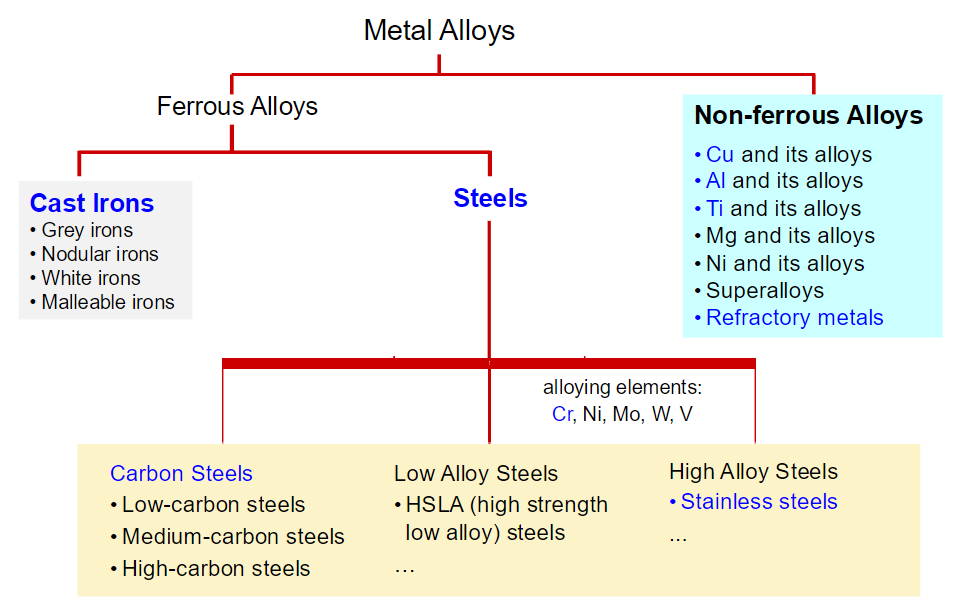
Ferrous Alloys
- Iron is one of the most used elements in the world
- 2.5 billion tons of iron ore mined in 2019
- Key element in steel
Steels
Nearly all steels produced as either:
- Cast products produced by casting, produces near-finish components
- Wrought products semi-processes raw materials for further fabrication into components
Steels are roughly Iron (Fe) + Carbon (C) alloys
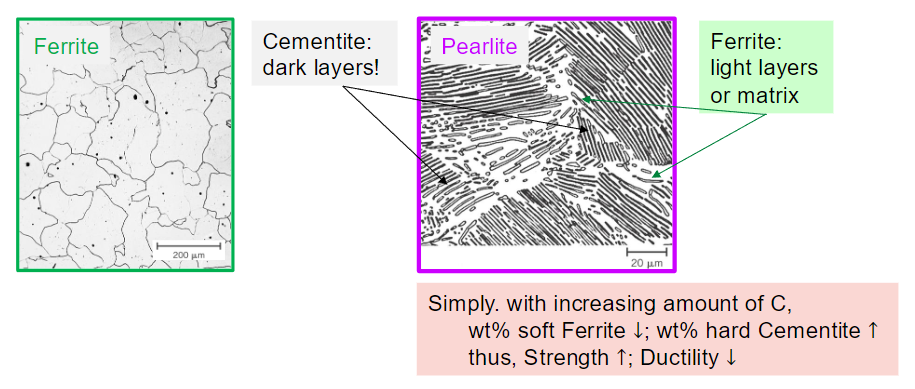
- Increasing C content leads to:
- Increased strength and hardness
- Decreased ductility and toughness
Main microstructure characteristics in steels:
- Two dominant phases:
- Ferrite: Fe-C
- Solid solution; appear as equiaxial grains
- A soft & ductile phase
- Cementite: FEC
- Typically of platelike morphology
- A hard & brittle phase
- Ferrite: Fe-C
- Unique microstructure:
- Pearlite: layered structure of ferrite and cementite
- Good strength & toughness
Low Carbon Steels (Mild Steels)
Carbon: 0.1-0.3 wt%
Properties:
- Strength: relatively low (𝜎𝑦 =250-400 MPa)
- Ductility: high (~30% elongation)
- Weldability: excellent
- Relative cost: set as 1
Used where low cost, high formability are needed
- Typical applications: structural panels (cars, train carriages…), containers, pipes, panels, sheets, wires, etc.
Medium Carbon Steels (Structure Steels)
Carbon: 0.35-0.55 wt%
Properties:
- Strength:
1.5 times of low carbon steel (400800 MPa) - Ductility: ~75% of low carbon steel (~25% elongation)
- Weldable, weldability decreases with increased C%
- Relative cost: 1.1
Used where high strength/toughness is required
- Typical applications (load bearing): crankshafts, bolts, gears, link rods, structures, heavy-duty machinery, mining equipment, pressure vessels, railway tracks, train wheels, axles, chassis…
Higher Carbon Steels (Spring and Tool Steels)
Carbon:
- 0.6-0.8 wt% (spring)
- 0.8-1.2 wt% (tool)
Properties:
- Strength: ~ 2-7 times of low carbon steels
- Ductility: < 50% of low carbon steels
- Weldability: poor
- Machinability: poor
- Relative cost: 1.2 – 1.5
Used where high strength/high hardness is required, often ductility/toughness sacrificed
- Typical applications: springs, hammers, chisels, drill bits, knives, saw blades, extrusion dies, punches, cutting tools and other wear resistant applications
Stainless Steels
- Has 12 wt% Cr by definition
- The Cr lets the steel form CrO which protects it from corrosion
- Reduced level of C to prevent CrC forming (causes cracks)
Properties:
- Strength: 𝜎𝑦 ~ 200-1600 MPa
- Ductility: %EL~ 2-40%
- Relative cost: 4 to 10
Cast Irons
- Iron (Fe) + Carbon (2.5-4.3 wt%)
- Much higher carbon content than steels
- Higher C → lower melting temperature of the alloys
- Enables easier casting
- Higher C → Formation of graphite
Four Main Types of Cast Irons:
- Grey irons
- Nodular irons
- White irons
- Malleable irons
Grey Cast Irons
Microstructure:
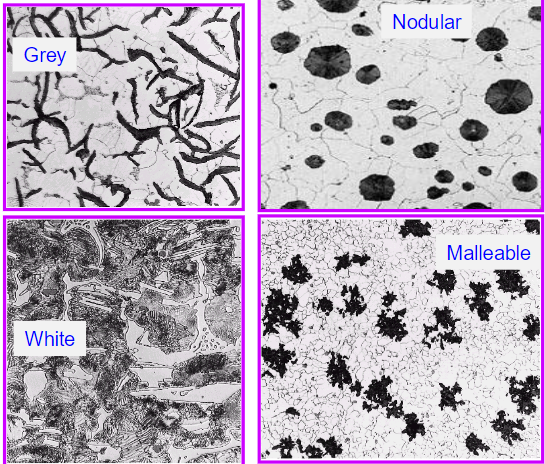
- Graphite flakes embedded in ferrite and/or pearlite matrix, ‘cutting’ the continuity of the matrix and rendering the grey irons of high brittleness
Mechanical/processing characteristics:
- High strength in compression, but brittle in tension
- Graphite flakes act as cracks
- High damping capacity
- Good metal-metal wear resistance when lubricated
- Excellent castability
- Cheap to produce
Typical applications: engine cylinders, pistons, gear box casing, transmission casing, machine tool bases, balance weight of large cranes, large diameter underground pipework…
- Casting enables making of complex shapes that are difficult to machine
Ductile (Nodular) Cast Irons
Microstructure:
- Graphite nodules in ferrite and/or pearlite matrix, which significantly improve the toughness and ductility
Mechanical/processing characteristics:
- Much stronger and tougher than grey irons
- More expensive than grey irons
Typical applications: produced for higher specification applications, including gears, crankshafts, pump bodies, pressure valves, rollers, …
White Cast Irons
Microstructure:
- Cementite plates (light areas) embedded in pearlite matrix (dark areas)
Production:
- Produced with low Si (< 1.0 wt%) cast irons under rapid cooling (thus stabilizing FeC and preventing graphite formation)
- Mostly produced as an intermediary to produce malleable irons
Properties:
- High hardness & brittleness
Typical applications: suited for abrasion wear resistant applications, such as ball mill lining tiles, slurry pipeline elbows, slurry pump bodies, earth moving equipment and jaw crushers …
Malleable Cast Irons
Microstructure:
- Graphite rosettes embedded in ferrite or (ferrite + pearlite) matrix
Production:
- Heat treatment of white cast irons to decompose FeC into ferrite and graphite, as following:
- Heat to 900 °C - 950 °C for 40 hours
- Cool to 700 °C & hold for another 40 hours
- This extensive heat treatment procedure makes malleable irons expensive to produce
Properties:
- Stronger, tougher, much more ductile than grey irons and comparable to nodular irons
- Have certain capacity to take shock loading, bending and tension
- Suitable for thin-wall casting
Typical applications: gear box casing, transmission casing, differential casing, …