Angular momentum () is a measure of a body’s quantity of rotational motion. It applies equally to a particle orbiting a point as to a spinning rigid body.
Angular Momentum of a Particle
For a particle with linear momentum , angular momentum is defined as the “moment” of the particles linear motion about :
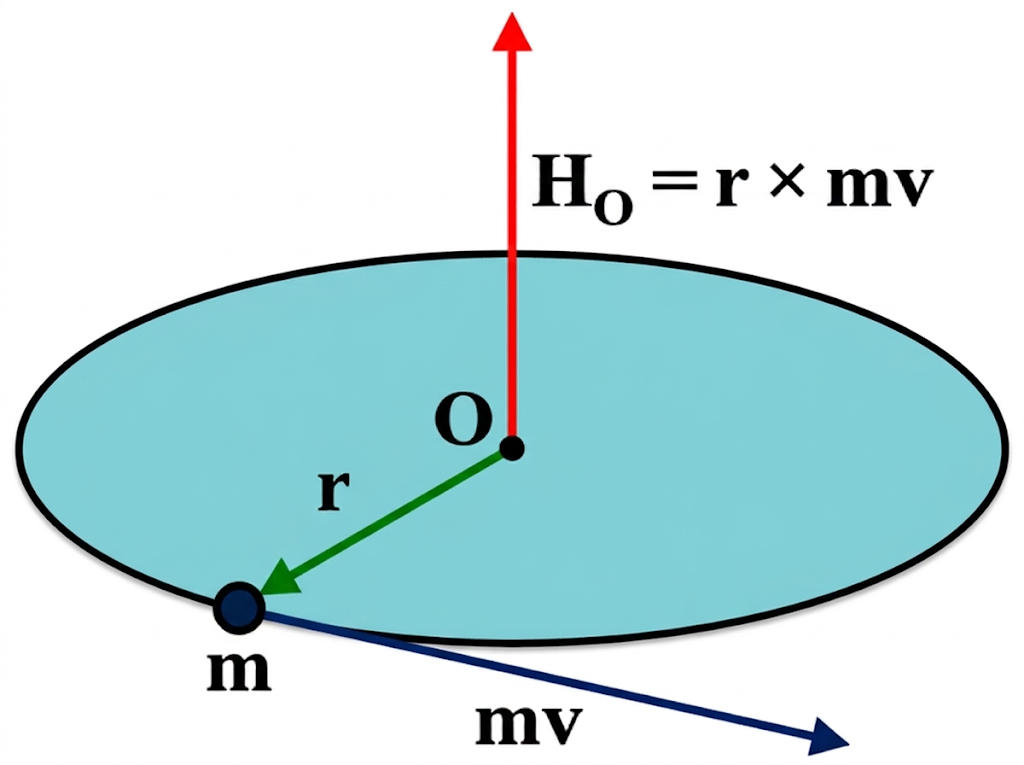
In 2D, this reduces to a scalar where is the perpendicular distance from :
Angular Momentum of a Rigid Body
Integrating the particle definition over every point in a rigid body gives us equation with angular velocity and with mass moment of inertia :
Principle of Angular Impulse and Momentum
Applying a moment about a point over a period of time changes a body’s angular momentum about that same point:
For a constant net moment, this simplifies to:
Angular Impulse
is known as the angular impulse. It represents the net torque accumulated over time.
If there are no meaningful angular impulses about point , then angular momentum is conserved.
await dv.view("Scripts/topic-backlinks");