Gyroscopic motion is the motion of a spinning rigid body whose spin axis is also rotating or precessing in 3D space. Spinning objects resist changes in its axis of rotation due to their angular momentum.
Velocity and Acceleration of a 3D Rigid Body
For a point at from a fixed point on a body with angular velocity :
Constant Spin Rate
If is constant, we can calculate the total angular velocity of the object using this simplified equation:
Definition bq
is the angular velocity of the spin axis itself.
Effect of a Small Moment on Spin Axis
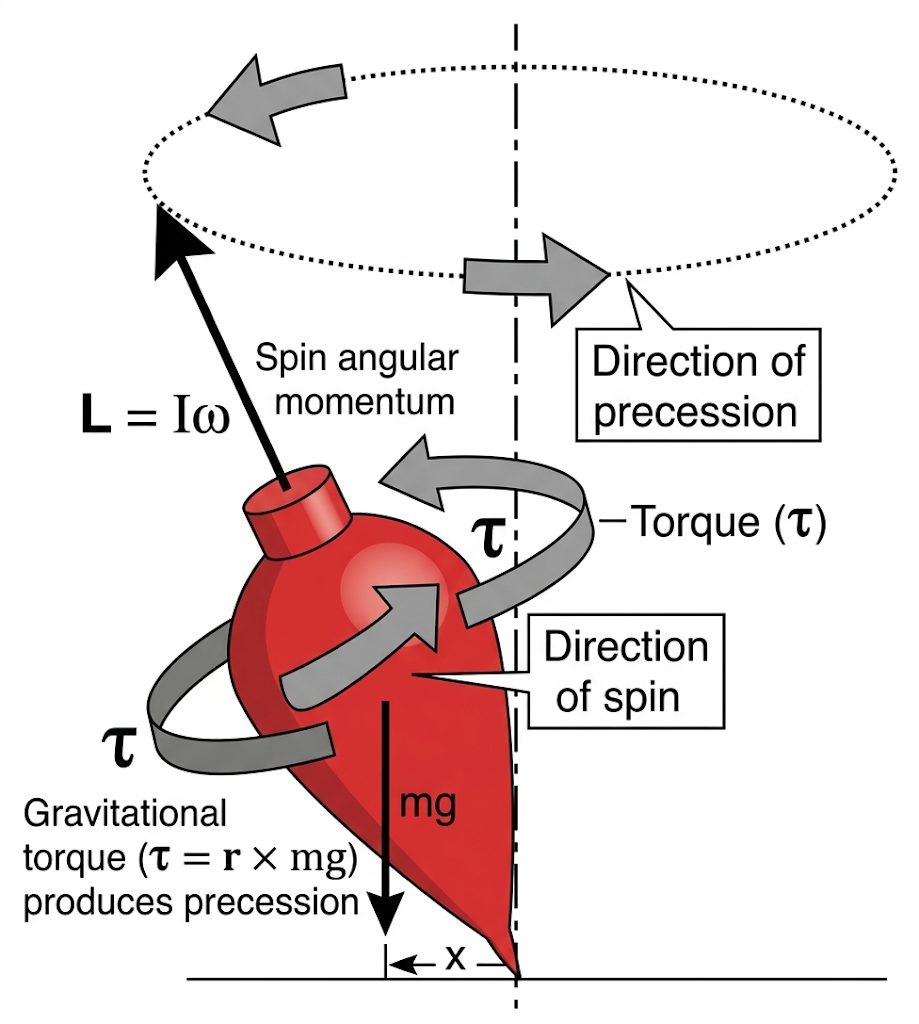
Precession refers to the motion of a spinning body’s spin axis when an external moment is applied to it. Precession rate () is the speed at which the spin axis rotates or wobbles.
As seen in the equation above, the faster an object is spinning () or the larger its mass moment of inertia () about the spin axis, the slower the precession rate () for a given external moment ().
Quote bq
We assume for all following equations that spin rate greatly exceeds precession rate (i.e. the gyroscopic effect).
Vector Form and Direction:
The direction of precession can be determined using the cross product relationship, where .
The spin axis always turns towards the direction of the applied moment vector ().
Steady Precession of a Symmetric Top
A symmetric top, with mass and spin rate , tilts at an angle from the vertical. The centre of mass is a distance from the pivot .
Gravity pulls down on , creating a torque (moment ) :
The precession rate is about the vertical, thus the component of normal to the spin axis is . Then gives:
Comment bq
This is known as steady precession where is constant and is independent of .
Nutation
If the moment or the starting conditions don’t match steady precession then and oscillates. This is known as unsteady precession which is called nutation.
await dv.view("Scripts/topic-backlinks");