Linear momentum () is a measure of an object’s quantity of translational motion. It applies equally to a single particle as to a rigid body.
Linear Momentum of a Particle
Momentum is the product of an object’s mass and velocity:
Linear Momentum of a Rigid Body
Integrating the particle definition over every point in a rigid body collapses to the same form, evaluated at the mass centre :
Principle of Linear Impulse and Momentum
The Principle of Linear Impulse and Momentum states that the initial linear momentum of an object plus the total linear impulse applied equals its final linear momentum.
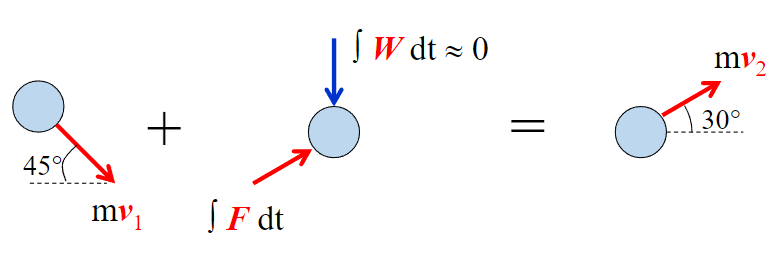
For a constant net force (), this simplifies to:
Impulse
Impulse is the measure of how much a force changes an object’s momentum over a specific period of time.
If is constant, than impulse is simplified to:
Summary bq
For short events (such as impacts), the impulse due to weight force is considered negligible and is ignored in our equation.
If there is no meaningful external impulses, then momentum is conserved.
await dv.view("Scripts/topic-backlinks");