Hyatt Regency Walkway
- Walkway collapsed killing 114 people, why?
- Two reasons below
Original design was changed, but new forces were not checked properly:
-
Original: one continuous rod runs from ceiling through both walkways
-
New: rod split into two shorter rods
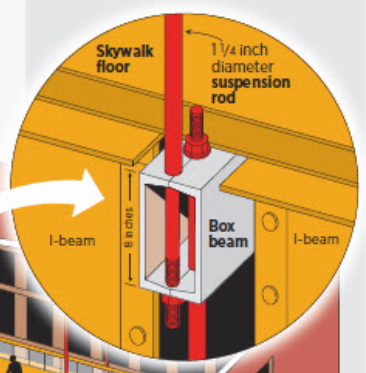
- Top rod: ceiling → upper walkway
- Bottom rod: upper walkway → lower walkway
-
This doubled the load on the upper walkway causing it to collapse
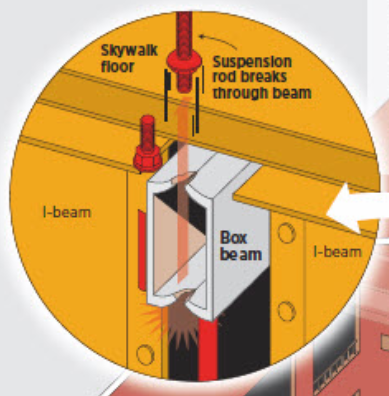
- Upper walkway holds both its own weight and lower walkway’s
- Engineers did not redraw FBD for the new design and did not realise that load had doubled on the box beam
Use of box beams in original design were flawed:
- Box beams are a very weak connection
- The sides of the box’s walls are thin and weak while being impacted the most from the load
- Box beams were requested by the architects for aesthetic reasons
Torsion
- Torsion refers to twisting of a straight bar when loaded by moments
- Moments (or torques) produce rotation about longitudinal axis
- Torque twisting moment
- Shaft cylindrical member subject to torque ()
- Transmits power through rotation
- revolutions per minute
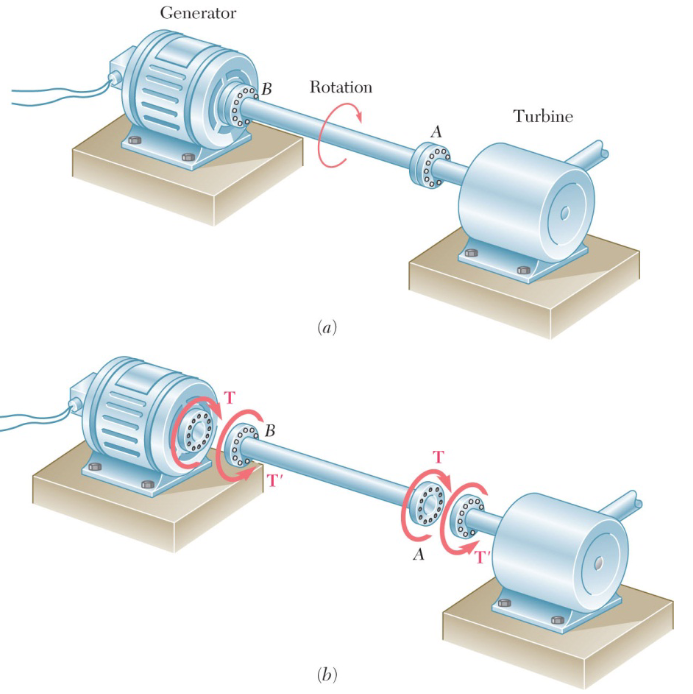
- Turbine applies torque
- Generator provides reaction torque
- Shaft transmits torque between them
Model of a Shaft
-
Torque creates shear stress on cross-sections of shaft
-
Internal equilibrium requires matching shear stresses
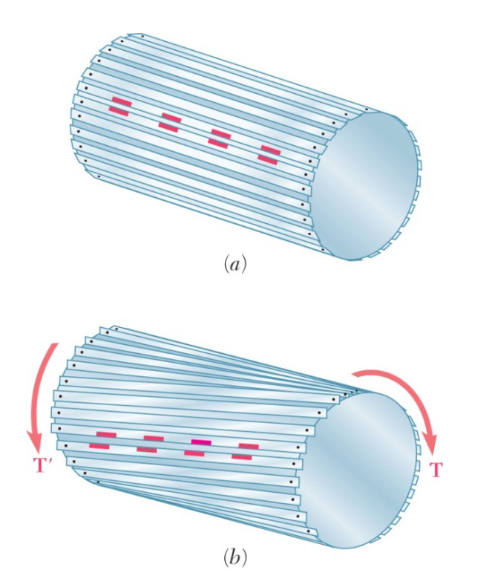
-
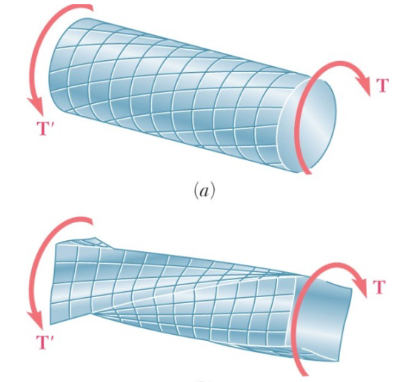
This can be visualised (as seen above) using slats:
- The slats slide with respect to each other when equal and opposite torques are applied at each end
- Each slat rotates relative to others, but stays rigid internally
Each “slice” of the shaft rotates different from its neighbour, but in each slice, the rotation angle is constant, i.e. the angle of rotation can be thought of as a function of length.
Shear Stresses in Circular Shafts
- See: Cylindrical Coordinates
- Simpler than using cartesian coordinates as ↓
- ! Stress/strain increases with radius
- Max stress occurs on the edge of the shaft
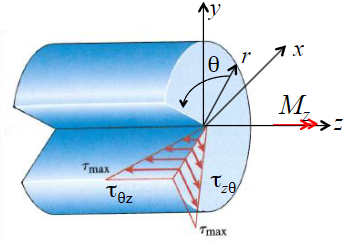
- Usually for torsion related problems, the -axis runs through the shaft
- moment around -axis ()
- shear stress acting on surface perpendicular to
- First index = normal direction of surface
- Second index = direction of force
- Cartesian form:
Angle of Twist
-
Angle of twist () is angular deformation of a shaft subject to torque
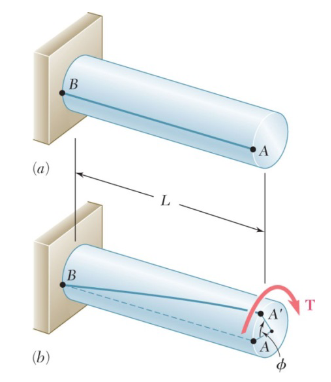
-
proportional to applied torque and shaft length:
-
Circular shaft → cross-section undistorted under torsion
-
Non-circular shaft → cross-section distorted under torsion