Energy Storage Elements
- Energy storage elements do not dissipate but store energy
- Capacitors and inductors are energy storage elements
Capacitors
-
Capacitors store energy in the electric field
- It is both a passive and linear circuit element
-
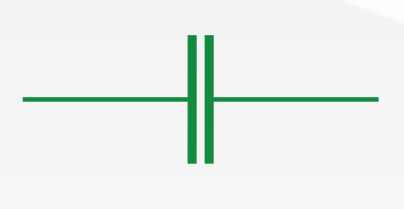
Symbol for a capacitor:
-
Structure of a capacitor:
- Two parallel, conducting plates + insulating gap in-between
- Voltage causes:
- +ve charge on one plate
- -ve charge on other plate
- This creates electric field that stores energy
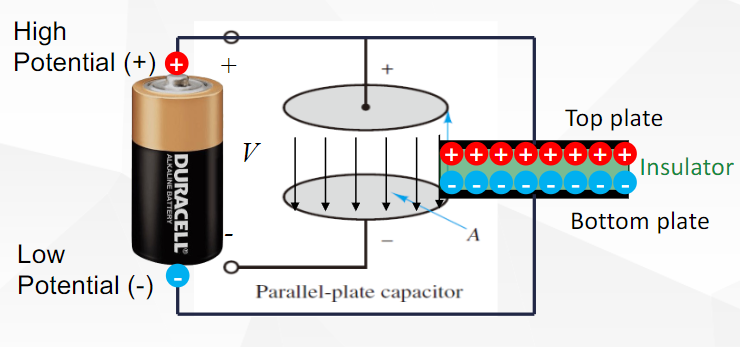
Capacitance relates voltage () applied to the charge () generated:
- is the capacitance, measured in Farad (F)
Capacitance Relationships
Current-voltage relationship for a capacitor:
- Current depends on how fast voltage changes
- In DC current with constant voltage → no current
Voltage-current relationship for a capacitor:
- Voltage must be continuous as its calculated from integration
- Current however, can be discontinuous
Energy stored in capacitor:
Equivalent Capacitance
- Capacitors in parallel combine by addition, like resistors in series:
- Capacitors in series combine like resistors in parallel:
Resistor-Capacitor (RC) Circuit Analysis
- Case 1 DC steady-state:
- Voltage = constant ()
- Therefore: → capacitor behaves like an open circuit
- Case 2 DC transient-state:
- Voltages + currents changing with time
- Known as transient-currents and transient-voltages
- Capacitor may be charging or discharging
- Eventually, circuit reaches steady-state
- Voltages + currents changing with time
- Transient solution for voltage across capacitor:
- initial voltage (capacitor is still open)
- final voltage (steady-state voltage)
- equivalent resistance from capacitor’s perspective
- Use Thevenin/Norton
- → time constant
- ? Can plug answer back into to find transient current
Must memorise above equation!
It is derived from KVL or KCL equations
Time Constant ()
- Measures how fast circuit responds/capacitor charges
- Large → slow charging
- Small → fast charging
- At , capacitor reaches 63.21% of total charge