Double Integrals
- We can use double integrals to find the volume of a surface
- i.e. volume underneath a surface formed by
- Region
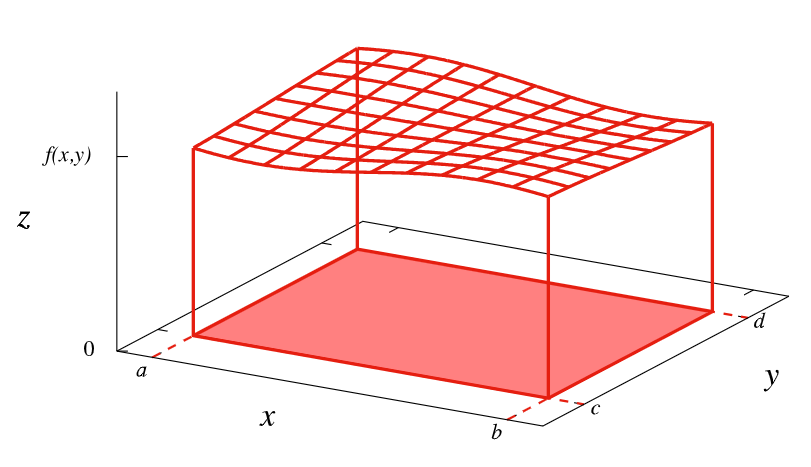
- We are given the double integral: (see slides)
- If for all in , then the double integral is the volume of the solid bounded by and -plane over
- for this example would equal
- Order does not matter as long as the bounds match the variable
- If for all in , then the double integral is the volume of the solid bounded by and -plane over
Regions Bounded By Functions: Type I
- Let a given region be bounded by the functions
- for all
- The shape is enclosed by and
- i.e. is bounded by constants and is bounded by functions of
- The volume below over is given by the double integral:
Regions Bounded By Functions: Type II
- Let a given region be bounded by the functions
- for all
- The shape is enclosed by and
- i.e. is bounded by constants and is bounded by functions of
- The volume below over is given by the double integral:
For regions bounded by functions, if you are trying to find area in a 2D space, set to . Example of area of eclipse on lecture recording.
Fubini’s Theorem
More Complicated Regions
- When the region is neither type I or type II, we can usually describe is as a union of several sub-regions
- Thus:
We will miss next Friday’s lesson, thus we are starting content early
Triple Integrals
- The triple integral of over is:
Fubini’s Theorem Revisited
This equation is equal to all forms of its rearrangement