Creep
- Creep is the time-dependent and dissipative deformation of materials subjected to constant stress
- More critical at high temperature
- Observed for all material types
Stages of Creep:
- Instantaneous deformation mainly elastic (upon initial load)
- Primary creep strain rate decreases with time
- Material increases in creep resistance
- Secondary creep constant strain rate
- Competing processes of hardening and recover
- Tertiary creep strain rate increases with time
- Formation of internal cracks, voids, etc.
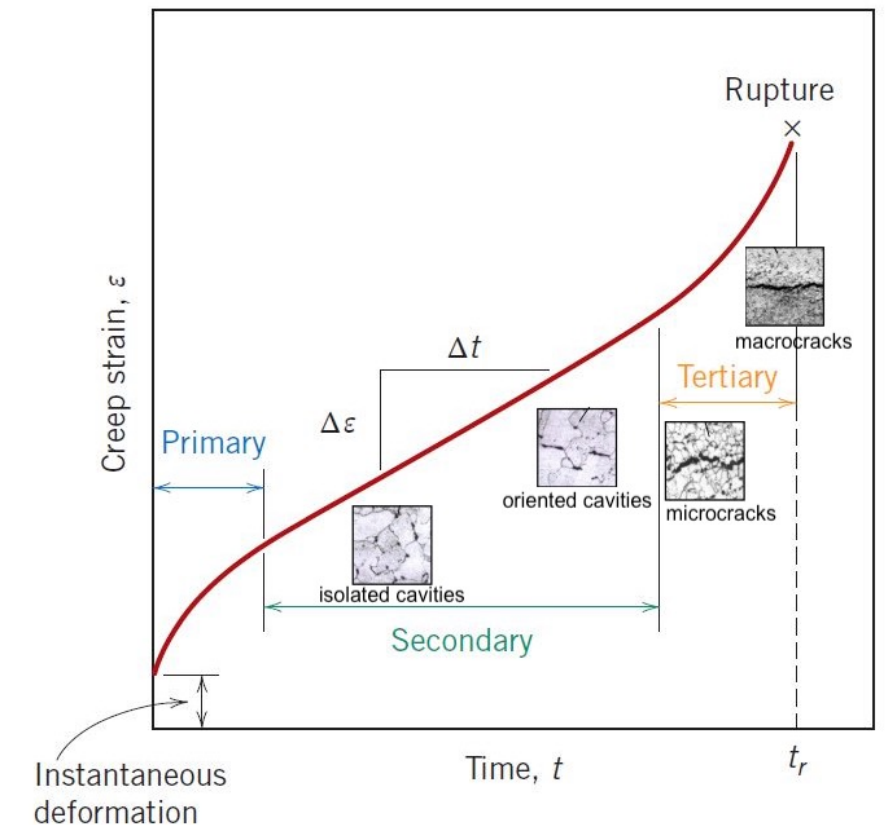
You can observe the strain rates (slopes) on the diagram above
Effect of Temperature on Creep
- Both temperature and the level of applied stress influence the creep characteristics
- Increasing stress or temperature, the following will be noted:
- The instantaneous strain at time of initial stress increases
- The steady-state creep rate increases
- The rupture lifetime decreases
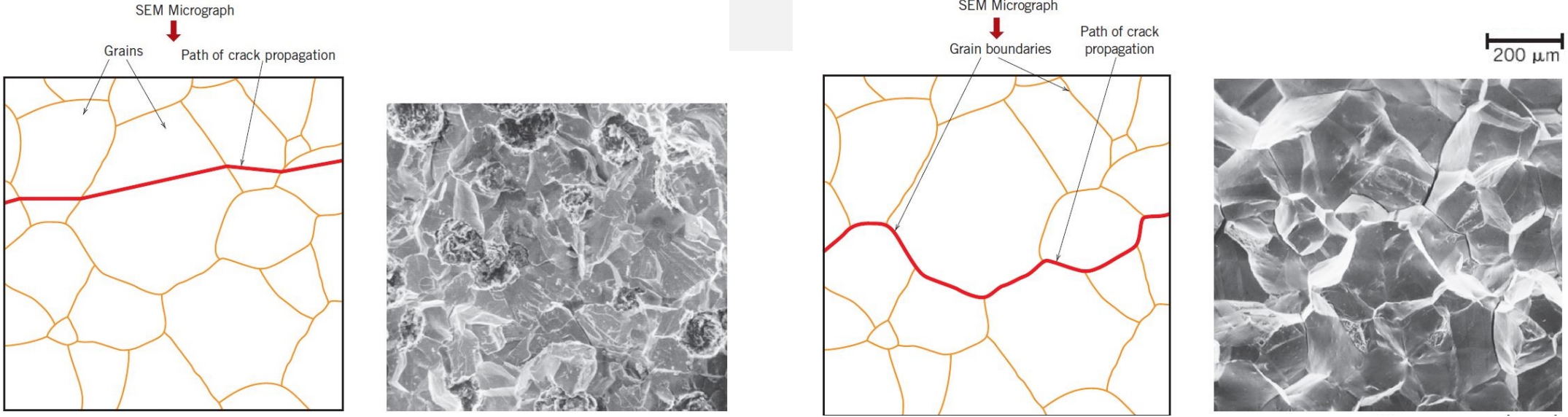
- Cracking that precedes the rupture of the material can be transgranular or intergranular
- and are material constants
Taking temperature into account:
- and are material constants
- is the activation energy for creep
- is the gas constant ()
Data Extrapolation Methods for Creep
- Sometimes impractical to conduct creep tests over long periods of time
- More convenient to conduct tests at excessive temperature over a short period
- Then extrapolate that data to in-service conditions
- Commonly used Larson-Miller method:
- constant (usually ~20)
- absolute temperature (kelvin)
- rupture lifetime (typically in hours)